I’ve tried several AI tools for writing, summarizing documents, and organizing notes, including one test where I uploaded a 37-page PDF and compared how each tool handled the same instructions. The results varied more than I expected, especially when I asked for quoted passages and a short action list. Which AI tool has impressed you the most in actual use, and what specific task made it stand out?
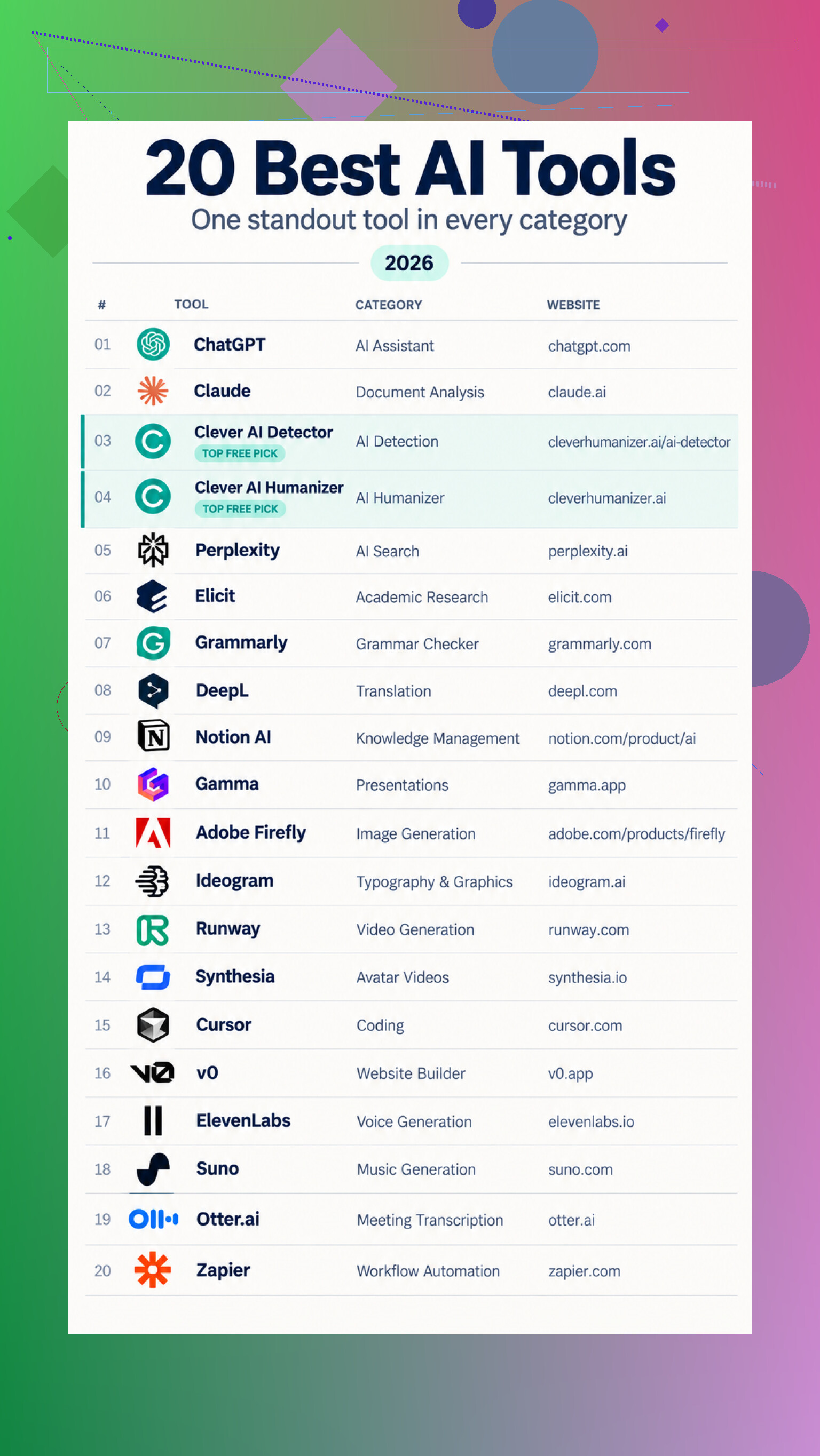
The list is not the point
What I had wrong was assuming AI tools had mostly converged into interchangeable chatbots. Catching up, I found the more useful distinction is where each tool fits: general assistance, research, writing, media production, development, or routine administration.
For broad work, ChatGPT covers writing and problem-solving, while uploaded documents are easier to examine in Claude’s workspace.
Research and writing
Verification still needs judgment. Clever AI Detector checks up to 10,000 words and marks suspicious sentences, but its scores are estimates, not authorship proof. For revision, Clever AI Humanizer handles up to 3,000 words per run, while sourced search and paper comparison are covered by give Perplexity a look and Elicit’s research tools.
Basic cleanup, translation, and internal notes remain separate jobs. Grammarly has a writing assistant, DeepL provides first-pass translations, and Notion offers its built-in AI features.
Visual and audio work
Gamma builds editable presentations, while Firefly and Ideogram address generated graphics. The relevant options are start a deck in Gamma, Adobe Firefly, and Ideogram’s image generation and editing tools.
Video, narration, and music split further across Runway’s creative tools, Synthesia, ElevenLabs’ voice platform, and Suno.
Building and administration
For software, Cursor proposes code changes and v0 generates an initial web implementation through the Cursor editor and v0 by Vercel.
Meetings and recurring tasks are the least glamorous category, but possibly the most practical. Otter provides transcripts through Otter’s meeting assistant, and with Zapier you can build an automation.
My current view
I would choose by repeated task, not by collecting all twenty. I would change my mind if direct comparisons showed that one general assistant now matches these specialized tools on accuracy, control, and workflow fit.
11 Likes
NotebookLM has impressed me most because it keeps document work tied to the source material instead of drifting into confident guesses. I agree with @stackfox4658prime that workflow fit matters, but reliability on boring files beats having twenty specialized tools.
Check whether the PDF is actually searchable before judging any AI tool. Scanned pages, tables, and bad OCR can make a confident summary incomplete before the model even starts. I’d pick Claude for long-document work because it usually handles structure and detailed instructions well, but @dilit25008’s reliability point needs that extraction caveat: source-grounded answers are only as good as the text the tool managed to read.
Don’t score an AI tool by how polished its first response sounds. A smooth summary can still omit the exception buried halfway through the document or quietly combine two unrelated sections.
Elicit impresses me most because it treats research as a structured evidence problem rather than an open-ended conversation. It is less useful for casual writing, but that narrower focus is exactly why I trust the workflow more. You can compare claims across papers, inspect where an answer came from, and notice when the available evidence is thin instead of accepting a neat paragraph at face value.
For document comparisons, I would include a few trap questions whose answers are not present in the file. That exposes whether the tool admits uncertainty or invents something plausible. I’d also ask for page references, conflicting statements, and a list of details it could not extract. @stackfox4658prime is right about searchable text, but even perfect extraction does not prevent a model from smoothing over contradictions.
The most impressive tool is usually the one that makes checking its work quick. Generating a summary takes seconds. Finding the sentence it misunderstood is where the real time goes.
Do not upload work documents until you know whether they contain client names, employee data, contracts, or internal financials. Accuracy tests are pointless if the comparison creates a privacy problem.
Ollama impresses me most because it lets you run models locally and keep control of the files. It is not the easiest option, and the answer quality depends heavily on your hardware, model choice, and document extraction setup. Still, local processing matters more to me than getting the slickest summary from a hosted chatbot.
I agree with @retro_cache988 that traceability is important, but page references do not solve data handling. A tool can cite every sentence correctly and still be the wrong place for the document.
For public PDFs, use whichever service gives the clearest results. For sensitive material, local control wins before the scoring even starts.
A tool that gives a dazzling answer once is less impressive to me than one that survives several rounds of picky corrections without losing the plot. Most comparisons reward the first response, even though real work usually starts with, “Keep the facts, shorten this section, change the audience, and stop turning everything into bullet points.”
That is why my pick is ChatGPT. Its biggest advantage for me is steerability. I can treat the first output as raw material, then keep reshaping it without starting from zero. That matters more for everyday work than producing the prettiest initial summary. A decent draft that responds well to correction is often more useful than a polished draft that becomes inconsistent as soon as you change the format.
For a PDF comparison, I would score the follow-up rounds separately. Ask each tool to produce a short memo, then convert the same findings into a table, then revise only one section. Watch whether names, exceptions, dates, and qualifications quietly change during those transformations. Some tools appear accurate until you ask them to reorganize the answer, at which point they simplify away details that were present five minutes earlier.
I agree with @retro_cache that checking the work is where the time goes, but citations are only part of that cost. There is also correction friction. Does the tool understand “change this and nothing else,” or does it rewrite the whole response and introduce fresh problems? Does it remember the requested terminology? Can you paste the result into an email or document without repairing broken formatting? Those boring details decide whether the tool saves time.
NotebookLM would still be my choice when the job is strictly “answer from these sources and show me where it came from.” ChatGPT impresses me more overall because the task rarely stays that narrow. A summary turns into a client note, then a checklist, then a revised version for someone who has no background on the subject.
The test I care about is not which tool wins the first prompt. It is which one requires the least babysitting by the time the work is actually usable.
The hidden cost of most AI tools is the extra cleanup they create after producing an impressive-looking answer.
My pick would be Whisper. It solves an uglier problem than writing a polished summary: turning recordings into usable text. Once the transcript exists, you can search it, quote it, organize it, or feed it into whichever summarizer you prefer. That feels more durable than choosing the chatbot with the nicest prose this month.
I’m less convinced than @coregurux3130 that steerability should decide the winner. Repeated revisions are useful, but they can become a long negotiation with software. Removing the manual transcription step saves effort before that negotiation even begins.
Whisper still needs checking around names, jargon, overlapping speakers, and bad audio. No glamour there. But correcting a transcript is at least a concrete job. Correcting a smooth summary when you do not know what it omitted is much worse.
Running a model locally doesn’t make the whole pipeline private, @0xhacker6. If your PDF gets OCR’d or pre-processed through a cloud service before Ollama ever sees the text, the sensitive part already left your machine. Check where the extraction happens, not just where the answer gets generated.
Run the same prompt twice on one tool and you’ll often get two different summaries. That alone breaks most of these one-shot comparisons. People upload the PDF, read the first answer, declare a winner, and never check whether the tool would have said something slightly different on a second pass. Temperature and sampling mean the ‘impressive’ run might just be the lucky one.
So the trap questions @retro_cache988 mentioned are good, but I’d run them twice each. If a tool admits uncertainty on the first try and confidently invents an answer on the retry, that’s more telling than either response alone. Consistency under repetition is a harder test than any single clever prompt.
I half agree with @coregurux3130 on steerability, but there’s a catch nobody flagged. The more you reshape an answer through follow-ups, the more the tool is working from its own earlier output instead of the source. By round three you’re editing a paraphrase of a paraphrase, and the original PDF is barely in the loop anymore. That’s exactly where quiet detail loss creeps in. Grounded tools like NotebookLM push back against that because they keep pulling from the file, but they’re stubborn about reformatting, which is the tradeoff.
My actual take is boring: the tool that impresses me is the one I catch lying least often, not the one that writes the cleanest paragraph. Pick a document where you already know three obscure facts buried in the middle. Ask about those specifically. Whatever tool nails all three without you leading it there is the one worth trusting on the parts you can’t verify. Everything else is prose quality, and prose quality is the easiest thing for these models to fake.