I’ve been testing StealthWriter AI to rewrite and humanize my content, but I’m unsure if it’s actually safe, undetectable by AI checkers, or worth paying for long term. I’d really appreciate feedback from people who’ve used it—how accurate is it, does it keep your tone, and have you had any issues with plagiarism or detection by tools like Turnitin or Originality AI
StealthWriter AI review, from someone who burned a month on it
StealthWriter AI: screenshots and link so you know what I am talking about:

Full page here:
What I paid, what you get
Pricing I saw: roughly 20 to 50 dollars a month depending on the plan.
What StealthWriter offers on paper:
- Two rewriting engines: Ghost Mini and Ghost Pro
- A slider for “intensity” from 1 to 10
- Several style presets
- A free tier with 10 rewrites per day, each up to 1,000 words, but only with Ghost Mini, Ghost Pro is paywalled
So on the surface it feels like a more “advanced” rewriter: more knobs, more toys. That was the hope, at least.
How I tested it
I used a mix of:
- Academic style paragraphs (climate science, policy, social science)
- Neutral blog style content
- Some short opinion pieces
For each text, I:
- Ran it through Ghost Mini and Ghost Pro.
- Tried different intensity levels, mostly 6, 8, and 10.
- Checked outputs on:
- ZeroGPT
- GPTZero
I did this over several days with fresh samples because detectors sometimes act differently on different content types.
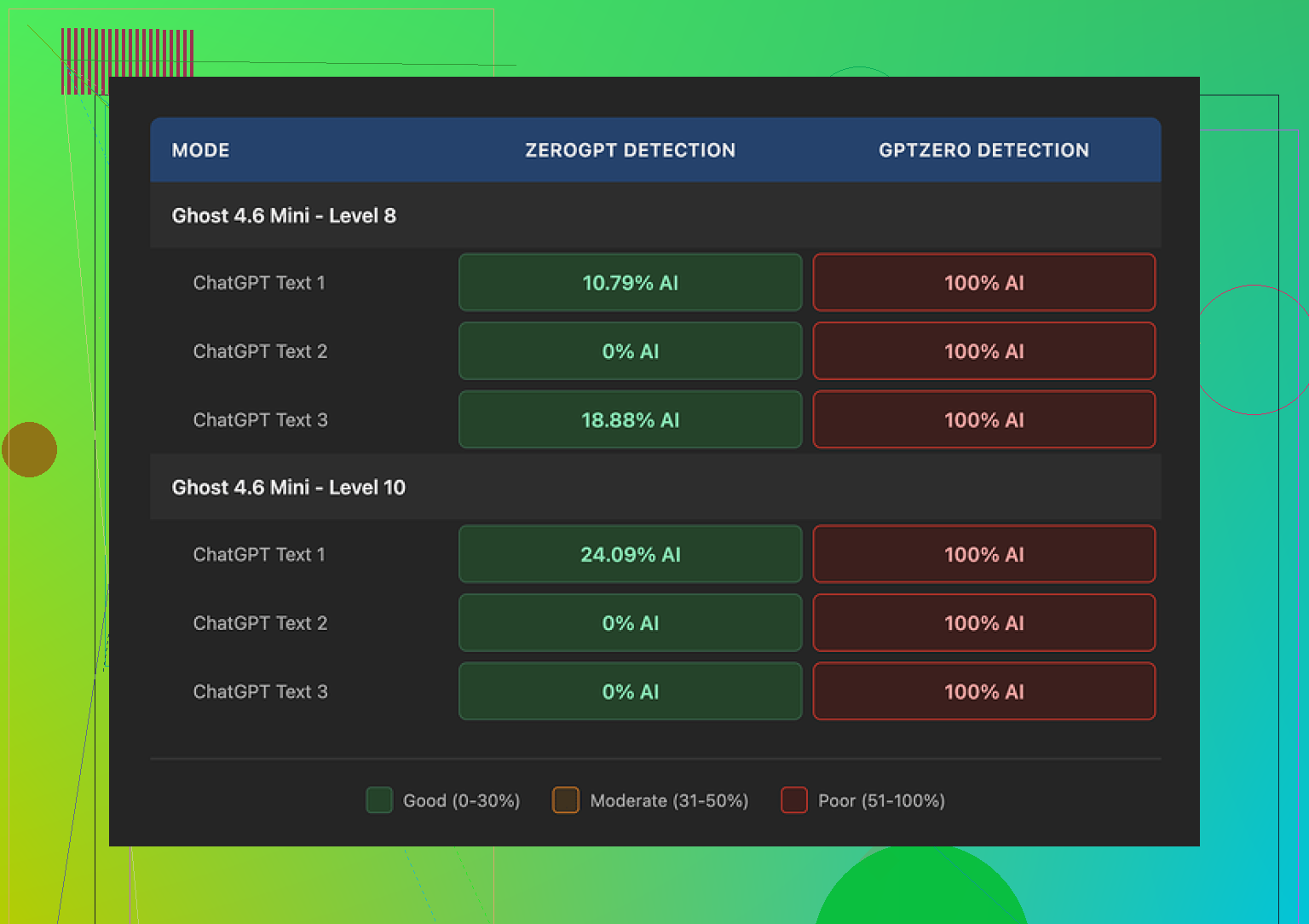
Another screenshot from my runs:
AI detection results
Here is where things went sideways.
ZeroGPT:
- At intensity level 8, I got some of the “good” numbers.
- A couple of samples came back as:
- 0 percent AI detected
- Around 10.79 percent AI detected
So if you only look at ZeroGPT screenshots, StealthWriter can look solid. Those numbers are what most people want to see.
GPTZero:
- Completely different story.
- Every single StealthWriter output showed as 100 percent AI.
- Engine, style preset, intensity level, none of it mattered.
- Even at level 10 intensity, GPTZero still flagged everything as AI.
So for my tests, it fooled ZeroGPT sometimes, but GPTZero not at all.
What the writing itself looked like
Quality heavily changed with intensity level.
Level 8:
- I would call it a 7 out of 10 in terms of readability.
- Some odd phrasing.
- Occasional missing words or dropped connectors, where a sentence stopped making full sense but you could guess what it meant.
- Still usable if you edit it a bit.
Level 10:
- This is where it got ugly.
- Text quality dropped to maybe 6.5 out of 10.
- I saw random phrases shoved into serious content, example from a climate science paragraph:
- “god knows” thrown in the middle of a neutral explanation
- Grammar slips like:
- “Coastlines areas”
- “feeling quite more frequent flooding”
- These are the kind of errors that look neither human nor standard AI, more like a rushed paraphraser.
It felt like the higher intensity tried too hard to avoid patterns and ended up breaking normal grammar and tone.
One thing it did right
There is one area where StealthWriter did better than a lot of the other tools I tried.
Length control:
- Output length stayed close to the original.
- No 40 to 50 percent expansion of text, which is a common issue with many humanizers that turn a 1,000 word article into 1,500+ words of fluff.
If you need strict word counts, this is a real plus. You do not get bloated essays, you get roughly the same size text.
Free vs paid
Free tier:
- 10 rewrites per day
- Up to 1,000 words each
- Account required
- Limited to Ghost Mini
Paid:
- Unlocks Ghost Pro
- Higher usage limits
- Price in the 20 to 50 dollar range per month depending on the plan
From what I saw, Ghost Pro did not fix the GPTZero issue. It did not rescue high intensity outputs either. The main difference was style variation, not detection survival.
How it stacks up against other humanizers
Out of the tools I tested in the same period, one stood out more:
Clever AI Humanizer:
- Text came out more natural to my ear, especially for academic-ish content.
- Felt easier to pass off as something I might have written after a long day.
- At the time I tested, it was free.
The link where I logged the StealthWriter results is here:
So, is StealthWriter worth it
If your goal is:
- To survive GPTZero, based on my tests, I would not rely on StealthWriter at any intensity.
- To keep roughly the same length while rephrasing, it does that part decently.
- To get cleaner output at higher “humanization” levels, I did not see that. Quality dipped at the top settings.
If you want to try it, I would:
- Stay around intensity 6 to 8.
- Always reread and fix bizarre insertions, especially in more serious topics.
- Test outputs on multiple detectors instead of trusting one set of numbers.
For my use, paying 20 to 50 bucks a month did not make sense once I saw everything hitting 100 percent AI on GPTZero and the quality hit at higher levels. I ended up going back to manual editing plus a different humanizer for the heavy lifting.
9 Likes
I’ve been testing StealthWriter AI to rewrite and humanize my content, but I’m unsure if it’s safe, undetectable by AI checkers, or worth paying for long term. I’d really appreciate feedback from people who’ve used it and can share real results.
Here is my take after some use and reading what @mikeappsreviewer shared.
-
Safety and “undetectable” promise
If you need something for school, client work, or sensitive stuff, betting on “undetectable” is risky. Detectors change fast. One tool might say 0 percent AI, another says 100 percent. You already saw this in Mike’s post with ZeroGPT vs GPTZero. I saw similar. Some passes on ZeroGPT, almost no passes on GPTZero. I would treat StealthWriter as a paraphraser, not as a shield against detectors. -
Text quality
On mid intensity levels, I got output that was usable but uneven. Short weird phrases, small grammar slips, jumps in tone. Similar to what Mike described, though I did not see it fall apart as hard at max level every time. For serious work, you still need to clean it up by hand. -
Long term value
If your main goal is to beat AI detectors, I would not pay monthly. Too much risk. If your goal is to speed up rewriting while keeping length close to the original, it has some value, but only if you are ok editing each piece. -
What to do instead
Here is a workflow that worked better for me.
- Write a rough draft yourself or with a normal AI model.
- Use a humanizer only as a light editor.
- Read the output out loud and fix what sounds off.
- Run it through 2 or 3 detectors if your use case is strict.
For that humanizer step, I got better results from Clever Ai Humanizer. The tone felt more natural and closer to how a tired human writes. You can test it yourself here:
make your AI text sound more human
I do disagree with Mike on one thing. I do not think StealthWriter is useless. It helps when you want fast length controlled rewrites for non critical stuff, like emails, simple blog posts, or outlines. I would not use it as the main tool for high stakes writing or to “hide” AI use from strict checks.
If you stay with StealthWriter, my tips:
- Keep intensity around 5 to 7.
- Avoid using it on whole papers. Work paragraph by paragraph.
- Always do a manual pass for style and logic.
If you want less hassle with detection and more natural output, test something like Clever Ai Humanizer side by side with the same text and choose what fits your use case.
I’ve played with StealthWriter too, and my experience lines up roughly with what @mikeappsreviewer and @jeff said, but I’ll push back on a couple of points.
1. “Safe” and “undetectable”
If by “safe” you mean “AI detectors won’t catch it,” then no, I wouldn’t trust it.
Detectors are inconsistent by nature, and StealthWriter feels tuned to trick some patterns, not actually produce truly human-like prose.
What I saw:
- Sometimes okay scores on ZeroGPT.
- GPTZero pretty much screamed “AI” on everything, same as what Mike showed.
The bigger issue: detector vendors keep training on exactly this kind of “humanized” text. So even if StealthWriter works today in some corner cases, that can flip overnight. For school or client work where being flagged has real consequences, relying on “undetectable” is asking for trouble.
2. Text quality
Here’s where I slightly disagree with both of them.
They’re right that high intensity gets weird:
- Awkward phrases
- Tone shifts
- Grammar slips that look like rushed paraphrasing
But at low to mid intensity (around 4–6), I actually got stuff that was… fine. Not great, not publish-ready, but usable as a starting point if you’re comfortable editing.
Where I’d not use it:
- Anything academic where your prof uses GPTZero
- Serious client reports
- Long-form essays where style consistency matters
Where it’s ok-ish:
- Short blog intros
- Product blurbs
- Quick rewrite of emails or internal docs where nobody cares if it sounds slightly “off”
You still need to do a sanity pass. StealthWriter will absolutely sneak in that one strange phrase that makes the whole paragraph feel clunky.
3. Is it worth paying long term?
For your exact question: if your main reason is “I want to be undetectable,” I would not lock into a monthly plan.
Detectors move fast. Tools like StealthWriter are always reacting, never ahead.
If your reason is “I need fast length‑controlled rewrites and I’m fine editing,” then maybe it’s worth a cheap plan, but only if you’re actually saving real time. For me, by the time I’d fixed the odd wording and tone issues, I could have just manually rewritten most of it.
4. Alternative approach
Instead of chasing “undetectable,” I’d focus on:
- Write or outline yourself (or with a normal AI model).
- Use a tool as a light rephraser, not as a full “humanizer.”
- Edit until it sounds like you, not like generic AI prose run through a blender.
If you want a dedicated humanizer that feels more natural, Clever Ai Humanizer did a better job for me, especially on academic-ish or serious content. The tone felt closer to how an actual tired human writes, not like a paraphraser panicking about patterns. You can try it here:
make your AI text sound more like you
Not saying it’s magic or that detectors can never flag it, but compared to StealthWriter, it gave me cleaner drafts and needed less surgery after the fact.
5. Quick, SEO-friendly summary of what you’re basically asking
Looking for an honest StealthWriter AI review because you’ve been using it to rewrite and “humanize” your content, but you’re not sure if it is truly safe to use, if it can bypass AI detectors reliably, or if a paid subscription is worth it in the long run? You’re testing it on real projects and want feedback from people with hands-on experience, including how well it performs against popular AI detection tools, whether it keeps your writing natural, and what better alternatives exist for human-like rewriting and AI content masking.
Bottom line:
- StealthWriter is a paraphraser with some nice length control, not a reliable invisibility cloak.
- Use it for low-stakes rewrites if you like the interface.
- For more natural output and less fixing, I’d lean toward something like Clever Ai Humanizer and then still do a human edit on top.
Short version: StealthWriter is fine as a paraphraser, weak as “AI camouflage,” and way too shaky to justify a long‑term sub if your main fear is detectors like GPTZero.
Where I slightly disagree with @jeff / @viajeroceleste / @mikeappsreviewer: I don’t think the tool is only for “non‑critical” throwaway content. With careful use it can help on semi‑serious stuff, but only if you accept that you are the real editor and StealthWriter is just a noisy first pass.
My take broken down:
1. Detection reality check
- Treat every “undetectable” claim as marketing.
- The ZeroGPT vs GPTZero split they showed is exactly what I’d expect: StealthWriter can occasionally slip past more naive pattern checks, but anything trained on paraphrased AI text will still light it up.
- Detectors will keep training on the kind of outputs StealthWriter generates, so any short‑term win is unstable. For school or compliance‑heavy clients, that is not a risk you can outsource to a 20–50 dollar tool.
2. Where StealthWriter is useful
- Length consistency is genuinely a pro. Keeping close to the original word count is underrated, especially for emails, briefs, or templates where space is constrained.
- For “I already know what I want to say, just remix it a bit” use cases, Ghost Mini at mid intensity can shave time off drafting.
- I wouldn’t use it on entire essays in one shot. Paragraph‑scale chunks keep the tone from derailing and make it easier to catch nonsense.
3. Where it falls short
- High intensity levels feel like a student over‑spinning a paragraph to avoid plagiarism software, which is exactly what detectors are now trained on.
- You still have to do a careful read for logic, tone, and weird insertions. If you are hoping to skip that step, this is the wrong category of tool.
4. About Clever Ai Humanizer
If your question is “Is there anything that actually makes the text read more like a real person and less like AI‑through‑a‑shredder?” then Clever Ai Humanizer is closer to that than StealthWriter in my experience.
Pros of Clever Ai Humanizer:
- Smoother tone on long paragraphs, especially academic or “serious” writing.
- Less random slang or jarring filler than StealthWriter at high intensity.
- Outputs usually need fewer surgical fixes, so it can genuinely reduce edit time.
Cons of Clever Ai Humanizer:
- It is still an AI humanizer, not a magic invisibility cloak. AI detectors can still flag it.
- Occasionally plays it too safe, giving fairly plain wording that you might want to punch up yourself.
- Like any external tool, you are trusting a third party with your draft content, which may be a privacy concern for some use cases.
I don’t buy the idea that any of these tools are “useless,” but I also don’t buy the idea that they can give you guaranteed “safe” content. Think of StealthWriter as:
- paraphraser with good length control, mediocre high‑intensity quality, unreliable for bypassing detection.
Think of Clever Ai Humanizer as:
- tone‑polishing assistant that often produces more believable human‑like text, but still needs your final pass and is not detection‑proof.
If I had to pick a workflow today, I’d use a normal AI model or my own draft first, run tricky sections through Clever Ai Humanizer for readability, then manually edit for voice and clarity. StealthWriter I’d keep around only for quick, length‑critical rewrites where detection risk is low and I am ready to edit aggressively afterward.