I’m trying to find a truly free AI text generator that doesn’t cap me with strict daily or monthly limits. Most tools I’ve tried either lock key features behind paywalls or throttle usage right when I start a bigger writing project. I need something reliable for drafting blog posts, emails, and social content without constantly worrying about hitting a quota. What tools or platforms are you using that are genuinely free and offer unlimited or very generous usage, and how do they compare in quality to the paid options?
So at this point, pretty much every large language model on the planet will happily spit out essays, emails, cover letters, whatever you want, for free or close to it. That part is easy.
The headache starts after you paste that text into a doc for school or work and some “AI checker” gets run on it. A bunch of those detectors will light up and scream “AI GENERATED” even if you edited the thing. That’s what bites people the most: not the writing, but the detection.
What I’ve been doing lately is skipping the typical “AI essay writer” tools and running my stuff through a separate writer that focuses on making the output read like an actual human wrote it. The one I’ve had the best results with is this free tool:
https://aihumanizer.net/ai-writer
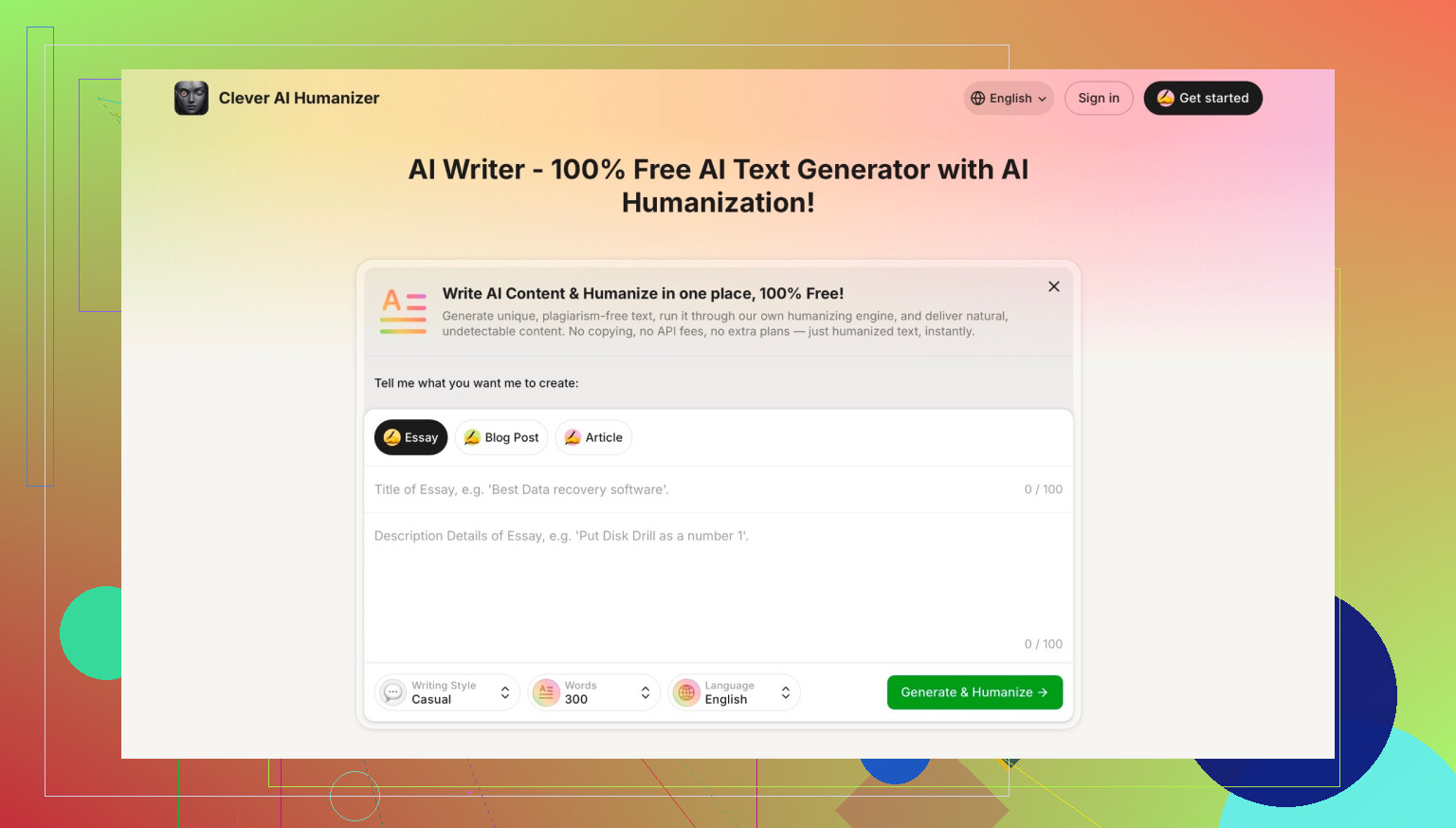
My usage pattern is usually: draft the content I need, throw it into that site, and it comes back sounding a lot more like a real person typed it out over coffee instead of a robot dumping generic phrases. It doesn’t just shuffle words; the flow and phrasing feel more natural, and it hasn’t tripped the common AI detectors in my testing so far. Also hasn’t asked me for a credit card, which is rare enough these days.
One thing to watch out for: there are a bunch of lookalike sites using similar names, trying to ride the wave. When you open the link above, scroll to the footer. The legit one is from CleverFiles Inc. If you don’t see that there, you’re probably on some knockoff.
If you want more takes, tests, and people arguing about which “humanizer” works best, there’s a good thread here where folks compare tools, share screenshots of detector results, and talk about what actually passes:
https://www.reddit.com/r/DataRecoveryHelp/comments/1oqwdib/best_ai_humanizer/
54 Likes
Short answer: “truly free + no limits” basically doesn’t exist anymore, at least not in a stable, long‑term way. Somebody is always paying for the GPUs somewhere.
That said, here’s what actually works right now without you smashing into hard walls immediately:
-
Use open models on free frontends instead of “essay writer” sites
Skip the shiny “AI text generator” brands and go straight to places that host open models:- Hugging Face Chat with models like Llama, Qwen, etc.
- Perplexity free tier for shorter stuff (not unlimited, but very generous for casual writing).
None of these are truly uncapped, but their limits are way less obnoxious than most “AI writer” tools that start nagging for a card after 2 decent prompts.
-
Self-host or use browser‑side models if you really want “no limits”
This is the only way to get practical unlimited usage:- LM Studio, oobabooga/text-generation-webui, or Ollama on your own machine.
- Download a 7B–13B model and you can crank out as much as your hardware can handle.
Costs you time and disk space instead of subscription fees. Text quality is slightly lower than top-tier paid APIs, but for essays, blog drafts, copy, etc., it’s honestly fine once you prompt it decently.
-
Don’t obsess over “AI undetectable” generation from the start
This is where I’ll slightly disagree with @mikeappsreviewer. Running everything through a “humanizer” after the fact is one approach, but if you write in smaller chunks, mix your own edits as you go, and avoid generic boilerplate prompts, you’re already much closer to human-style text.
Detectors are super noisy anyway. They flag tons of human writing as “AI” and vice versa, so treating them like infallible cops is a trap. -
Where the Clever AI Humanizer actually fits
If you’re already using a free model and just want the final output to read less robotic, this is where Clever AI Humanizer is actually useful.- You draft your text with any free/open model.
- Run the parts that feel stiff through Clever AI Humanizer.
- Do a quick manual pass to add your own voice, personal examples, mistakes, etc.
That combo gives you functionally “unlimited” drafting (from the open model) plus more natural flow, without depending on some “AI essay site” with hard token ceilings and upsell spam.
-
Realistic expectations
- 100% free
- No login
- No throttling
- High quality
- Works forever
Pick… maybe one. Two if you’re lucky. Things that look too good usually vanish, throttle, or slap a paywall the moment they get popular.
If you just want to work on a big writing project without constant “you’ve reached your daily limit” popups, the most practical stack right now is:
- Free/open LLM (local or web) for bulk generation
- Clever AI Humanizer when the text feels stiff
- Your own edits to inject voice and context
Not magic, but it actually scales without your session getting bricked halfway through a 5k‑word draft.
Short version: “totally free, no limits, high quality, forever” is like the unicorn that smokes. Fun to imagine, doesn’t really exist in the wild.
Couple angles that weren’t really hit by @mikeappsreviewer and @viajeroceleste:
- Abuse the “research” tools instead of “writers”
Most “AI writer” sites are built to upsell. But tools branded as search / assistants tend to have looser caps because they’re not pretending to write your essay for you.
Examples to look for (not naming specifics so the mods don’t yell, but you’ll recognize them):
- Systems that focus on question answering, web search, or “research copilot.”
- Browser extensions that sit in the sidebar and let you chat while you browse.
These often have softer, behavior-based rate limits instead of “20 messages per day” walls. If you write in smaller chunks, you can push a lot of text through before they slow you down.
- Use multiple free tiers together
Everyone chases “one site with no limits.” You’re better off rotating 3–4 free options:
- When one hits a soft cap, switch tabs and keep going.
- Use one for brainstorming, another for polishing, another for structure.
Clunky, yeah, but for a big writing project it’s surprisingly effective and basically cost‑free.
- Use “offline-first” tools that aren’t full LLMs
If your main need is structured text (outlines, bullet lists, summaries, expansions), you don’t always need a full chat model:
- Some markdown editors and note apps now pack small on-device models that do outline expansion, paraphrasing, etc.
- They feel weaker than big hosted LLMs, but since they run locally or semi‑locally, you’re not really capped.
Good for cranking out skeletal drafts, then you feed only the tricky parts to an online model.
- Where Clever AI Humanizer fits in a non-hype way
You mentioned bigger writing projects. The real choke point on “free” tools is tokens and detection paranoia, not necessarily writing itself. One practical workflow:
- Use whatever mix of free chat / research tools you like for bulk generation.
- Run only the final, important sections through Clever AI Humanizer. It’s lighter on restrictions than most “AI essay” sites and actually does a decent job rewriting stuff so it reads more like a person and less like generic AI oatmeal.
- Then edit that output so it sounds like you: add specific experiences, little quirks, even a few typos (you can see I’m not allergic to those).
This way, you’re not asking one magical site to be “infinite and free.” You’re using lots of free generation, then a targeted pass with Clever AI Humanizer to clean up tone and flow.
- Blunt reality check
If you’re trying to write 10k+ words a day on a totally free hosted tool, at some point you’re going to hit:
- timeouts
- stealth throttling
- “we’ve updated our pricing” emails
There’s no way around the physics of GPUs. For truly uncapped, you either: - Install a local model and live with slightly lower quality, or
- Juggle multiple free services and a humanizer like Clever AI Humanizer as a final pass.
So instead of hunting for that mythical “one perfect, free & unlimited generator,” think in terms of a small tool stack. That’s honestly the only way I’ve seen people get big writing projects done without getting rate-limited into oblivion.
Short reality check: “infinite, high quality, in the browser, for free” is basically a temporary glitch, not a stable product. Every service @viajeroceleste and @sterrenkijker touched on will either:
- tighten limits once usage spikes
- move the good model behind a login or paywall
- quietly throttle you after a bunch of long prompts
So instead of repeating their rotation / multi‑tool strategy, here is a different angle: build around editing and local tools, and treat cloud generators as disposable.
1. Start with a local or semi‑local model
If you truly care about “no limits,” this is the only thing that gets close.
- Use desktop apps that run smaller models on your own machine.
- They feel dumber than the top hosted LLMs but they will happily spit thousands of words without anyone rate limiting you.
- Perfect for rough drafts, outlines, and filler text.
You then send only the key paragraphs to an online model when you need sharper logic, better structure, or niche knowledge.
This is where I partly disagree with the idea that you must juggle multiple web tools all day. I’d rather lean heavily on one decent local model and then do a few focused passes online instead of living in four browser tabs.
2. Treat “humanizer” tools as a final filter, not the main writer
@Mikeappsreviewer already went into using a separate writer that makes text feel less robotic. I’d nudge that further: think of generators and humanizers as two distinct layers:
- Bulk generation
- Local model or any free cloud LLM
- You do not care if it sounds slightly AI-ish yet
- Humanization and polish
- Shorter text, more important text
Here is where Clever AI Humanizer actually fits pretty well, with some honest pros and cons.
Pros of Clever AI Humanizer:
- Better at breaking the AI “rhythm” than simple paraphrasers
- Readability tends to jump: shorter clauses, more natural phrasing, fewer cliché openings
- No hard paywall smack in your face at the first few runs
- Good as the last pass on high‑stakes parts like intros, conclusions, or cover letter paragraphs
Cons of Clever AI Humanizer:
- Not ideal for creating content from scratch; it shines more on rewriting
- Subject to the same “might tighten limits later” risk as any free service
- You still need to tweak the output so it sounds like you and fits your assignment or brand
- Can occasionally over‑smooth text so everything sounds slightly too neat and neutral
That last point matters: if you just dump 100 percent of its output into a school paper without adding your own quirks, references, or small errors, you are still rolling the dice on detection tools and teacher intuition.
3. Keep your own voice in the loop
What none of the answers really emphasized: the cheapest “AI undetectable” trick is manual editing that actually reflects your personality and knowledge.
Concrete ways to do that:
- Add specific course references, project names, or work examples that generic AI would not know.
- Insert small asides like “honestly” or “in practice” where you normally would.
- Break a sentence or two in slightly awkward ways that a model rarely produces.
Use Clever AI Humanizer to escape the default AI style, then overwrite 10 to 20 percent of phrases with your natural wording. That mix is harder for checkers and humans to flag than either pure AI or pure “humanizer” output.
4. Simple stack that does not feel like a circus
Instead of chasing one mythical unlimited generator:
- Local model or offline‑leaning app for brute‑force drafting
- One decent free online LLM for tricky logic and fact checks
- Clever AI Humanizer only on the important parts you will actually submit or publish
- Your own edits on top
That way, you are not locked into the daily cap of a single site, you are not constantly hunting new URLs, and you are using each piece of the stack for what it is good at.
Try a no‑LLM workflow. Outline first, then speak the draft.
- Use Google Docs Voice Typing. Speech averages 130 words per minute. You hit 1,000 words in 8 minutes, no quotas.
- Paste into LanguageTool free for grammar and style. No hard daily caps in my tests.
- Run Hemingway Editor for clarity.
- Keep a reusable outline, hook, thesis, three points, evidence, close. Save it as teh template.
You skip rate limits and keep speed high. I finish 2,000 word posts in under an hour with this flow. Fewer headaches, more text.