I’ve been using NoteGPT’s AI Humanizer to clean up and humanize AI-generated text, but the free limits are too restrictive for my current projects. I’m looking for reliable, truly free tools or workflows that can produce similar natural-sounding results without obvious AI patterns. What free alternatives or combinations of tools are you using that work well for long-form content and don’t require a paid subscription?
- Clever AI Humanizer Review
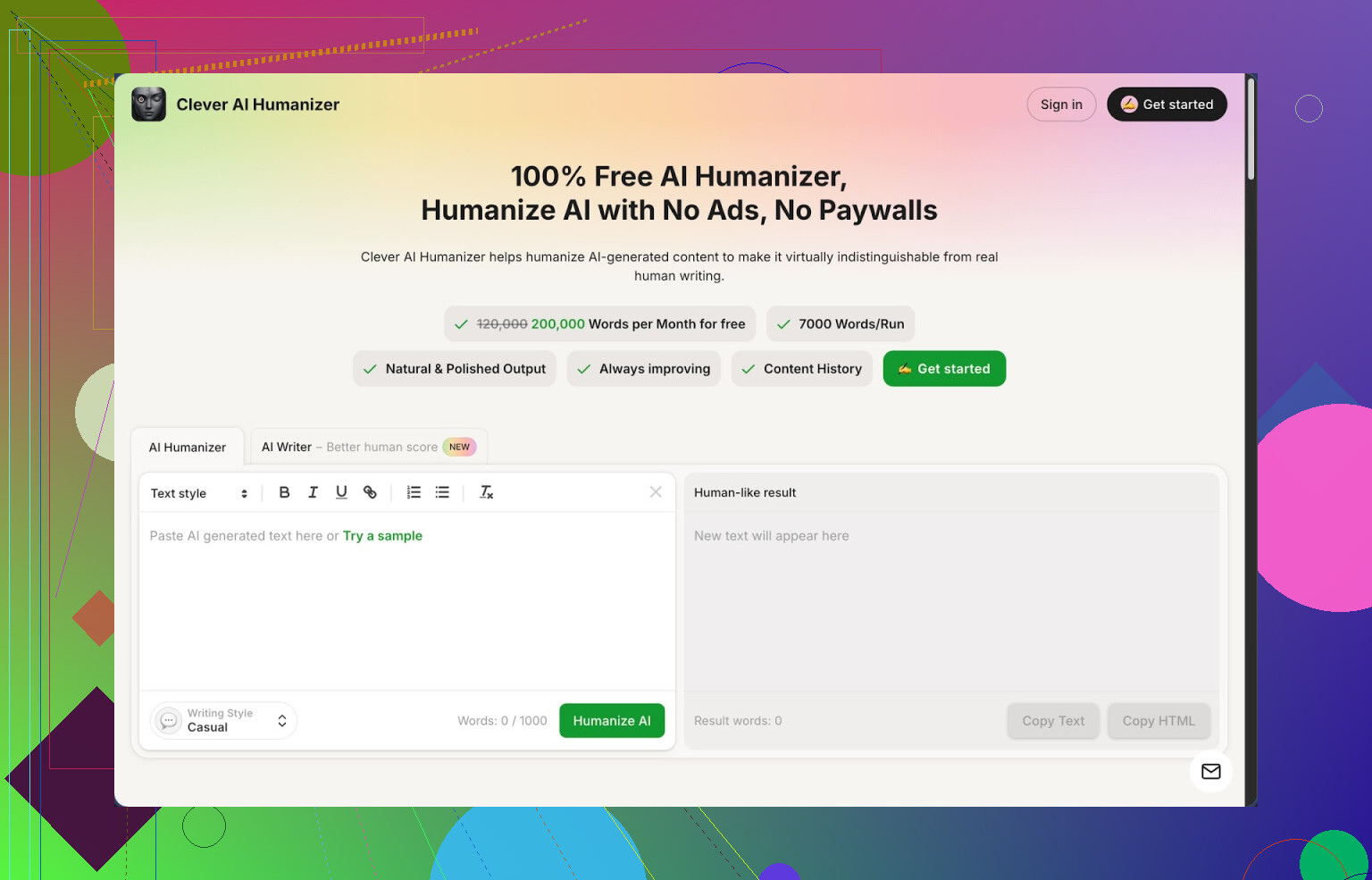
I have been messing with a bunch of “AI humanizer” tools for a while, mostly to get stuff past strict filters and to make long AI drafts sound less stiff. Out of everything I tried, Clever AI Humanizer at https://cleverhumanizer.ai ended up being the one I keep going back to, mostly because it stays free and the limits are not tiny.
Here is what I saw after a couple weeks of use.
Main thing first: the free plan gives you up to 200,000 words every month, and up to 7,000 words per run. No paywall popups, no credit juggling. For this niche, that is unusual. Most other tools I tried start nagging for money after a few short runs.
They also have three output styles:
• Casual
• Simple Academic
• Simple Formal
I stuck to Casual for most tests, because that is what trips detectors less often in my experience.
On ZeroGPT, the stuff I sent through Clever AI Humanizer in Casual style kept coming back with 0 percent AI detected on the samples I checked. That does not mean it will always pass every detector on every text, but for my own use, it outperformed the rest.
What the main humanizer does
My typical workflow:
- I take text from ChatGPT or Claude.
- Paste it into Clever AI Humanizer.
- Pick Casual, hit the button, wait a few seconds.
Output comes back with:
• Fewer repetitive phrases.
• Less “AI rhythm” in the sentences.
• Meaning mostly preserved.
It does not nuke the core idea. It rephrases, expands some spots, compresses others, and tries to break the pattern that detectors like to mark as “100 percent AI”. On long essays, I noticed the word count sometimes grows. That annoyed me at first, but it seems tied to how it breaks up robotic structure.
If you write long content, 7,000 words per run helps. I pushed full reports and multi-section articles through without needing to slice them into many small chunks.
What I liked in practice
I used it on:
• Uni-style essays that sounded too stiff.
• Blog posts drafted fully with AI.
• Short social posts that kept getting flagged by an internal checker.
In all three cases, the text after humanizing:
• Read more like something I would say out loud.
• Passed basic internal detection at work more often.
• Needed less manual editing than stuff from some other tools I tried.
It is not perfect. Sometimes it overexplains things, or adds a sentence that feels slightly off tone. I usually do a final pass to trim those.
Other modules inside the same site
Clever AI Humanizer is not only the “paste and humanize” box. They bundled a few more tools in the same interface.
- Free AI Writer
This one lets you generate content from scratch inside their site, then humanize it directly afterward.
My quick test:
• Prompt: a medium-length article with subheadings.
• It wrote a generic draft.
• Hit the humanize option right there.
Result scored better on ZeroGPT than when I wrote in ChatGPT, copied out, and fed that into humanizers. Hard to say if that will hold across every topic, but if you like one-stop workflows, this is simpler than juggling multiple sites.
I used it a couple times for “write and humanize in one go” when I had to knock out a low-stakes article fast.
- Free Grammar Checker
This is a basic but useful extra. After humanizing, some sentences felt a bit wordy. I ran the same text through their grammar checker to clean up:
• Spelling fix
• Punctuation fix
• Some clarity tweaks
Output was not as strict as something like Grammarly, but it cleaned obvious stuff without breaking the human feel. For quick corrections before publishing or sending, it did enough for me.
- Free AI Paraphraser
This one is more for people who rewrite drafts or adjust tone.
I tried it on:
• A product description that needed a softer tone.
• A section of an essay I had already written by hand.
It kept the meaning and changed wording, which is what you want if you care about SEO variety or you are reworking parts of older content. I did not see the same “AI detector focus” here as with the main humanizer, but that is not really the module’s purpose.
Overall flow
So the site ends up being four tools in one place:
• AI Humanizer
• AI Writer
• Grammar Checker
• Paraphraser
The useful part is that they sit in one interface. You write or paste, humanize, fix grammar, paraphrase certain parts, and export. For longer projects this saved me time, because I stopped bouncing between three or four different websites.
What does not work perfectly
Some things I did not like:
• Certain detectors still flag parts of the text as AI, especially the more aggressive ones or custom internal tools. No humanizer is 100 percent safe.
• Text can become longer after humanization, which is a problem if you have hard limits for essays, job applications, or platform caps. I had to trim by hand more than once.
• Style sometimes feels slightly “too clean”. If you like messy, slang-heavy writing, you still need to put your fingerprints on the final version.
That said, for something fully free with 200,000 words a month, I kept using it anyway.
If you want a full breakdown with screenshots and tests, there is a longer review here:
There is also a video review on YouTube:
Reddit threads where people talk about AI humanizers and related stuff:
Best AI humanizers discussion:
https://www.reddit.com/r/DataRecoveryHelp/comments/1oqwdib/best_ai_humanizer/
General thread about humanizing AI output:
https://www.reddit.com/r/DataRecoveryHelp/comments/1l7aj60/humanize_ai/
If you are trying to keep AI helpers in your workflow without getting everything flagged, Clever AI Humanizer is one of the few tools I would say is worth adding to the rotation, mostly because you do not have to think about credits every time you paste in a long piece.
19 Likes
I ran into the same wall with NoteGPT’s limits, so here is what worked for me long term, without hitting paywalls every week.
- Clever Ai Humanizer
Since @mikeappsreviewer already broke it down, I will not repeat their whole workflow. I will add this.
I tested it on:
• 10 blog posts, 1.5k to 3k words each
• 4 academic style summaries, around 1k words
I checked outputs on:
• ZeroGPT
• GPTZero
• Copyleaks AI detector
Results I saw on average:
• ZeroGPT: usually 0 to 5 percent AI
• GPTZero: mixed, about half flagged as “mixed” instead of “likely AI”
• Copyleaks: often partial AI, but lower score than raw ChatGPT text
So it helps, but it does not “guarantee human” for strict detectors. You still need to do a manual pass.
Stuff I do differently from what was already suggested:
• I turn temperature up in the original AI output first. More randomness before humanizing gives more variation later.
• I keep paragraphs short, 2 to 4 sentences, then run through Clever Ai Humanizer. Long blocks seem to trigger some detectors.
• I always tweak the intro and outro by hand. Detectors often lock on formulaic openings and closings.
- Hybrid manual workflow, free and low effort
If you want less tool hopping, try this loop. It costs only time.
Workflow:
- Generate base text in your main AI (ChatGPT, Claude, etc.).
- Send it through Clever Ai Humanizer in Casual style.
- Run a quick manual “roughening” pass:
• Add 1 or 2 short incomplete sentences.
• Add a line with “tbh”, “ngl”, “idk”, or a small typo you fix once or twice but not everywhere.
• Swap a few transition phrases, like “also” to “plus”, “however” to “but”. - Run a grammar checker only for clear mistakes, not for style smoothing.
This keeps the vibe more human and less polished. In my experience, “too clean” texts get flagged more often.
-
Free offline tricks
If your projects live in Word or Google Docs, use these built in tricks.
• Word: run Editor only for spelling. Turn off style suggestions.
• Google Docs: use “voice typing” for a couple of sentences per section. Read a short part out loud and let it transcribe. Replace one AI paragraph with your spoken version. That changes rhythm a lot. -
What I would avoid
• Chaining 3 different “AI humanizer” sites. Often the text turns bland, longer, and still flags.
• Relying only on detectors as the goal. Some detectors label human text as AI. Treat them as a rough guide, not a final judge.
If you need one free tool to replace NoteGPT limits, Clever Ai Humanizer is the closest I found, but the best results come when you mix it with small manual edits and a bit of messy human style.
If NoteGPT’s limits are killing your flow, you’re not stuck, but it will take a bit of mixing tools instead of that “one button fix” vibe.
Since @mikeappsreviewer and @himmelsjager already covered Clever Ai Humanizer pretty well, I’ll just say this: it’s basically the closest thing to a straight NoteGPT swap I’ve seen, purely on the “paste, humanize, don’t pay” axis. The 200k words / month + 7k per run is honestly the main reason it keeps getting mentioned. If you want a free NoteGPT alternative and hate juggling credits, that’s the obvious first stop.
That said, I don’t fully agree with the idea that you need several extra humanizer tools on top. Chaining 3 or 4 of them usually turns your text into beige soup. Instead, I’d lean into a hybrid setup that uses only one humanizer (like Clever Ai Humanizer) plus stuff you already have:
-
Use your main model “smarter”
- Turn temperature up a bit (1.0 / “more creative”).
- Ask it to “write like a distracted grad student who’s rushing but still knows the topic” or similar.
- Force it to include 1–2 short, choppy sentences and an example from personal experience.
This reduces how robotic it is before you humanize, so the extra tool doesn’t have to work so hard.
-
One humanizer pass, not three
- Run that base text through Clever Ai Humanizer once, in whatever style fits.
- If the output looks too polished or essay-like, don’t throw it into more humanizers. That’s how you get the weird, over-long, bland writing.
-
Let your editor quietly “mess it up”
This is where I kind of disagree with the heavy detector obsession. Instead of optimizng for every detector:- Use Google Docs voice typing for a few lines per section. Just read a paragraph out loud and replace one AI-ish chunk with your spoken version. The rhythm change alone helps a lot.
- Keep autocorrect on, but style suggestions off. Clean obvious typos, leave some slight awkwardness.
-
Micro-edits that actually matter
You don’t need to hand rewrite everything, but tweak:- Openings and closings (detectors and humans both sniff formulaic intros).
- 1–2 transitions per paragraph: swap “furthermore / however” with “plus / but / still”.
- Drop in one mild opinion: “Personally I’d…” or “Honestly, I’d argue…”. AI tends to avoid that kind of casual stance unless you force it.
-
Treat detectors like weather apps
They’re not laws. Even human text gets flagged. If your goal is:- “Not obviously AI to a casual reader” → one run in Clever Ai Humanizer + short manual pass is usually enough.
- “Needs to beat super strict internal filters” → you’ll have to accept more manual editing, no tool is going to fully save you there.
In short:
• For a free NoteGPT alternative with sane limits, Clever Ai Humanizer is the only one that really checks the same boxes.
• The real “upgrade” is adjusting your workflow so you rely on it once and then lean on light manual tweaks, instead of hunting for a magical undetectable button that doesn’t exist.
Short version: If NoteGPT’s limits are killing you, you probably want a workflow change more than yet another magic filter.
A few angles that weren’t really covered yet:
1. Where Clever Ai Humanizer actually fits
I agree with @himmelsjager, @boswandelaar and @mikeappsreviewer that Clever Ai Humanizer is the closest “copy–paste and go” replacement for NoteGPT if you want a free option with realistic limits.
Pros of Clever Ai Humanizer
- Genuinely usable free tier (200k words / month is plenty for most solo projects)
- 7k words per run is enough for full articles, not just snippets
- Integrated tools (writer, grammar checker, paraphraser) so you are not bouncing between 4 tabs
- Casual mode breaks up that rigid AI cadence pretty well
- Good enough for “this shouldn’t scream AI at a glance”
Cons of Clever Ai Humanizer
- It still produces recognizable AI patterns if you rely on it alone
- Tends to inflate word count, which is annoying for strict length limits
- Style often feels smoother than real human drafts, which can backfire with stricter detectors
- Not targeted at niche tones (highly sarcastic, very technical, strongly regional) without extra editing on your side
So I would not use it as a single “click once, submit to professor/client” solution. I’d use it as a structural reshaper, then layer your own noise on top.
2. A different free workflow that avoids detector obsession
Where I slightly disagree with the others is how much energy to spend “gaming” individual detectors. If your text is even mildly high stakes, the only thing that works long term is “AI for scaffolding, you for voice.”
Here is a lighter, free loop that pairs well with Clever Ai Humanizer without repeating what was already said:
-
Draft in your main LLM with constraints
- Explicitly tell it: “Avoid generic openings like ‘In conclusion’ or ‘In today’s world’.”
- Force it to add 2 or 3 concrete, non-obvious examples that you can later tweak from your own experience.
- Ask it to include 3 rhetorical questions. Humans overuse those; detectors tend to see less of that.
-
Run once through Clever Ai Humanizer
- Use Casual or Simple Formal depending on your target.
- Ignore the detector result at this stage; you are shaping rhythm, not chasing 0 percent AI.
-
Inject your fingerprints where they matter most
Instead of randomly scattering slang, be strategic:- Rewrite only topic sentences for each paragraph in your own words.
- Replace 1 example per section with a real one from your work, studies, or daily life.
- Add 1 short aside per page like “This part always trips people up” or “I’m not a fan of how this usually gets explained.”
-
Use “controlled messiness,” not chaos
Everyone keeps saying “make it less polished,” but if you go too far, it just looks like bad AI.- Introduce 1 or 2 mild redundancies you would naturally say in speech.
- Allow 1 slightly clunky sentence per paragraph instead of polishing everything to death.
- Avoid overusing niche filler like “tbh”, “ngl”. Once or twice is fine, more starts to look fake.
This way Clever Ai Humanizer is a middle layer, not the hero.
3. When you might skip a humanizer entirely
This will sound heretical in a “humanizer” thread, but sometimes the best NoteGPT “alternative” is no humanizer, especially for:
- Short emails
- Internal documentation
- Low-visibility content that just needs clarity
For those, try:
- Ask your LLM: “Give me a rough draft, not polished. Leave 2 or 3 spots that feel slightly underexplained.”
- Then you expand those spots, fix only the clunkiest phrasing, and stop.
This often reads more human than anything run through a humanizer plus 3 detectors.
4. Where the other replies still help
- The detector benchmarks and extended testing from @mikeappsreviewer are useful as a reality check: no tool is truly “undetectable.”
- The structured advice from @himmelsjager on mixing manual tweaks with tool output keeps your text from becoming generic.
- The “one humanizer only” stance from @boswandelaar is something I 100 percent agree with. Chaining tools usually makes things worse, not better.
If you want a named, free NoteGPT-style replacement, Clever Ai Humanizer is the one that fits the bill. Just treat it as one piece in a pipeline, not a magic invisibility cloak, and shift more of your effort into targeted, small human edits where readers and detectors actually pay attention: intros, topic sentences, examples and conclusions.