I’ve been using BypassGPT for a while, but I can’t rely on it anymore because of recent limits and downtime. I’m looking for a trustworthy, completely free alternative that offers similar functionality for bypassing restrictions on text generation and analysis. What tools or services are you using that work well, and what are the pros and cons of each?
- Clever AI Humanizer review from someone who hammered it a bit too hard
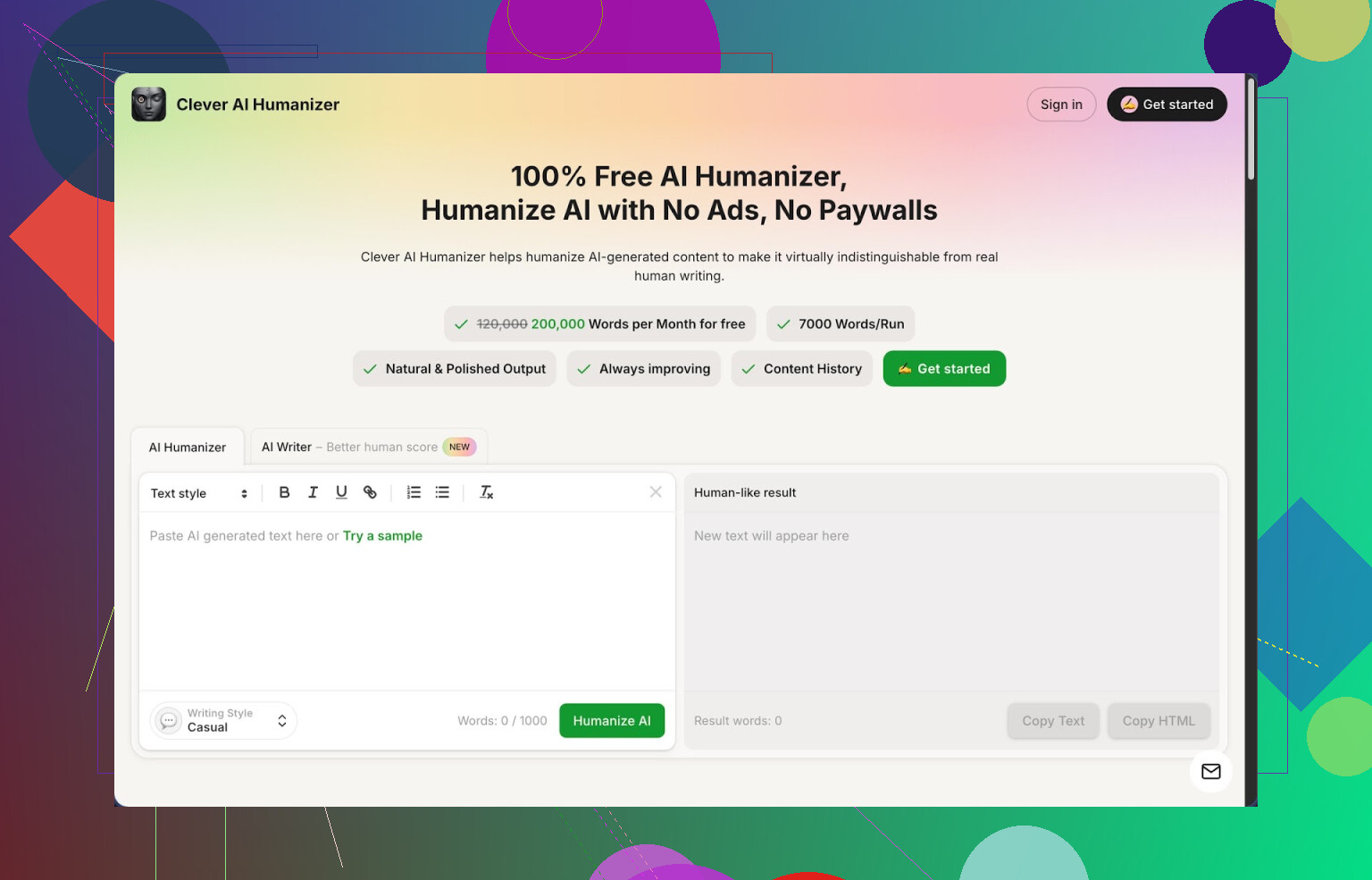
Link: https://cleverhumanizer.ai
I stumbled on Clever AI Humanizer after getting annoyed at every “free” tool locking me after 500 words. This one felt different, so I stress tested it.
Here is what stood out first:
- You get around 200,000 words per month for free
- Up to about 7,000 words per run
- Three styles: Casual, Simple Academic, Simple Formal
- There is a built-in AI writer in the same dashboard
No login paywall halfway through, no “buy credits” popup after one serious use.
I ran a few long samples through it, stuff written with a generic GPT-style model. I then checked the output with ZeroGPT. Using the Casual style, all three samples came back with 0 percent AI in their report. ZeroGPT is not perfect, but it is one of the stricter public checkers. So that result got my attention.
If you write with AI often, you already know the problem. The draft reads fine, but detectors love to scream “100% AI” at it. That has grades, clients, and platforms attached to it, so it is not something you ignore.
Clever AI Humanizer is built for that exact headache. You paste your AI text, pick a style, hit the button, and wait a few seconds. It spits out a version that sounds more like someone who slept badly and drinks coffee, and less like a language model parroting patterns.
What I noticed while comparing source vs output:
- The meaning stayed intact on all the long tests I tried
- Structure changed enough to feel less template-like
- Sentence length varied more
- Repeated phrasing dropped off
I did not see it hallucinate facts in my tests, which matters if you do technical or data-heavy writing.
Now, the extra tools inside the same site are worth mentioning if you want one place to do everything instead of jumping between five tabs.
Free AI Humanizer module
This is the main reason to use the site.
Workflow I used:
- Paste AI draft
- Select style
- Run it
- If needed, run it one more time with a slightly different style for stubborn passages
The Casual setting produced the lowest AI scores for me on external detectors. Simple Academic felt good for essays and reports, and Simple Formal worked for emails and more stiff documents.
One thing you should know. The text often gets longer. The tool likes to unpack dense AI sentences into more natural lines. That is one tradeoff for dropping some AI patterns.
Free AI Writer
This sits in the same interface.
You give it a topic, some rough instructions, and it generates a full piece. Then you can push that content straight into the humanizer without leaving the site.
My experience:
- For blog-style pieces and essays, this combo workflow tested better on detectors than taking raw GPT text and only running it once
- If you are starting from zero, it saves time, because you do not have to write a base draft elsewhere
I still would not trust it for niche technical domains without manual edits, but for general writing it worked fine.
Free Grammar Checker
I fed it some sloppy copy riddled with typos and missing punctuation.
It fixed:
- Basic spelling mistakes
- Comma and period issues
- Some awkward sentence structure
Output felt cleaner but not over-polished. I used it after the humanizer step, so the final version was easier to paste into email, docs, or CMS.
Free AI Paraphraser
This one is more of a traditional rewriter.
Use cases I tried:
- Rewriting my own old blog paragraphs to avoid sounding identical
- Adjusting tone from stiff to more natural
- Swapping phrases while keeping the same meaning
For SEO and content refresh work, this part seems handy. I would still check for over-similarity if you are trying to get away from an older version of your text.
How it fits into a daily workflow
The biggest upside is that everything is bundled:
- Humanizer
- Writer
- Grammar check
- Paraphraser
All inside one simple interface.
My real flow looked like this on a long piece:
- Generate core draft in my usual AI tool
- Paste into Clever AI Humanizer in Casual mode
- Review the output line by line
- Run the grammar checker
- Paraphrase small parts that still felt stiff
That covered most of what I needed without touching any credit system or payment page.
Where it falls short
It is not magic.
- Some detectors still mark it as AI, especially the more aggressive or private ones
- Text gets longer than the original most of the time, which is sometimes awkward if you have strict word limits
- Style sometimes drifts a bit from what I would personally write, so I still edit
So if you expect 100 percent stealth on every detector, you will end up disappointed. If you want a strong improvement over raw AI text and you are okay doing some manual cleanup, it is solid.
Is it worth using in 2026
For a completely free tool, with 200k words per month and decent style control, I would say yes. I use it when:
- I need to calm down AI scores on text that matters
- I want to avoid spending money on credit-based humanizers
- I do not feel like juggling three different tools for writing, humanizing, and grammar
If you are curious and want to see a deeper breakdown with screenshots and detection results, there is a longer review here:
Video review is here:
If you want to see what others say or compare tools, these Reddit threads helped me gauge the general vibe:
Best AI humanizers list:
https://www.reddit.com/r/DataRecoveryHelp/comments/1oqwdib/best_ai_humanizer/
More general talk about humanizing AI text:
https://www.reddit.com/r/DataRecoveryHelp/comments/1l7aj60/humanize_ai/
11 Likes
Short answer for BypassGPT alternatives that are free and not a total pain:
- Clever Ai Humanizer
You already saw @mikeappsreviewer go deep on it, so I will not repeat their steps. I will add this. If your main goal is “AI text that passes public detectors like ZeroGPT or GPTZero most of the time,” it does the job better than most free tools.
Key points from my testing:
- Free tier was enough for weekly student level or freelance level volume.
- Casual mode gave me the lowest AI flags on ZeroGPT and Winston.
- Outputs need light editing so you keep your own voice.
Where I disagree a bit with @mikeappsreviewer. I would not trust any humanizer if you deal with strict academic integrity tools from big universities or enterprise setups. Private detectors often use extra signals and they are harsher. If you submit high risk stuff, expect risk, no matter the tool.
- QuillBot (free tier)
- Use “Standard” or “Fluency” modes.
- Paste smaller chunks, like 300 to 500 words.
- Then run a final light pass through Clever Ai Humanizer if scores still look bad.
On its own, QuillBot outputs often still read “AI-ish”, but combined with another humanizer you get more variance.
- Manual hybrid method
If you want more control and less dependence on one site:
- Generate with any GPT model.
- Break into short paragraphs.
- Rewrite topic sentences yourself.
- Use Clever Ai Humanizer on the rest to randomize structure.
This cuts detector scores while keeping meaning. Takes more time but safer than full auto.
- What to avoid
- “One click, 100% undetectable” sites.
- Anything that locks you after 200 words and pushes paid plans on every click.
Most of those spin text too hard or inject nonsense, which hurts you more than AI flags.
Last thing. No tool is a shield if your use case crosses rules from your school, client, or platform. Treat humanizers like strong helpers for editing style and variance, not a magic invisibility cloak.
BypassGPT dying on you is kinda the standard lifecycle for these “free & magical” tools, tbh.
I’ll push back a tiny bit on what @mikeappsreviewer and @nachtschatten implied: if you’re only chasing “0% AI” on public detectors, you’re gonna be forever hopping tools as they get patched. Detectors change, tools chase, cycle repeats. So I’d treat any “bypass” as a workflow, not a single app.
Since you asked for completely free and as close as possible to BypassGPT, here’s what’s actually worked for me:
-
Clever Ai Humanizer as the core tool
Yeah, both of them already mentioned it, but it’s honestly the closest thing to a BypassGPT-style “paste → transform → done” flow that is still usable and not ultra-paywalled.
Where I think it’s different from a lot of clones:- The free quota is high enough that you’re not crying after 2 essays.
- Styles actually matter. “Casual” really does shove the text away from typical GPT rhythm.
- It doesn’t go full word-salad like some “100% undetectable” garbage sites.
If you’re replacing BypassGPT, this is the one I’d make your new default tab.
-
Stack it with a light manual edit
This is where I kinda disagree with the “run it twice in different modes and you’re done” idea.
My experience:- One pass through Clever Ai Humanizer.
- Then you rewrite just intros, conclusions, and any super-generic sentences (“In conclusion, it is clear that…” type stuff).
Detectors hate patterns, and your own messy phrasing is the best anti-pattern you have. Doesn’t take long and feels way less sketchy than pure auto-humanizing.
-
Short chunks instead of giant walls of text
BypassGPT used to kinda handle big blobs, but a lot of tools get stiff on long inputs.
I get better results by:- Splitting into 3–6 paragraph chunks.
- Running each chunk separately through Clever Ai Humanizer.
- Then stitching and smoothing transitions manually.
It avoids that “this entire 2k words feels like the same robot talking” vibe.
-
Know what “risk level” you’re actually in
Nobody wants to say this out loud, so I will:- Public checkers like ZeroGPT are easier to “beat.”
- Institutional / enterprise detectors are a black box and often harsher.
So if you’re dealing with: - Low to medium risk stuff (client blogs, casual content, low-stakes assignments) → Clever Ai Humanizer + light edit is usually enough.
- High-risk academic / corporate compliance stuff → no tool will be “trustworthy” in the sense you probably want. At that point, you’re not bypassing, you’re gambling.
-
What I’d avoid that kinda looks like BypassGPT
- Any “bypass” site that promises 100% undetectable and slams you with ads / popups.
- Aggressive spinners that wreck meaning just to change every single word.
These look tempting as BypassGPT replacements, but they output stuff that: - Still triggers detectors half the time.
- Reads like a bad translation of your own text.
- Can even invent nonsense facts.
If you want something that feels like BypassGPT in daily use, Clever Ai Humanizer is honestly the only free tool I’d bother building a workflow around right now. Just don’t treat it like a magic invisibility cloak. Use it as a strong style editor, then add a bit of your own human chaos on top.
BypassGPT breaking is not a glitch, it is the business model in slow motion. So instead of hunting the “next BypassGPT,” think in terms of a stack.
1. Where I agree / disagree with the others
- @mikeappsreviewer went hardest on Clever Ai Humanizer, and I do agree it is the closest thing to a straight BypassGPT swap for day‑to‑day use.
- @nachtschatten and @waldgeist are right that pure “0% AI” chasing is a treadmill, but I think they’re slightly underestimating how far you can get with a decent setup plus some discipline.
2. Pros of Clever Ai Humanizer in this context
- Genuinely usable free tier for regular users, not just a demo.
- Handles bigger chunks than most “free” tools without choking or forcing paywalls.
- The styles do actually change rhythm and structure, not just synonyms.
- Keeps meaning relatively intact, so you are not babysitting every sentence.
3. Cons you should not ignore
- It still has a recognizable “processed” feel if you paste a long essay and accept everything untouched.
- Output often gets wordier, which is annoying if you have strict length caps.
- Public detectors are one thing, but nobody can promise you safety against closed, institutional systems. Same applies here.
- If your own voice is very sharp or specific, you will have to edit to avoid sounding slightly generic.
4. How I would use it differently from what others suggested
Instead of chaining multiple auto tools on top of each other, I would:
- Generate your draft with whatever model you like.
- Run it once through Clever Ai Humanizer in your preferred style.
- Manually rewrite only: intro, transitions between sections, and conclusion.
- Read it out loud. Anything that feels too “smooth” or repetitive, rough it up in your own words.
So I agree with stacking manual edits, but I would not bother with multiple humanizer passes like a lot of people suggest. One solid pass plus real human noise is usually more natural and less time‑wasting.
5. About “completely free & trustworthy”
This is the part nobody loves to hear: for high‑risk academic or corporate use, there is no such thing as a fully trustworthy bypass, no matter what @nachtschatten, @waldgeist or @mikeappsreviewer lean on in practice. These tools are fine as style editors that reduce flags on casual or medium‑stake content. Treat them as that, not as legal armor.