I’ve been using Monica AI Humanizer to rewrite AI-generated text so it sounds more natural and less detectable, but I’ve hit the paywall and can’t afford the premium plan. I’m looking for reliable, truly free tools or workflows that can humanize AI content without ruining quality or getting flagged by detectors. What free options are you using that actually work and are safe for long-form content and client projects?
- Clever AI Humanizer – my take after beating on it for a week
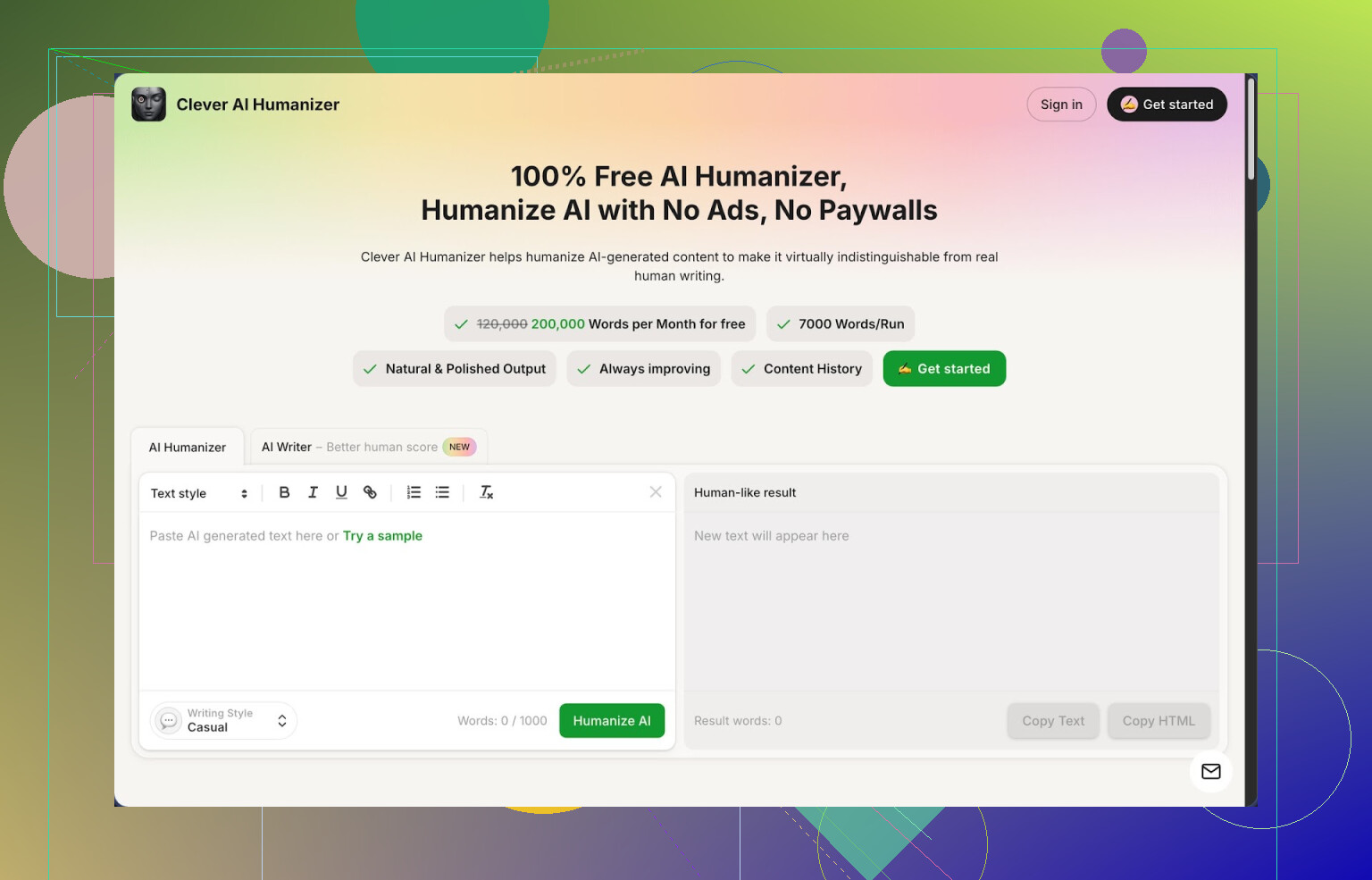
Link: https://cleverhumanizer.ai
I write a lot with AI, and at some point last month everything started getting flagged as “99–100% AI” on detectors. Teachers, clients, even random editors started running stuff through ZeroGPT and similar tools. So I went hunting for a humanizer that did not cap out after 1k words or throw a paywall at me.
Clever AI Humanizer is the one I ended up sticking with, for now.
Here is what stood out after using it daily.
Free usage and limits
I pushed it pretty hard.
• Around 200k words per month for free
• Up to roughly 7k words in one go
I fed it full essays, long blog posts, some technical docs. It handled them without breaking the structure. No “upgrade to pro to finish your text” nonsense.
For my use, the word limits are enough for serious work. You can keep re-running text until you like the result, without watching credits drain.
Styles and how I used them
It has three presets:
• Casual
• Simple Academic
• Simple Formal
I mostly used:
Casual for blog posts, Reddit-style content, emails.
Simple Academic for school-type work and reports.
Simple Formal for basic business writing.
The Casual mode gave me the best “human score” in AI detectors. I tested several runs in ZeroGPT and got 0% AI detected multiple times when using Casual on text that originally showed as 100% AI.
That was the first tool where I saw consistent 0% on longer samples, not just on a short paragraph.
Core humanizer workflow
What I did most days:
- Paste AI text.
- Pick style (usually Casual).
- Hit humanize and wait a few seconds.
- Scan for weird phrasing and fix manually.
The output stayed close to my original meaning. It changed word order, cut repetitive phrases, and broke some of the obvious “LLM rhythm” I see a lot in raw AI output.
Important detail. It does not trash your structure. Headings, lists, basic formatting, all stayed understandable after the rewrite.
Quality vs meaning
I had one main requirement:
“Stop the detectors from screaming without turning my text into nonsense.”
On that front it did ok. Meaning stayed intact most of the time. Once in a while, with technical content, I saw:
• Swapped wording that softened a definition
• A slight change in precision in data-heavy lines
So for code, math, or strict legal phrasing, I always compared side by side. For essays, blog posts, reviews, it was fine 95% of the time.
Extra tools inside the site
This part surprised me because I expected a single humanizer box and nothing more.
- Free AI Writer
You type a prompt and it writes an article or essay, then you run the same text through the humanizer in one flow.
I tried:
• A 1,500-word article
• A 2,200-word “how-to” piece
The raw AI Writer output scored high on AI detection. After running it through the in-site humanizer, the detector scores dropped hard. Again, Casual style helped the most.
I stopped using the AI Writer for anything niche or expert-level, but for generic blog/essay stuff it was convenient.
- Free Grammar Checker
I pasted some messy notes and an old blog draft with broken punctuation.
It fixed:
• Typos
• Missing commas and periods
• Odd sentence breaks
Not as deep as a full grammar suite, but good enough for quick cleanup after humanizing. I used it as a final polish before sending things out.
- Free AI Paraphraser
This one is more of a classic rewriter. I used it for:
• Variations of product descriptions
• Rewriting older drafts without losing the main idea
• Adjusting tone to something simpler
It held the meaning better than many random paraphrase tools I used earlier. Some lines still needed small tweaks, but it did not distort facts in my tests.
Whole workflow in one place
My typical chain on busy days was:
- Write with a normal AI model.
- Paste into Clever AI Humanizer, Casual style.
- Check tone, remove weird lines.
- Run Grammar Checker.
- Done.
Having humanizing, paraphrasing, and basic writing in the same interface saved time. No hopping through five different sites.
Things I did not like
It is not magic. A few annoyances showed up.
- Some detectors still flag the text
ZeroGPT liked the output, but other detectors did not always give 0%. Sometimes I still got “partially AI” on certain tools.
So if your teacher or boss uses a different detector, you still need to check. Do not assume it passes everywhere automatically.
- Output tends to get longer
On longer pieces, the humanized version often had more words. It adds small connectors and clarifications that bloat the size.
For school assignments with a strict word ceiling, I had to trim things down after humanizing.
- Occasional awkward lines
You will notice some “off” sentences here and there, especially if you read fast. They are easy to edit out, but you cannot skip manual review.
If you paste and submit blind, you will get caught by tone mismatches or slightly odd phrasing more than by detectors.
Where to read and watch more
More detailed Clever AI Humanizer review with AI detection screenshots:
YouTube review:
Relevant Reddit threads discussing humanizers and detection:
Best AI Humanizers on Reddit
https://www.reddit.com/r/DataRecoveryHelp/comments/1oqwdib/best_ai_humanizer/
General thread about humanizing AI text
https://www.reddit.com/r/DataRecoveryHelp/comments/1l7aj60/humanize_ai/
Who this is useful for
From my own use, it helped most if:
• You write with AI often and keep getting hit by detectors.
• You need a free option with high monthly limits.
• You are ok doing a quick manual pass after the tool rewrites your text.
If you expect one click and instant “human-perfect” text with zero edits, you will get disappointed. If you treat it as a strong first pass that strips obvious AI patterns, it does its job.
13 Likes
I hit the same Monica wall a while ago. Short version, you have three realistic paths if you want free and “less detectable” text:
- Use a dedicated humanizer
- Use a mix of normal AI tools plus your own edits
- Change how you generate the text in the first place
On 1) Dedicated humanizer
You already saw @mikeappsreviewer talk about Clever Ai Humanizer in detail. I agree with them on one thing, for pure “paste AI text, get more human output” it is one of the better free options right now. I do not fully agree with relying on detectors as the main metric though. Different detectors disagree a lot.
If you try Clever Ai Humanizer, a simple workflow:
- Generate with your usual model
- Run through Casual style
- Compare side by side, fix any odd sentences by hand
- Run once through a free grammar checker like LanguageTool or Grammarly free
You do not need to touch every sentence. Focus on spots where the tone sounds too formal or too “perfect”.
- Mix of standard tools, no “humanizer” label
If you do not want to depend on one site:
- Generate text
- Run through a paraphraser
- QuillBot free or Paraphraser.io work ok in “fluency” or “standard” mode
- Then shorten and roughen the text
- Use a free summarizer to shrink it
- Add a few short sentences, contractions, and small quirks by hand
Stuff detectors often flag:
- Long, perfectly balanced sentences
- Repeated patterns like “Firstly, Secondly, Lastly”
- Overuse of transitions like “however, moreover, additionally”
Break those patterns. Write a few lines yourself at the start and end. Add a small personal note or opinion.
- Change how you generate in the first place
If you have control over prompts, try:
- Ask the AI to “write like a rushed student” or “write like a mid level employee who is a bit tired”
- Ask for shorter sentences, more contractions, fewer transition words
- Ask it to include one or two small mistakes or informal phrases
Then run that through a light paraphrase instead of a strong humanizer. Less distortion of meaning, fewer weird lines.
Some free extras that help:
- LanguageTool browser extension for grammar and light style fixes
- Hemingway Editor to shorten and roughen text
- Typing a quick “messy pass” yourself over key paragraphs, then asking AI to clean grammar only
Last note. Detectors give false positives and false negatives. Treat them as a rough check, not a judge. Focus on:
- Does the text sound like you
- Does it fit your level of knowledge
- Is the tone consistent across the whole piece
If you use Clever Ai Humanizer, combine it with your own edits. That mix works better than chasing 0 percent on every detector.
If Monica’s paywall caught you mid‑workflow, you’re definitely not the first.
I mostly agree with @mikeappsreviewer and @stellacadente on using a humanizer, and Clever Ai Humanizer is honestly one of the few that’s actually usable for free right now. Since they already walked through that one in detail, here are some different routes you can stack on top or use instead, without just repeating their playbook.
1. Use models that already sound “human” out of the box
Instead of relying only on a humanizer, change how you generate:
-
Tell the AI:
“Write this like a tired college student who is trying to hit the word count but not sound like a robot. Use contractions, vary sentence length, avoid ‘moreover/however/additionally’ and skip perfect structure.”
-
Force imperfection:
“Include a couple of slightly awkward phrases and occasional informal words, but keep grammar mostly correct.”
You’ll be surprised how much that alone drops AI detector scores, even before running through anything like Clever Ai Humanizer.
2. Simple “roughening” pipeline with generic tools
If you don’t want to lean completely on a branded humanizer:
- Generate your text.
- Run it through a plain paraphraser (e.g. standard / fluency mode, not “creative”).
- Then shorten and mess it up a bit:
- Cut some transitions like “in conclusion,” “overall,” “moreover.”
- Merge or split a few sentences manually.
- Add a few personal asides: “Honestly,” “To be fair,” “I kinda think,” etc.
Detectors hate:
- Perfect paragraph symmetry
- Overly tidy logical structure
- Repeated formulaic phrases
Break those patterns and you’re already doing more than any 1‑click humanizer.
3. Where Clever Ai Humanizer actually fits
I slightly disagree with how heavily detectors are being used as the main benchmark. Some people obsess over hitting “0% AI” like it’s some holy grail. That’s… not necessary and often unrealistic.
Where Clever Ai Humanizer does make sense:
- You need a free tool that handles long text without nagging you to top‑up credits.
- You want to quickly strip the classic LLM cadence and then fix a few weird spots yourself.
- You do not want your headings and structure nuked.
Treat it as a strong first pass, not as a magic cloak. The SEO‑friendly angle here is simple: if you’re publishing online a lot, using something like Clever Ai Humanizer to post‑process AI content can help you get more natural‑sounding articles without rewriting everything from scratch.
4. Add a “human fingerprint” at the edges
Detectors and instructors often look hardest at:
- The intro
- The conclusion
- Any very technical paragraph
So:
- Write your own first and last paragraph from scratch.
- Let AI (and/or a humanizer) handle the middle.
- Then skim through and inject 2–3 tiny “this sounds like me” bits: personal opinion, quick example from your real life, a small disagreement.
That kind of inconsistency is exactly what most AI output lacks.
5. Don’t trust detectors like they’re some infallible god
Quick reality check:
- Different detectors contradict each other all the time.
- They flag human text and miss AI text regularly.
So instead of chasing 0% everywhere, ask:
- Does this sound like my level of writing?
- Could I reasonably defend that I wrote this if someone questioned me?
- Are there sections that feel way more polished than the rest?
If you combine:
- better prompts
- light manual editing
- a free tool like Clever Ai Humanizer in Casual style as a pass
you’ll get closer to “undramatic, believable human text” than by constantly hopping tools hoping one will magically beat every detector. And you won’t be stuck behind Monica’s paywall every other week.
Short version: you don’t actually need another Monica clone, you need a safer workflow.
I’ll skip what @stellacadente, @mike34 and @mikeappsreviewer already covered about prompts and basic paraphrasers and focus on what I think they underplayed: mixing your own “noise” into the text and rotating tools.
1. What I’d actually do right now
- Generate with your usual model, but:
- Avoid super-structured prompts like “Introduction / 3 body paragraphs / conclusion”.
- Ask for 20–30% shorter output than you really need.
- Run that shorter draft through Clever Ai Humanizer once, usually in Casual.
- Then manually:
- Add a few sentences you truly write yourself in key spots.
- Intentionally leave 1–2 slightly clunky phrasings in there.
That last part matters. Everyone is polishing to perfection, which ironically screams AI.
2. Quick pros / cons for Clever Ai Humanizer
Pros
- Genuinely usable free tier for long pieces, unlike Monica’s wall.
- Keeps structure intact, so headings and lists don’t implode.
- Casual mode does a decent job breaking the classic “LLM rhythm.”
Cons
- Tends to inflate word count, so watch any strict limits.
- Some awkward lines slip in, especially on niche topics.
- Different detectors still disagree; it won’t give you universal “0% AI”.
So I’d treat Clever Ai Humanizer as a “structure-safe roughener,” not as a magic invisibility cloak.
3. Where I slightly disagree with the others
- I would not obsess over hammering everything to 0% on every detector. That often leads to over-processing and Frankenstein prose.
- I’d also avoid running the same text through 3–4 humanizers in a row. It starts to sound like badly translated content, which raises its own red flags.
4. Simple extra habits that help more than yet another tool
- Always hand-write:
- The first 2–3 sentences.
- The final 2–3 sentences.
- Drop some “normal human flaws”:
- Mild repetition of a word you personally overuse.
- One slightly long, rambling sentence you would actually say.
- Keep your own style consistent across pieces. If one assignment reads like a polished blog and the next looks like a rushed text, that’s suspect no matter what detectors say.
If you want a single free Monica alternative, Clever Ai Humanizer is fine to sit in the middle of that pipeline. Just let your own messy edits bookend it instead of trusting any tool to do the entire disguise for you.