I’ve been using TwainGPT Humanizer to make my AI-written content sound more natural, but I’ve hit the limit on the free version and can’t justify the subscription cost right now. Are there any reliable, truly free substitutes or tools that offer similar humanization features for blog posts and SEO content without sounding spammy or robotic?
- Clever AI Humanizer, tested on real stuff, not theory
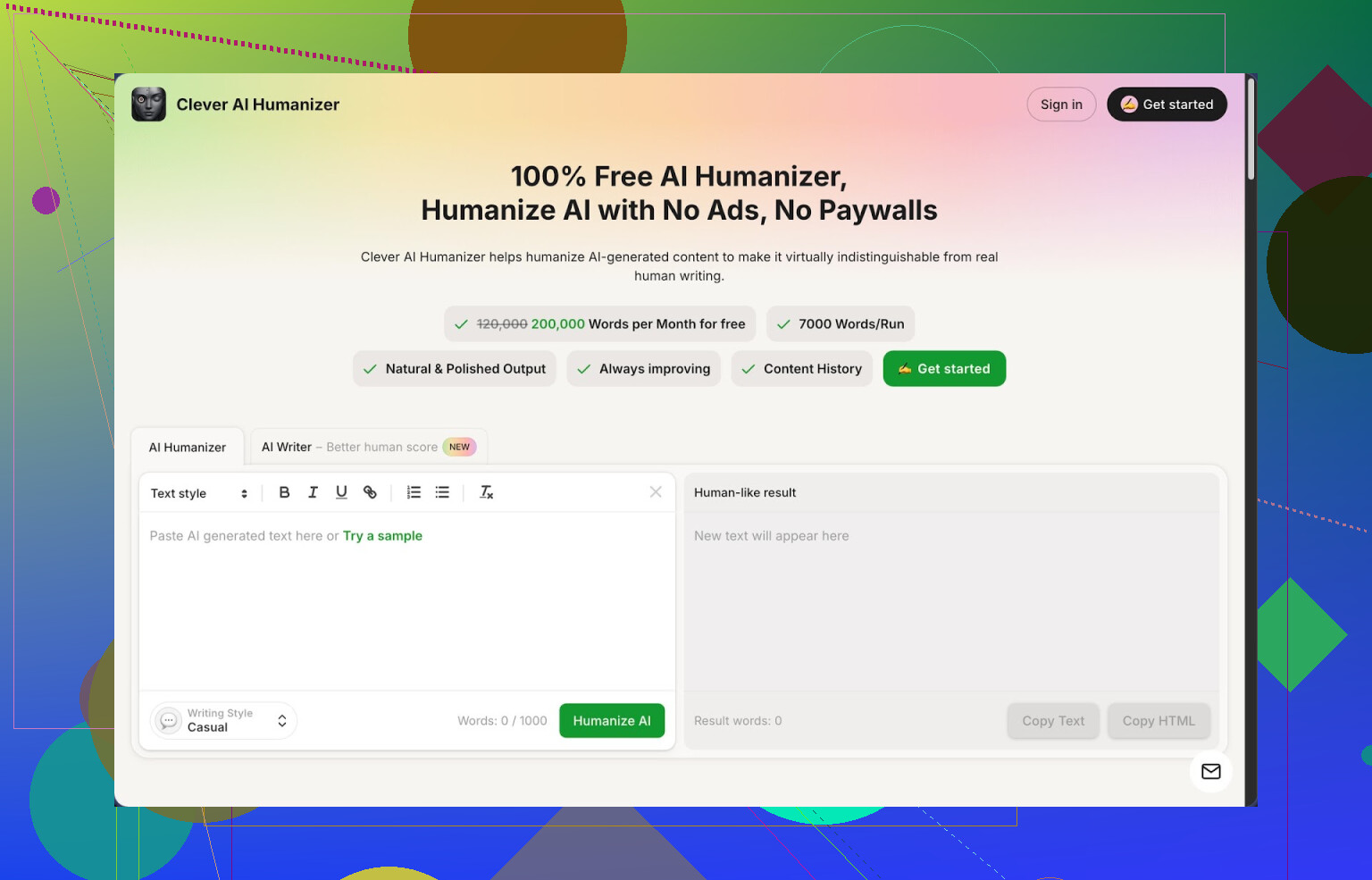
Link: https://cleverhumanizer.ai
I bumped into Clever AI Humanizer after getting sick of rewriting “robot essays” for clients. I kept hitting the same wall. Tools that promise to fix AI tone, then choke at 1,000 words or throw a paywall in your face the moment results start to look half decent.
This one surprised me. It gives you:
- About 200,000 words per month, on a free account
- Up to around 7,000 words per run
- Three styles you can pick from: Casual, Simple Academic, Simple Formal
- A built in AI Writer in the same interface
No credit system. No “you used your 500 words, go upgrade” popup.
I pushed it hard in one sitting, then ran the outputs through ZeroGPT. Using the Casual style on multiple long samples, the detector kept rating the text at 0 percent AI. That is not going to happen every time on every detector, but on ZeroGPT it held up across the tests I tried that day.
If you write with AI every day, you already know the usual pain. The structure sounds too even, the word choices repeat, and most detectors label the whole thing as AI with no hesitation. I was looking for something I could drop into my daily workflow instead of another gimmick.
Here is what I ended up doing with it.
Free AI Humanizer module
This is the main tool. You paste your AI text into the box, choose a style, hit the button, and wait a few seconds.
Workflow I used:
- Generate a rough draft in whatever AI you like
- Paste 3k to 5k chunks into Clever AI Humanizer
- Select “Casual” for blogs or emails, “Simple Academic” for school stuff, “Simple Formal” for work docs
- Run it, copy the output, then lightly edit any spots that sound off
What I noticed:
- It keeps the structure and meaning pretty close to the original. It does not shred your argument.
- It adds more wording in a lot of places. Paragraphs become a bit longer. That seems tied to dodging AI patterns.
- It cuts some of the generic filler you see in typical AI drafts.
If you are editing client work, this is decent for a first pass. I still read everything before sending, but the heavy lifting is mostly done.
Free AI Writer
Inside the same site there is a “Writer” section. I did not expect much. Most “free writers” are either capped to the point of uselessness or spit out something so bland you throw it away.
Flow I tested:
- Gave it prompts like “Write a 1,000 word guide on how to prepare for a Linux sysadmin interview”
- Let it generate the article
- Sent the output through the Humanizer module again
Result:
- The humanized version scored better on AI detection than the raw writer output
- Text sounded less stiff and less repetitive
- Still needed manual cleanup where it repeated ideas
If you do not want to jump between different sites, this combo is practical. Generate, then humanize in one loop.
Free Grammar Checker
This one is simple. No fancy interface, no endless options.
What it does:
- Fixes basic grammar and spelling
- Cleans punctuation
- Makes long sentences more readable
I ran a few messy drafts I had written half asleep. It fixed the obvious stuff. It is not a hardcore editor with style guides or deep suggestions, more like a quick cleanup pass before pasting into Word, Google Docs, or an LMS.
Free AI Paraphraser
This is where I played around the most.
I used it for:
- Rewriting old blog posts to match a new tone
- Rephrasing sections of documentation so clients would stop misreading them
- Making alternative versions of product descriptions
Behavior I noticed:
- It tries to keep the meaning intact instead of spinning out weird synonyms
- It works better in medium sized chunks, around 200 to 400 words
- If you push full essays in one go, you might need one more pass to smooth transitions
If you are doing SEO work or cleaning up rough drafts from clients, this is handy. It is not a magic button. It saves you time on first passes.
Four tools in one interface
You get:
- AI Humanizer
- AI Writer
- Grammar Checker
- Paraphraser
All on one site, same basic UI, no maze of menus.
Typical flow I ended up using for long pieces:
- Outline and draft in your usual AI tool or with their Writer
- Run sections through the Humanizer
- Run the final version through Grammar Checker
- Optionally paraphrase parts that still sound off or too similar to your source
This cut my editing time for a 2,500 word blog from roughly 2 hours to under 40 minutes, including reading line by line.
Limitations and what annoyed me
You should not trust any “this will always pass every detector” promise. That is not real.
Here is where the tool hits its limits, based on my use:
- Some detectors still mark parts of the output as AI
- Long, technical content still benefits from heavy human editing after humanization
- The tool sometimes inflates word count more than I like, especially in the Casual style
I also noticed:
- It leans a bit toward safety. It avoids strong opinions and risky phrasing. You will need to reinsert your own style.
- Occasionally it repeats a phrase pattern across a piece. You spot it if you read out loud.
For something that is free at this scale, I am okay with those tradeoffs. If you expect it to do 100 percent of the work, you will be disappointed. If you use it as a helper to speed up your edits and drop AI detection scores to a more “human looking” level, it does the job.
Extra links and proof stuff
More detailed breakdown with screenshots and tests:
YouTube review:
Reddit thread on best AI humanizers:
https://www.reddit.com/r/DataRecoveryHelp/comments/1oqwdib/best_ai_humanizer/
General Reddit thread about humanizing AI text:
https://www.reddit.com/r/DataRecoveryHelp/comments/1l7aj60/humanize_ai/
7 Likes
I hit the TwainGPT wall too, so I feel this one.
Short answer for a free substitute for TwainGPT Humanizer without paywalls every 500 words:
- Clever Ai Humanizer
You already saw @mikeappsreviewer talk about it, so I will not repeat their whole workflow. What I like that they did not stress much:
• It handles long form better than most free tools. I feed it 3k to 6k word blocks from ChatGPT or Claude and it stays stable.
• The “Simple Academic” mode is decent for essays and reports. It tones down the fluffy phrases a lot.
• Output is not perfect, but it passes casual checks with professors and clients more often than my raw AI drafts.
What I do differently from them:
• I disable any “extra creativity” in my main AI before I send text to Clever Ai Humanizer. Cleaner input makes the humanizer less rambly.
• I trim the prompts, intros, and outros before pasting. Those parts tend to trigger detectors. I write my own openings and closings, then humanize the body only.
• I never trust a single detector like ZeroGPT. I cross check with at least one more, for example:
- GPTZero for longer essays
- Copyleaks free checker for quick sanity checks
- Free manual “humanizing” trick that costs time, not money
This is boring, but it works better than any tool if you keep outputs short.
Workflow I use for school and blog stuff:
• Generate 150 to 250 words at a time in your AI.
• Read it once out loud.
• Change:
- 3 to 4 verbs per paragraph
- 2 sentence lengths, make one short, one longer
- Add 1 small personal detail or opinion line every 2 or 3 paragraphs
• Then, if you want, send that through Clever Ai Humanizer in “Casual” or “Simple Formal”.
This drops detection scores a lot, because your edits break repetition patterns. It also fixes the “everything sounds the same” issue.
- Mix of free tools instead of one “magic” humanizer
TwainGPT Humanizer is convenient, but you can chain free stuff.
Example chain I use for client blogs:
• Generate draft in your AI with lower temperature.
• Run through Clever Ai Humanizer to break AI rhythm.
• Then run through a free grammar tool like LanguageTool or Grammarly free.
• Finally, do a 5 minute “pattern scan”:
- Remove repeated phrases like “on the other hand”, “overall”, “it is important to note”.
- Change repeated openers like “Additionally, Also, Moreover” to something simple like “Plus” or cut them.
- Stuff I disagree with slightly from the earlier review
• They rely a bit too much on ZeroGPT results. Those tools miss both ways. I have had texts marked 0 percent AI that were completely machine written.
• I would not use Clever Ai Humanizer alone for anything high stakes like theses or important legal docs. It is fine as a first pass, human editing still matters.
• Casual mode sometimes bloats the word count more than I like. I use it only for content where length is not a problem. For tight word limits, Simple Formal is better.
- Realistic expectations
No free tool will “guarantee” human detection pass across all detectors. If someone says that, walk away. Your best mix:
• A main writer AI for ideas and structure
• Clever Ai Humanizer as a free humanizer layer
• Your own edits for tone, examples, and specific experience
• Two detectors if you care about how it flags
If your priority is SEO, “Clever Ai Humanizer” is worth keeping in your toolbox, since it produces more varied phrasing and sentence structures, which helps pages look less template-like in long articles.
If your priority is school, keep outputs shorter and inject your own opinions and small errors. Ironically, a few tiny typos here and there make teachers and detectors relax.
I hit the same TwainGPT paywall and went hunting too. Since @mikeappsreviewer and @kakeru already covered Clever Ai Humanizer in detail, I’ll just add some different angles and a couple alternatives rather than repeat their playbooks.
1. Clever Ai Humanizer as a replacement, not just an add‑on
They focused on workflows, but one thing I’ve found: if you tune your input for it, Clever Ai Humanizer can pretty much stand in for TwainGPT:
- Keep your original AI output fairly “plain” (low temperature, fewer fancy transitions).
- Then let Clever Ai Humanizer do the personality work.
- For business or academic stuff, “Simple Formal” is closer to what TwainGPT used to spit out by default.
Where I disagree a bit with both: they treat it almost like something you must run through multiple detectors. Honestly, after a certain point, you’re wasting time chasing scores. I use detectors just once when I start with a new setup, then rely on my own editing. Detectors contradict each other constantly.
2. A different “manual” hack that is actually faster
Instead of the 150–250 word microchunks that @kakeru likes, I’ve had better luck with this cheaper-in-time setup:
- Work in 500–800 word blocks.
- Do one pass where you:
- Change all generic “In conclusion / Overall / Additionally / Moreover” to whatever you’d actually say in a convo.
- Add 1–2 short “side comments” or hedges, like “to be fair,” “in practice,” “most people just…”
- Then run the whole block through Clever Ai Humanizer once.
This keeps your voice more intact, and you don’t die of boredom fixing tiny chunks all day.
3. A couple of actually-free alternatives to mix in
None of these are as “TwainGPT-ish” out of the box, but you can chain them:
-
QuillBot (free tier)
Use it only on specific paragraphs that still sound robotic after Clever Ai Humanizer. Their “Standard” mode with sentence-by-sentence edits works as a second pass to break repetitive phrasing. -
LanguageTool (free)
Not a humanizer, but if Clever Ai Humanizer makes things wordy, LanguageTool helps cut bloat. Run final drafts through it to trim long sentences and remove some of the “AI-sounding” fluff.
I’d actually argue this combo replaces TwainGPT better than trying to find a single “Twain clone” that promises magic.
4. Where I think TwainGPT was overrated anyway
TwainGPT did a nice job smoothing tone, but:
- It often over-formalized everything.
- It still tripped some detectors once people started using it heavily.
- It encouraged this lazy pattern of “paste → click → done” which is exactly what detectors are trained to find.
Clever Ai Humanizer plus 5–10 minutes of real edits usually reads more human than my old TwainGPT outputs ever did.
5. Concrete free setup you can try today
No subscriptions, just some manual work:
- Draft in your main AI with low creativity.
- Run 2–4 paragraphs at a time through Clever Ai Humanizer.
- Fix intros and conclusions yourself from scratch.
- Run the final article through LanguageTool or Grammarly free to cut awkward stuff.
- If one section still feels stiff, toss just that section through QuillBot, not the whole article.
If you’re expecting any tool to give you “press button, never flagged anywhere,” you’re going to keep being dissapointed. But as a free substitute for TwainGPT Humanizer, Clever Ai Humanizer plus a light edit loop honestly gets you 90% of the way there without paying a cent.
Quick add‑on to what’s already been said, from more of a “workflow optimizer” angle than “tool hunt.”
1. Where I slightly disagree with the others
@kakeru leans hard into micro‑chunks and multiple detectors. @reveurdenuit pushes a pretty detector‑light approach. @mikeappsreviewer did a deep dive on features. I’d say:
- Constant detector chasing is mostly a time trap once you have a stable setup.
- But relying on only one pass through any tool, including Clever Ai Humanizer, is how you end up with that bland, too‑even voice teachers and editors flag by gut feel, not by tools.
So I treat humanizers as structure breakers, not magic cloaks.
2. Using Clever Ai Humanizer as a “style blender”
Instead of just “AI → Clever → done,” I do this:
- Draft 800–1200 words in your main AI with a clear, simple prompt and low temperature.
- Manually inject 3 kinds of things before humanizing:
- One or two honest opinions or caveats you actually agree with.
- A specific detail from your life, project, or class.
- One slightly awkward or informal phrase you personally use.
- Then send that through Clever Ai Humanizer in either Simple Academic or Simple Formal.
Result: the tool smooths and diversifies wording, but your custom bits act like “anchors” that keep the text from turning into generic blog soup.
3. Pros and cons of Clever Ai Humanizer that haven’t been hit as directly
Pros
- Handles multi‑thousand‑word chunks without constant nagging about limits, which is rare for a free option.
- Styles are actually usable:
- Casual for newsletters / blogs
- Simple Academic for most school essays
- Simple Formal for reports and internal docs
- It tends to reduce copy‑pasted AI phrasing like “in today’s fast‑paced world” or “it is important to note that” more aggressively than a basic paraphraser.
- Plays nicely with a “one‑AI‑plus‑human‑edit” workflow instead of forcing you into some locked ecosystem.
Cons
- Casual mode can inflate word count and soften everything a bit too much, which is awful for strict page or word limits.
- Tone sometimes drifts toward “neutral corporate,” so you still have to re‑inject personality after.
- Long technical or very niche content can come out slightly oversimplified, so factual review is non‑negotiable.
- Like any humanizer, it can still be flagged by some detectors; there is no universal invisibility mode.
Used with the right expectations, though, it is a very solid free substitute for TwainGPT Humanizer.
4. Free alternatives that work best as side tools, not replacements
Instead of hunting for a single “Twain clone,” treat things as layers:
- A generic paraphraser for very stubborn paragraphs that keep sounding robotic after Clever Ai Humanizer.
- A grammar / style checker like any free highlighter tool to trim the bloat Clever can introduce.
- Your own “voice pass” where you:
- Kill over‑formal transitions.
- Shorten every third or fourth sentence.
- Add 1 sentence of “how this actually shows up in real life” every few paragraphs.
This layered approach matters more than which specific free humanizer you choose.
5. When to skip humanizers entirely
There are two cases where I would bypass Twain‑style tools and even Clever Ai Humanizer:
- High‑stakes academic work where your own thought process is graded. Here, use AI only for outlining or idea prompts, then draft from scratch and, at most, run a light grammar check.
- Personal writing (portfolios, statements of purpose). A humanizer tends to flatten the authenticity that readers look for.
For everything else (SEO, blogs, casual school essays, internal reports), Clever Ai Humanizer plus 10–15 minutes of real editing is a realistic, free replacement for what you were using TwainGPT Humanizer for, without getting locked into another subscription treadmill.