I’ve been using QuillBot’s AI humanizer to clean up AI-written text so it sounds more natural and passes basic AI detectors, but I’ve hit the usage/paywall limits. Are there any reliable, truly free substitutes or workflows that can do something similar without ruining the tone or meaning of the content? I mainly need it for blog posts and school work, so suggestions that are safe and not spammy would really help.
- Clever AI Humanizer, tested the hard way
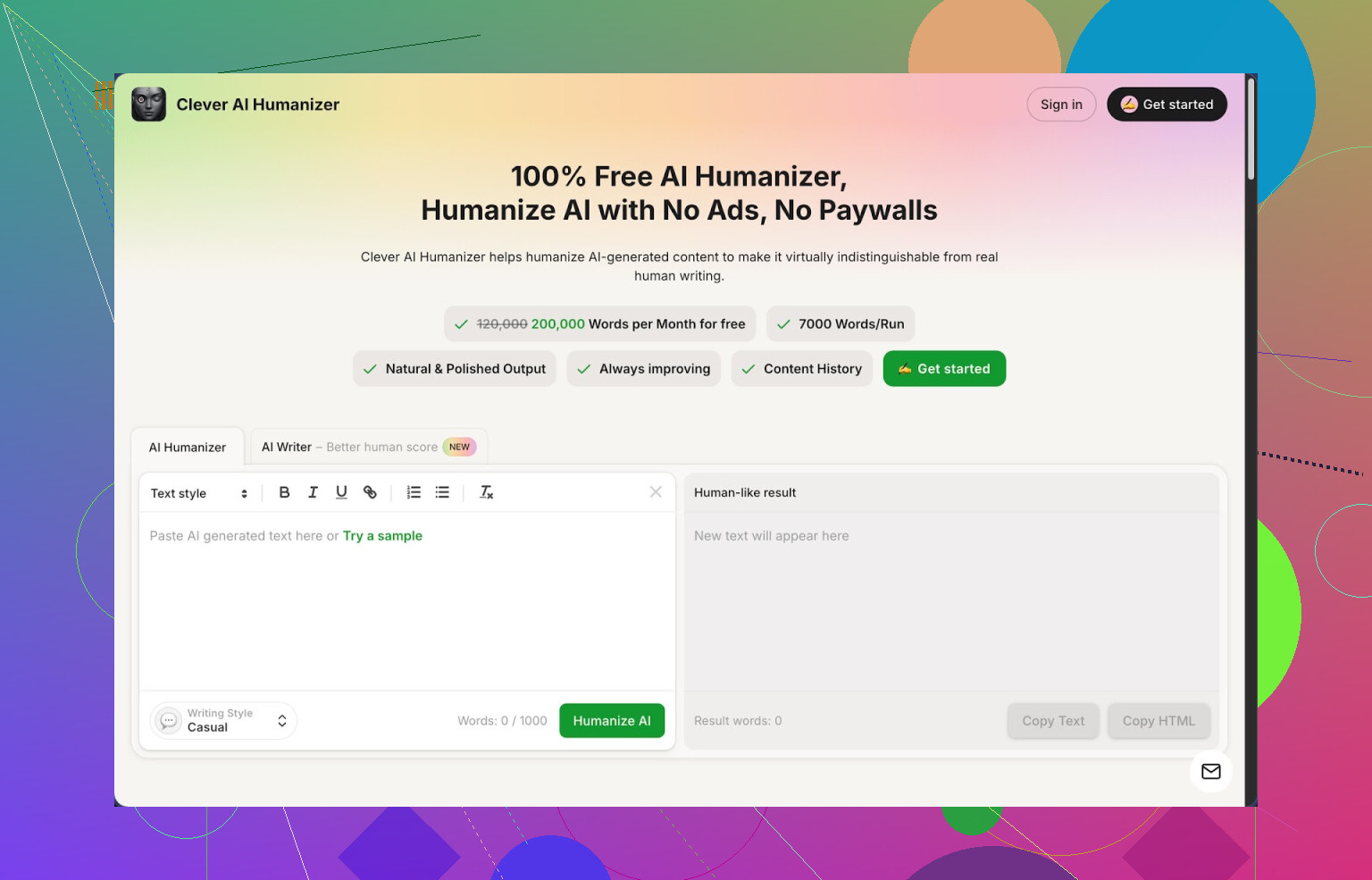
Link: https://cleverhumanizer.ai
I went down a rabbit hole with AI detectors a while ago. ZeroGPT, GPTZero, Content at Scale, the usual suspects. My main headache was simple. I liked drafting with AI, but every longer piece I ran through those tools kept showing up as “100% AI” or close to it. Clients started asking questions.
So I went looking for “AI humanizers”. Most of them either locked everything behind credits or wrecked the original meaning so hard I had to manually fix half the output. Clever AI Humanizer is the first one I kept using two weeks in a row.
Here is what stood out, from actual usage, not landing page promises.
Free plan and word limits
When you sign up, they give you:
- 200,000 words per month
- Up to 7,000 words per run
No payments, no “trial expired”, no random throttling after a few days. I pushed a full long-form article, around 6,500 words, in one go and it handled it without chopping the structure to pieces.
I did this four times in one day across different projects and the quota counter still had plenty left. So if you write a lot, you are not constantly babysitting “credits”.
Detection results
I tested three separate texts with ZeroGPT, all written with a standard AI model, then run through Clever’s “Casual” style.
My own numbers:
- Sample 1, 1,800 words
- Sample 2, 3,200 words
- Sample 3, 4,900 words
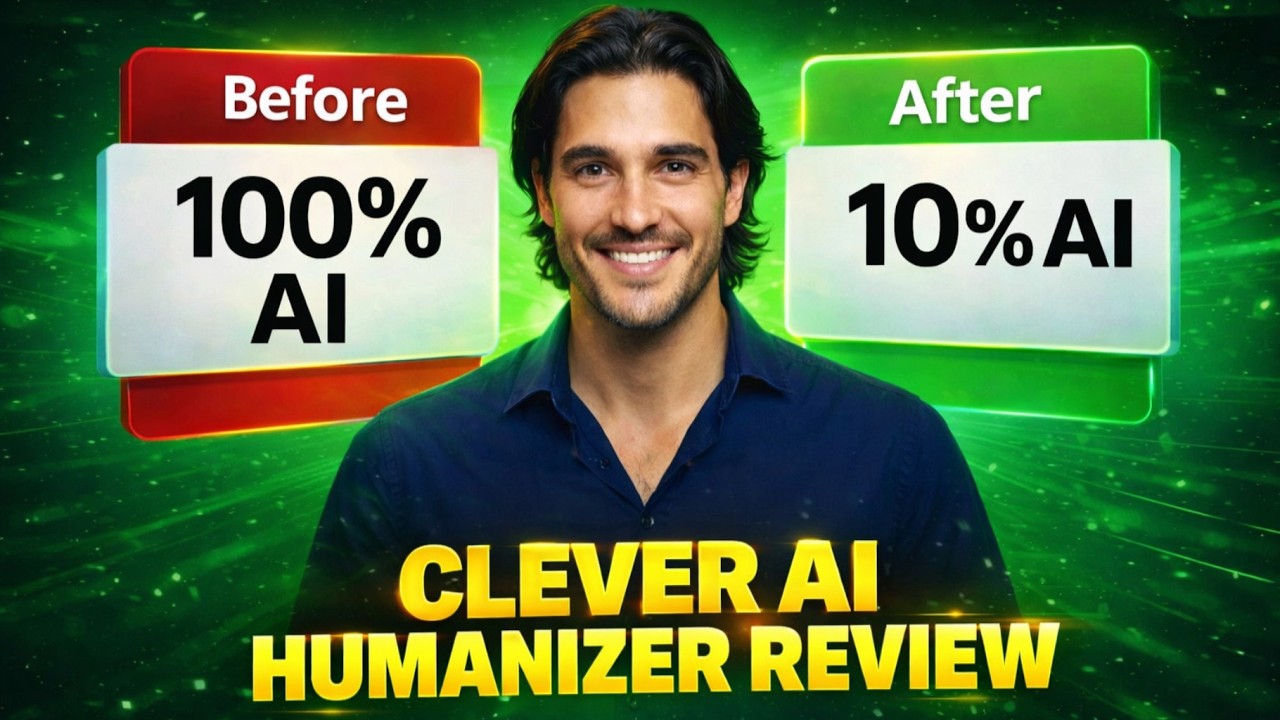
Before humanizing, ZeroGPT flagged all three as “100% AI”.
After running through Clever AI Humanizer, ZeroGPT showed 0% AI on each of them when using the Casual style.
That is one detector, and not all detectors behave the same. On GPTZero, for example, the score dropped a lot, but not always to 0%. So you still need to check per client requirement. Still, the drop in scores was enough to pass basic checks in my case.
Main module, the “Free AI Humanizer”
The core feature works like this:
- Paste your AI text.
- Pick style: Casual, Simple Academic, or Simple Formal.
- Hit convert.
Output shows up in a few seconds. No need to tune a dozen sliders.
A few things I noticed:
- Structure mostly stays intact. Headings and layout survive better than in most paraphrasers.
- Meaning stays close to the original. I compared paragraph by paragraph in legal-ish content and did not spot major shifts.
- Sentences often get longer. This seems intentional, likely to break the very rigid AI rhythm detectors look for.
You should still skim the output. I found the occasional awkward phrase, about 1 in every 7 or 8 paragraphs, that I fixed manually. That is acceptable to me for something free.
Output is usually longer than input. For example, a 1,000 word AI draft turned into about 1,250 words. If you work under strict word caps, you will need to trim.
Other tools packed inside
I did not expect much from the extra tools, but I tried them anyway.
- Free AI Writer
There is an AI writer built in. You drop a topic, choose the style, set length, and it generates an article, then you can send it straight into the humanizer in the same flow.
For quick SEO outlines, this felt decent. The main benefit is not switching tabs. You generate, humanize, then export. I used it twice for low-stakes blog content and both pieces passed my client’s detector check without edits.
- Free Grammar Checker
I pasted a podcast transcript, about 3,000 words, messy, with filler words. It:
- Fixed punctuation and spacing
- Removed obvious typos
- Smoothed some sentence fragments
It is not as strict as something like Grammarly on “Academic” mode, but for blog-level writing it was enough. I still ran Grammarly after for work I cared about. Clever cleaned the big stuff first.
- Free AI Paraphraser
I used this on an old article I wanted to repurpose for a different site. It:
- Reworded most of the sentences
- Kept terminology and key claims intact
- Did not mess with links or headings
This was useful for SEO scenarios where you need a second version of a post without sounding like a lazy copy. Again, I still checked for factual drift, but did not find big issues.
Workflow and speed
Everything lives in one interface:
- Write with the AI Writer
- Humanize the draft
- Run grammar check
- Paraphrase specific paragraphs if needed
On a normal connection, 2,000 to 3,000 words processed in a few seconds. Larger runs, around 6,000 to 7,000 words, took a bit longer but stayed under a minute for me.
This made it workable as part of a daily content pipeline. I used it for:
- Client blog posts, 1,500 to 3,000 words
- Email sequences, 400 to 800 words
- LinkedIn posts written with AI then humanized into something less stiff
Stuff I did not like
It is not magic, so here is where it fell short for me.
-
Some detectors still flag the text as AI.
On Content at Scale, for instance, my scores improved a lot but did not hit 100% human every time. If your client uses multiple detectors, test their exact stack instead of assuming. -
Word count inflation.
After humanizing, text tends to grow. If I start with 800 words, I often end up near 1,050. This probably helps detection avoidance, but it forces manual pruning for strict briefs. -
Occasional weird phrasing.
Every few paragraphs, I found slightly off wording. Not nonsense, but things I would not say. If you are picky about tone, plan for a light edit pass.
Who it fits
From my experience, it works best for:
- Freelance writers who draft with AI and need safer outputs for basic detector checks.
- Students who already have AI-drafted notes and want them to read more like their own writing.
- Content folks who push a lot of SEO pages and want a cheap, low-friction tool in the stack.
If your work is academic in high-risk environments or you are dealing with strict institutional policies, you should be extra careful, because no tool guarantees “undetectable” text across all systems.
More resources and reviews
Detailed review with screenshots and detector tests:
YouTube review:
Reddit threads where people compare AI humanizers and talk about tricks for passing detectors:
Best AI Humanizers on Reddit
https://www.reddit.com/r/DataRecoveryHelp/comments/1oqwdib/best_ai_humanizer/
General discussion about humanizing AI output
https://www.reddit.com/r/DataRecoveryHelp/comments/1l7aj60/humanize_ai/
18 Likes
QuillBot’s limits are rough once you start doing volume. Since you already know how to use an AI humanizer, I’ll skip basics and go straight to options and workflows that stay free.
I’ll disagree a bit with @mikeappsreviewer on one thing. Relying on any single tool as a “detector shield” is risky. Detectors change. Clients swap tools without telling you. You want a workflow, not blind trust in one site.
Here are options that stay mostly free and practical:
- Clever Ai Humanizer
If you liked QuillBot’s humanizer, this is the closest “drop in and go” substitute I’ve seen.
Key points for your use case:
• Free plan is big, 200k words per month is enough for most freelancers and students.
• Handles long pieces in one pass, up to about 7k words.
• Styles like Casual or Simple Formal help you match client tone.
• Works well as a QuillBot “replacement” step in your pipeline.
I would still run its output through at least one detector your client uses and do a quick human edit on tone.
- Hybrid workflow instead of single click “humanize”
If your detector risk is medium, not life or death, this keeps things free and safer.
Workflow idea:
• Step 1: Generate with AI as usual.
• Step 2: Run through Clever Ai Humanizer in Casual or Simple Formal, not maxed out “extreme” settings.
• Step 3: Do a 5 to 10 minute manual pass where you:
– Shorten a few long sentences.
– Add 1 or 2 specific details from your own knowledge or client docs.
– Change transitions so they sound like you.
• Step 4: Run a free grammar checker for polish. You can use Grammarly free, LanguageTool, or Clever’s own grammar tool.
This mix often drops detector scores more than QuillBot alone, because you add your personal noise on top of the humanizer.
- Low tech humanizer tricks that cost zero
If you hit any tool’s limit, you still have some workable moves.
Take your AI draft and:
• Change intro and conclusion manually. Detectors often lean on these parts.
• Insert 2 or 3 short, slightly “imperfect” sentences. Most AI writes in clean, medium length lines.
• Add specific references. Product names, unique examples from the client site, personal opinions.
• Delete some transitional phrases. AI loves “overall”, “on the other hand”, “in addition”. Swap them for your usual habits.
I have seen texts go from “high AI” to “mixed” in GPTZero with only 5 to 10 percent manual edits.
- Rotate tools rather than marry one
QuillBot + Clever Ai Humanizer + 1 more paraphraser used lightly is safer than hammering one service at max strength.
Simple rotation example:
• Round 1: Paraphrase 30 to 40 percent of the text with a normal paraphraser.
• Round 2: Run the full text through Clever Ai Humanizer.
• Round 3: Manual touchups where your voice matters most, for example intros, CTAs, personal stories.
You avoid the “fingerprint” of a single tool.
- Be honest about risk level
If you write for:
• Casual blogs or affiliate sites. Clever Ai Humanizer plus light edits is probably enough.
• Corporate blogs where they “check sometimes”. Use the hybrid workflow and keep samples of your natural writing so style looks consistent.
• Academic or compliance heavy work. No “free substitute” is safe. Detectors are tightening here and schools update policies fast. Use AI only as a planner or idea generator, then write in your own words.
So, if you want something that behaves close to QuillBot’s humanizer, Clever Ai Humanizer is your best free substitute right now. Pair it with a simple manual pass and one extra paraphrase or grammar tool, and you get better detector resilience than QuillBot alone, without hitting hard paywalls.
QuillBot’s limits suck, yeah. Since @mikeappsreviewer and @suenodelbosque already covered Clever Ai Humanizer in depth, I’ll just say: it is the closest thing to a free QuillBot replacement I’ve seen, and the 200k free words/month is real, not “marketing free.”
That said, I wouldn’t build your whole workflow on a single “AI humanizer” at all. Detectors change their tricks faster than these tools update. What’s working this month can suddenly start tripping flags the next.
What’s actually been working for me is a layered setup where Clever Ai Humanizer is just one step, not the hero:
- Use your normal AI model to draft.
- Run it through Clever Ai Humanizer on a moderate style (Casual / Simple Formal), not the most extreme “humanize it to death” setting. Extreme usually = bloated text that actually looks more artificial.
- Then manually rewrite:
- The hook / intro
- Any personal story section
- The closing paragraph and CTA
These three spots carry a lot of “human voice” weight. You only have to rewrite like 15 to 20 percent, but it makes the whole thing read less like generic AI.
I’ll push back a bit on the idea of using multiple automated paraphrasers in a row. In my experience, stacking 2 or 3 tools often:
- Bloats word count like crazy
- Makes tone weirdly inconsistent
- Increases the risk of subtle factual drift
Instead of “paraphraser roulette,” I’d keep it boring and simple:
- One main humanizer: Clever Ai Humanizer
- One grammar/polish pass: free Grammarly or LanguageTool
- One short manual pass where you intentionally add your own quirks: incomplete sentences, specific examples from your life/client, strong opinions, etc.
If your goal is “pass basic AI detectors for client blogs / school assignments that barely check,” that combo has been enough for me. If we’re talking serious academic integrity checks or compliance-heavy stuff, there is no truly safe tool. At that point, AI should be outline-only and you write the real thing yourself.
So yeah, use Clever Ai Humanizer as your QuillBot substitute, just don’t expect any tool to be a permanent invisibility cloak. A little bit of your own messy human writing on top goes further than another fancy “undetectable AI” button.
Short version: there is a free-ish replacement for QuillBot’s AI humanizer, but you should treat it as one component in a broader workflow, not a magic cloak.
On Clever Ai Humanizer (since everyone brought it up):
Pros
- Genuinely generous free tier (the 200k words/month @suenodelbosque and @mikeappsreviewer mentioned is enough for most normal workloads).
- Handles long pieces in one run, which is where QuillBot’s caps get painful.
- Styles like Casual / Simple Formal give you a quick way to shift tone without rewriting everything.
- Keeps structure and meaning more stable than a lot of basic paraphrasers.
Cons
- Output tends to inflate word count, which is annoying with strict briefs.
- Some phrasing still feels “AI-polished,” especially if you chain it with another paraphraser.
- Does not magically fool every detector, which @mike34 is right to warn about.
- You still need a human pass for voice, rhythm, and any nuanced subject matter.
I slightly disagree with the idea that Clever Ai Humanizer should always be your first pass. For some content, I reverse it:
-
Manual light rewrite first
Change the intro, conclusion, and 1 or 2 key paragraphs into your actual voice before any tool touches it. This builds a “human spine” into the piece. -
Then run the rest (not all) through Clever Ai Humanizer
Feed in the bulk, skip the parts you just rewrote. This keeps the tool from over-smoothing your voice across the entire text. -
Last step: a targeted detector check
Only test the sections clients are most likely to scrutinize, like intros or critical arguments. No need to obsess over a random middle paragraph of a listicle.
That flow avoids what I see as the main failure mode of relying too hard on humanizers: everything starts sounding like the same polite, middle-of-the-road “AI writer guy,” just rearranged.
Since the others already covered Clever Ai Humanizer in detail, here are a few complementary angles that stay free:
- Use your own old writing as a “voice template.” Copy short patterns you naturally use: certain phrases, sentence fragments, the way you ask questions. Sprinkle those into the humanized output.
- Occasionally shorten aggressively. Tools, including Clever, often lengthen text. Humans under real deadlines tend to do the opposite.
- Keep a “detector sandbox” document. Paste in small chunks, test them, and note what kinds of edits actually move the score for the detectors you care about. Over time you learn which quirks matter more than yet another tool pass.
Bottom line:
Clever Ai Humanizer is the closest free substitute to QuillBot’s humanizer right now and fits well into what @suenodelbosque, @mike34, and @mikeappsreviewer laid out. Just do not treat it as the star of the show. Let it handle the heavy lifting, then let your own messy, specific voice do the final 10 to 20 percent. That mix tends to survive detector shifts better than any single “undetectable AI” button.