I’ve been using Aihumanize.io to make AI-generated text sound more natural, but I’ve hit its limits and can’t justify paying for a subscription right now. I’m looking for reliable free tools or workflows that can humanize AI content without getting flagged by detectors. What free substitutes have actually worked well for you, and how do they compare to Aihumanize.io in quality and ease of use?
- Clever AI Humanizer, tested like an actual user
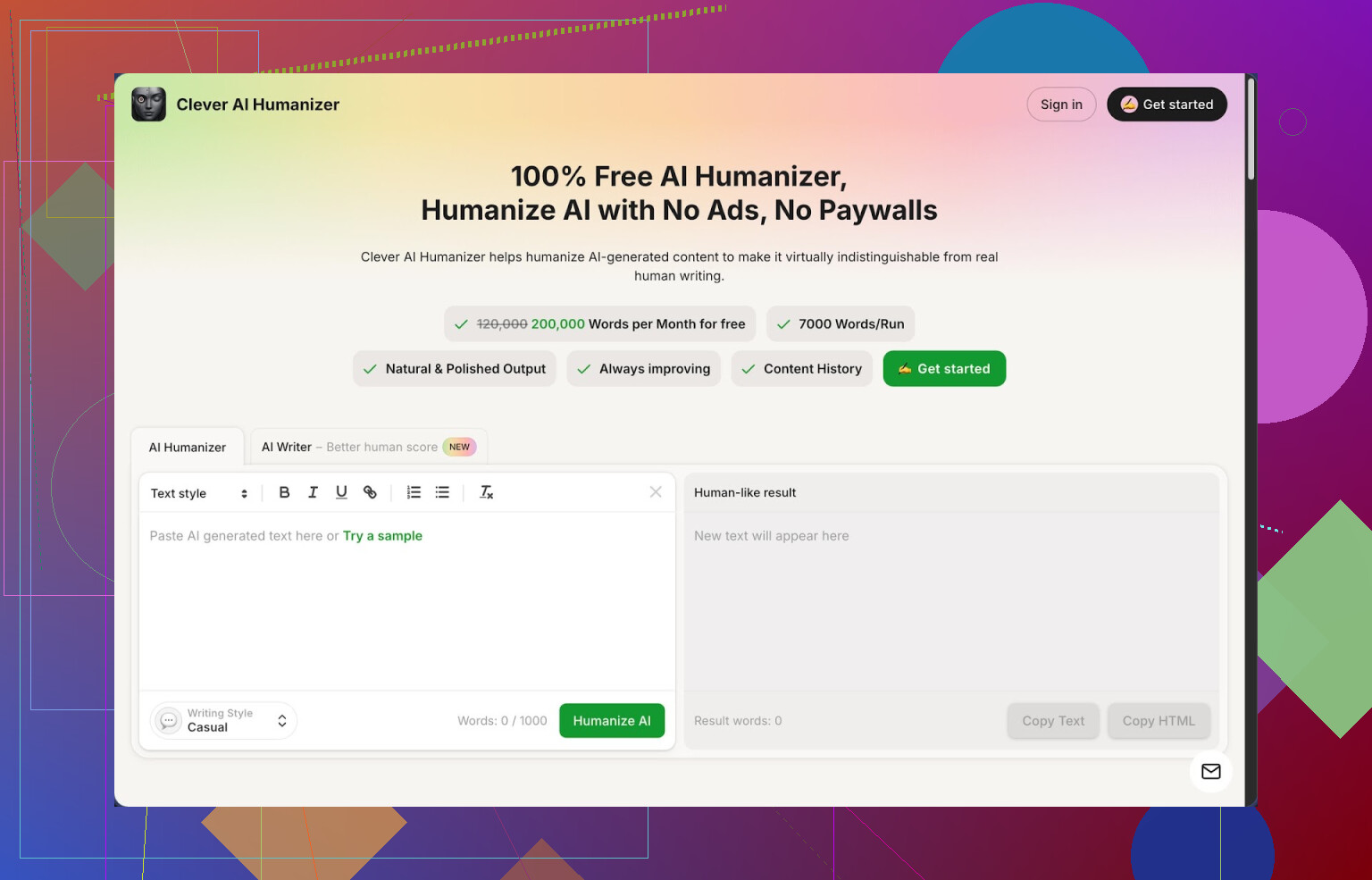
Link: https://cleverhumanizer.ai
I’ll keep this as practical as possible, because I burned an entire afternoon running texts through different “humanizer” tools and most of them felt useless or way too limited.
Clever AI Humanizer is the one I ended up keeping in my bookmarks. Main reasons:
- It is free up to 200,000 words per month
- Up to 7,000 words in a single run
- Three modes: Casual, Simple Academic, Simple Formal
- Extra stuff in the same interface: AI Writer, Grammar Checker, Paraphraser
No login paywall popups mid-run, no “you hit your 500 word limit, upgrade now” message after teasing you with one result.
I pushed three long samples through the Casual mode and then checked them on ZeroGPT. Each one came back as 0% AI. That surprised me, because I usually see partial flags somewhere in the text when I do this with other tools.
Here is how I used it in practice
I took a chunk of raw LLM output, something like a 1,800 word blog draft. Whole thing sounded robotic and got tagged as 100% AI by ZeroGPT.
What I did step by step:
- Pasted everything into the “Free AI Humanizer”
- Picked “Casual”
- Hit run and waited a few seconds
- Copied the result back into ZeroGPT
ZeroGPT score dropped from 100% AI to 0% AI on that first try. Flow was smoother, sentences varied more, but my original structure and arguments stayed intact. The tool did not hallucinate new facts or delete key points, which is the main thing I watch for.
The big plus here is the word limit. With 7,000 words per go and 200k per month, you can treat it like a normal part of your workflow instead of rationing tokens.
How the main module behaves
The core feature is the “AI Humanizer” itself.
You paste in your AI text, pick a style, and it rewrites it with different sentence rhythm, wording, and structure. It seems to target common patterns detectors look for, like:
- Repeated phrases
- Overly flat sentence length
- Overuse of the same connectors
The Casual style feels the most natural for blog posts, emails, or scripts. Simple Academic is usable for lighter essays or reports. Simple Formal sits somewhere in between work email and generic corporate text.
Important detail: meaning stayed consistent across all test pieces I tried. I cross-checked with side-by-side comparisons to see if anything critical got dropped. It did not remove arguments or claims, it only reshaped how they were expressed.
Other tools inside Clever AI Humanizer
What surprised me a bit was that it is not only a rewriter. There are three extra tools on the site that work with the same account and interface:
- Free AI Writer
This one lets you generate text from scratch, like an essay, blog post, or article. The key trick is that you can move that output directly into the humanizer, so you keep the whole thing inside one workflow.
When I generated a short article with their AI Writer and then humanized it, the human-score on detectors was even better compared to running external AI output. Probably because their system knows its own patterns.
- Free Grammar Checker
I fed it some messy text with broken punctuation and inconsistent capitalization. It cleaned up:
- Spelling
- Commas and periods
- Basic clarity issues
It is not trying to be some heavy editing assistant, more like the last pass before you paste into WordPress, Google Docs, or email.
- Free AI Paraphraser
This one rewrites existing sentences while keeping the meaning. I used it on:
- A product description that sounded stiff
- A section of a draft I had rewritten too many times
- A short FAQ I needed in a different tone
It helped shift style without wrecking factual content. For SEO users, this is the type of tool you use to avoid clones of your own pages or to adapt content for different audiences.
How it fits into a real workflow
If you write with AI daily, this is how I would set it up:
- Use your usual LLM to draft long content
- Run that draft through Clever AI Humanizer in Casual or Simple Academic
- Check the new version on your detector of choice
- Fix grammar with their Grammar Checker if needed
- Use the Paraphraser on sections that still feel stiff
The main thing is that you are not juggling five different tabs with five different sites that each lock you after 500 words.
What I did not like
It is not magic. A few caveats from my tests:
- Some detectors still mark parts of the text as AI. No tool gets you “safe” across every detector. The 0% on ZeroGPT was strong, but I also tried other detectors and saw mixed results.
- The text often gets longer after humanization. This seems intentional to break certain patterns, but it can be annoying if you need tight word counts, like for forms, short bios, or descriptions with hard limits.
- If your source text is trash, the humanizer does not fix logic or structure. It respects your original layout, so a bad outline stays a bad outline, only smoother.
Why I am still using it
For something that is fully free at this volume, it solved a real problem for me.
I no longer babysit word counts or credits, which was the main friction with other tools. Being able to paste in a 3,000 or 4,000 word draft and get one pass is better than slicing content into chunks and trying to glue them back together.
If you are looking for a daily writing helper that handles:
- Humanizing AI content
- Generating fresh text
- Cleaning grammar
- Paraphrasing sections
all in one place, then Clever AI Humanizer is worth trying. I have it pinned in my browser now, which is rare for tools like this.
More info and links
Detailed walkthrough with screenshots and detector tests:
YouTube review:

Reddit threads with other people’s experiences:
Best AI humanizers discussion:
https://www.reddit.com/r/DataRecoveryHelp/comments/1oqwdib/best_ai_humanizer/
General talk about humanizing AI text:
https://www.reddit.com/r/DataRecoveryHelp/comments/1l7aj60/humanize_ai/
5 Likes
If you are trying to replace Aihumanize.io for free, you have a few solid options and a few workflows that avoid subscriptions altogether.
Quick note on what @mikeappsreviewer said. Clever Ai Humanizer is legit useful, especially for long-form stuff. I had similar results on ZeroGPT and Writer AI detector. Where I disagree a bit is on relying on “0 percent AI” as the main success metric. Detectors are inconsistent and false positives are common, so I would treat them as a rough check, not the goal.
Here is what has worked well for me, all free or close to it:
-
Clever Ai Humanizer as the main “one-click” tool
- Strong for: blog posts, newsletters, casual explainers.
- I run 2k to 4k word drafts in one shot.
- Then I do a quick manual edit pass, especially on intros and conclusions. Those still feel a bit template-y sometimes.
- For SEO, I keep my keywords but rewrite nearby phrases so the text does not look over-optimized.
-
Mix tools plus manual passes
This workflow avoids dependence on a single humanizer site.
Steps that work well:- Generate with your usual LLM.
- Pass through Clever Ai Humanizer once.
- Then do a manual “pattern break” edit:
• Shorten some long sentences.
• Add 1 or 2 specific examples from your own life or work.
• Insert 1 or 2 mild imperfections, like a contraction or slightly informal phrasing. - Last, run a grammar check anywhere you like, including Clever’s grammar tool.
-
Prompt level “humanization” before any external tool
If you use ChatGPT or similar, try prompts like:- “Rewrite this as if you are a mid-level employee writing an internal email. Keep it clear. Use occasional contractions. Vary sentence length. Add 1 short personal aside.”
- “Rewrite this as a tech blogger who is a bit opinionated. Keep the same facts. Do not sound like a textbook.”
This reduces how robotic the text feels before you even hit a humanizer, so you rely less on detectors and more on tone.
-
Hybrid manual template
For recurring content types, I keep a simple human template in a doc:- Opening: short context, one personal sentence.
- Body: 3 to 5 short sections, each with 1 opinion line, not only neutral fact.
- Ending: 1 line with a “here is what I would do next” type statement.
I paste AI text in, then rewrite key sentences to match that template.
It takes 5 to 10 minutes for 1k words and feels much less robotic than pure AI.
-
When you should not overuse humanizers
- Technical docs, legal stuff, medical explanations. Tools might rephrase in a way that alters nuance. For these, I run only a light tone adjustment or word-level paraphrase.
- Very short pieces. Detectors tend to be unreliable on 1 to 3 sentence snippets anyway, so I focus on clarity rather than beating detectors.
If your priority is free plus practical, my current stack looks like this:
- Draft: any LLM.
- Humanize: Clever Ai Humanizer once in Casual or Simple Formal.
- Personalize: 5 minute manual edit with your own examples or opinions.
- Check: quick grammar check. Detector check only if a client insists.
This keeps cost at zero, keeps your time reasonable, and avoids the trap of running the same text through five different “undetectable AI” sites.
If Aihumanize.io is tapped out for you, you’re not stuck, but I’d actually flip the mindset a bit from what @mikeappsreviewer and @viaggiatoresolare focused on.
They’re both right that Clever Ai Humanizer is a solid free workhorse (200k words / month is wild for a free tier), and yes, it’s honestly the closest 1:1 free substitute you’re going to get for Aihumanize.io in terms of “paste > click > get human-sounding text.” So yeah, keep that in your stack.
Where I’d do things differently is:
-
Stop chasing “0% AI” as a main goal
Detectors are noisy and inconsistent. If a client / teacher / platform is obsessed with them, fine, run a quick check, but don’t mutilate perfectly fine text just to make ZeroGPT happy. You can pass one detector and still trip another. -
Use Clever Ai Humanizer more like a first pass, not the final version
- Run your AI draft through Clever Ai Humanizer (Casual or Simple Formal).
- Then do a quick “human fingerprint” pass yourself:
- Add 2 or 3 specific details you’d actually know.
- Insert 1 or 2 places where you slightly disagree with the AI’s wording and change it.
- Trim any overlong, fluffy paragraph the tool added. It tends to expand text a bit.
-
Lean on built‑in tools you already have
Instead of searching for a dozen humanizer sites:- Use your main LLM (ChatGPT, Gemini, Claude, whatever) with a better prompt:
“Rewrite this like a busy person typed it in one go. Keep all facts, vary sentence length, and allow the occasional slightly awkward phrase so it doesn’t sound too polished.” - Then after that, run it through Clever Ai Humanizer if you still feel it sounds too smooth.
- Use your main LLM (ChatGPT, Gemini, Claude, whatever) with a better prompt:
-
Use free offline / local tools for the “human mess”
This is where most people are lazy, but it helps a lot:- Paste into a regular editor (Word, Google Docs, LibreOffice).
- Read it once out loud. Anywhere you stumble, rephrase. That alone kills a lot of “robot” vibe.
- Add 1 or 2 short side comments in parentheses or as asides. AI tools rarely do that naturally.
-
What I’d avoid that others suggested indirectly
- Running the same text through 3 or 4 different humanizers. Past a point, it just becomes word salad.
- Humanizing very technical or legal content too aggressively. Clever Ai Humanizer and similar tools sometimes “soften” wording in a way that quietly shifts meaning. For anything sensitive, restrict it to light phrasing tweaks, not full rewrites.
So if you want a free Aihumanize.io replacement that’s actually usable at scale:
- Main tool: Clever Ai Humanizer as your free bulk rewriter.
- Support: your regular LLM with a strong “write like a normal human” prompt.
- Final pass: 3 to 5 minutes of you adding small imperfections and personal bits.
That combo tends to sound more natural than just grinding everything through humanizers until a detector finally shrugs.
Short version: Aihumanize.io is nice, but you can absolutely replace it with a free stack without wrecking your workflow.
Since others already covered the “paste → humanize” flow in detail, here’s a different angle: treat Clever Ai Humanizer as one component and build a simple, detector-resilient pipeline around it.
1. Where I slightly disagree with others
@viaggiatoresolare and @mikeappsreviewer leaned heavily on detector screenshots. I’d dial that down. Chasing “0% AI” on every run is how you end up with bloated text that sounds like 3 writers fighting over a paragraph.
My rule:
- Detector pass only when a client or teacher explicitly cares
- Otherwise, prioritize clarity, voice, and accuracy
2. Clever Ai Humanizer in a lean workflow
Use Clever Ai Humanizer, but not as a magic wand.
How I position it:
Pros
- Very generous free tier (good for long blogs, essays, scripts)
- Handles 1 long piece in one pass, no chopping into tiny chunks
- Modes that are actually distinct (Casual vs Simple Formal are noticeably different)
- Keeps structure mostly intact, so outlines and headings survive
Cons
- Tends to inflate word count, which is bad for tight limits or socials
- Still “too smooth” if you want something that looks fast and a bit messy
- On niche or technical topics, it sometimes softens phrasing in a way that slightly blurs nuance
- If your starting text is generic, it will still feel generic, just more readable
I’d treat it as the polisher, not the author and not the final human touch.
3. Alternatives & complements that don’t repeat what others said
Others already mentioned workflows with manual passes and detector checks. To avoid rehashing:
A. Rotate roles, not tools
Instead of “humanizer after the fact,” build human tone into the text upstream:
- First pass with your main LLM:
Prompt it as a specific human role each time- Example: “project manager writing in a hurry”
- Next piece: “grad student who’s a bit skeptical”
- Then send that into Clever Ai Humanizer only if it still feels stiff
This constant role shift kills repetitive patterns that detectors latch onto and keeps you from depending on a single site like Aihumanize.io.
B. Content slicing by risk
Not every section needs equal “humanization.”
- High risk (intro, conclusion, “about me” sections)
Rewrite these yourself. 3–4 sentences in your own words change the overall feel of the piece more than tweaking every line. - Low risk (middle explanatory chunks, lists, definitions)
Let Clever Ai Humanizer smooth these out. This is where it shines.
This saves time and keeps your “voice” where it actually matters.
C. Use “boring tools” for real human noise
What @hoshikuzu described about offline steps is underrated. I’d double down:
- Paste the final version into Word or Google Docs
- Turn on “Track changes”
- Force yourself to make at least 5 edits by hand:
- Cut one whole sentence that adds nothing
- Combine two short sentences into one
- Add one aside in parentheses
- Change one generic phrase to something you actually say in real life
- Swap a neutral sentence for a mild opinion
Detectors hate inconsistency; humans produce it naturally. This editing pattern adds non-LLM quirks without breaking content.
4. Competitor mix without overcomplicating it
You already got good breakdowns from:
- @viaggiatoresolare focusing on practical, test-heavy workflow
- @hoshikuzu pushing more manual “fingerprint” edits
- @mikeappsreviewer doing a deep dive on Clever Ai Humanizer itself
Instead of stacking 3 humanizers, I’d pick one bulk humanizer (Clever Ai Humanizer fits that slot nicely), then rely on:
- Your primary LLM for initial voice shaping
- Your own edits for personal flavor
Swapping among many humanizer sites usually adds noise, not quality.
5. Concrete, no-frills pipeline to replace Aihumanize.io
You can run this without paying anything:
- Draft with your usual LLM using a specific persona (not “generic explainer”)
- Pass once through Clever Ai Humanizer in the mode that matches your target audience
- Manually edit:
- One more concrete example
- One personal aside or opinion line
- One ruthless trim for verbosity
- Optional: run a single detector if someone higher up insists
That setup gives you a reliable Aihumanize.io replacement, keeps cost at zero, and avoids the spiral of endlessly rehumanizing the same text.