I used Twain GPT to help draft an essay and now my professor says the grammar and tone feel off and possibly AI-generated. I’m worried it weakened my writing instead of improving it. Can anyone explain how Twain GPT handles grammar, and how I can fix or edit my essay so it sounds natural, human, and academically acceptable?
Twain GPT: Tried It So You Don’t Have To
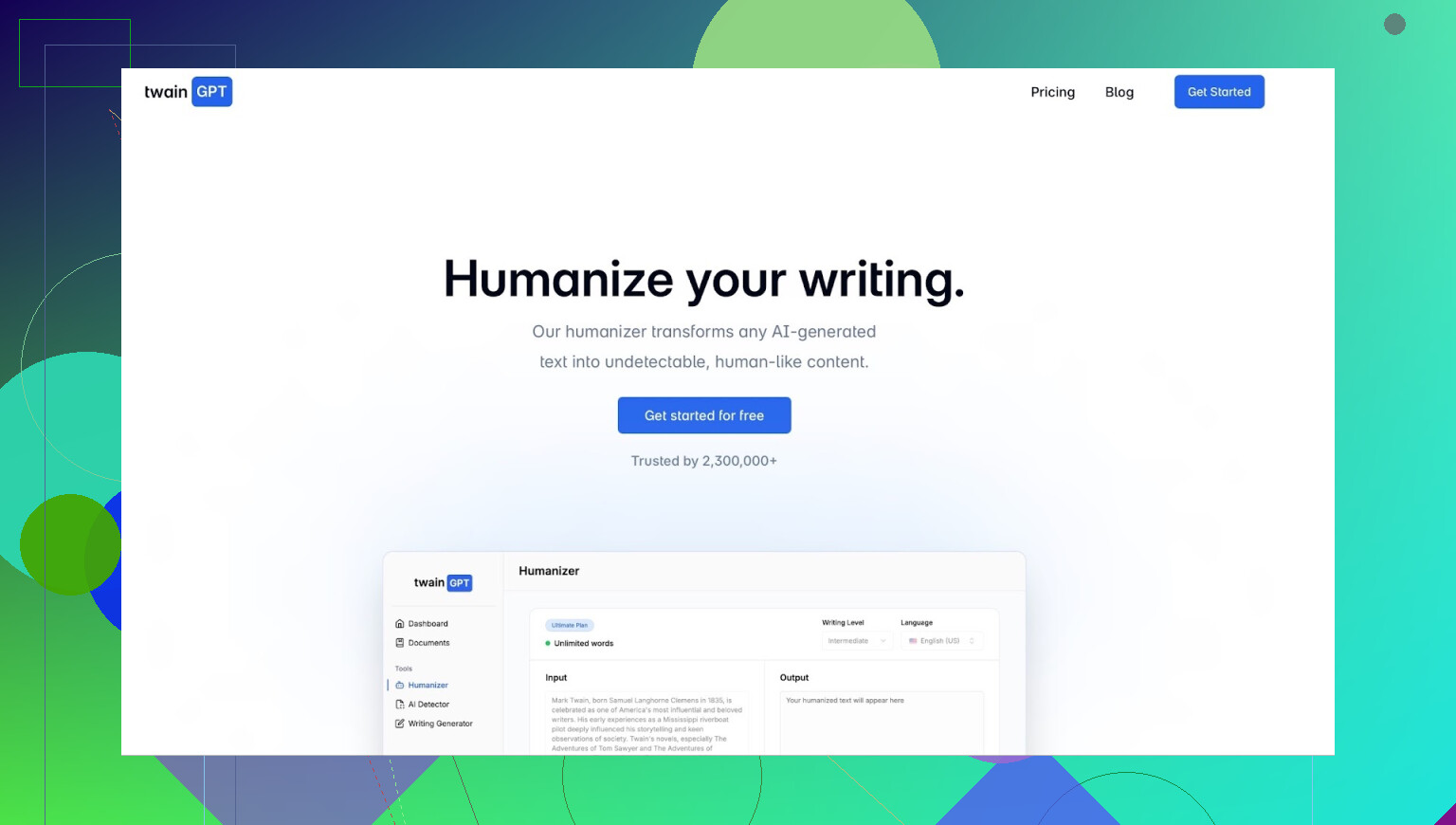
I ended up down the rabbit hole of “AI humanizer” tools and figured I’d share what actually happened when I tested Twain GPT against one of the better-known free options, Clever AI Humanizer.
Spoiler: the marketing and the reality are not on speaking terms.
What Twain GPT Says It Is
Twain GPT presents itself like some top-shelf AI text “stealth mode” tool. Search for AI humanizers and it pops up everywhere with ads, promising:
- Premium rewriting
- Bypass for “advanced detectors”
- The “ultimate” fix for AI-written content
On paper, it’s supposed to take something obviously written by an AI and turn it into text that passes detectors as human.
In practice, it behaved more like a clunky paraphraser with a subscription page stapled to the front.
Pricing vs Reality
The first red flag was how fast it tried to get me on a paid plan.
- Limited word counts out of the gate
- Aggressive upsell screens
- Subscription tiers that aren’t cheap
- Hints of “gotcha” around cancellation that felt sketchy
Meanwhile, you have tools like Clever AI Humanizer that are actually free to use and give you plenty of room to test without being nagged every 3 clicks.
Simple comparison:
-
Twain GPT
- Paid monthly plans
- Tight word limits
- Not-transparent cancellation flow
-
Clever AI Humanizer
- Free
- Up to 200,000 words per month
- Up to 7,000 words in a single run
If one tool locks you into subscriptions while doing less, and the other lets you hammer it with big chunks of text for free, it’s pretty obvious which has better value. I’m not against paying for software, but there has to be a reason it deserves the money. I didn’t see it here.
How I Tested It
I grabbed a basic essay generated by ChatGPT. No tricks, nothing edited. Every detector I ran it through originally tagged it as straight-up AI.
Then I did two passes:
- Ran the essay through Twain GPT
- Ran the same original essay through Clever AI Humanizer from https://aihumanizer.net/
After each pass, I checked the outputs using:
- GPTZero
- ZeroGPT
- Turnitin
- Copyleaks
So this wasn’t “vibes-based” testing. I ran the same source text, changed by two different tools, into the same detectors.
The Results
Here’s how it shook out:
| Detector | Twain GPT Result | Clever AI Humanizer Result |
|---|---|---|
| GPTZero |  100% AI 100% AI |
 Marked as Human Marked as Human |
| ZeroGPT | 100% AI |
Marked as Human |
| Turnitin | 89% AI |
Marked as Human |
| Copyleaks | Failed as AI-generated |
Marked as Human |
| Overall | DETECTED | UNDETECTED |
Twain GPT basically just lost at every checkpoint. It did change the text a bit, but not in a way that fooled any detector I tried. The rewritten version still lit up as AI with high confidence across the board.
Clever AI Humanizer, using the same base essay, cleared all the detectors I used in this test.
So Is Twain GPT “The Worst”?
I can’t say it is the absolute worst in existence, because I haven’t tried every scammy AI humanizer out there, but:
- It charges like a premium tool
- It caps your usage aggressively
- It did not beat the detectors in my tests
- A free alternative did significantly better using the same input
That combo alone makes it a hard pass for me.
If you want to experiment with humanization tools yourself, I’d start with something like Clever AI Humanizer here:
https://aihumanizer.net/
At least there you’re not paying just to find out it doesn’t work.
4 Likes
Yeah, Twain GPT absolutely can mess up grammar and tone, and not just in a “tiny typo” way. Tools like that usually do three things that profs pick up on instantly:
-
Over-smoothing the language
It tries to “fix” your text by making everything sound super generic and flat. You end up with:- Repeated sentence structures
- Overuse of vague connectors like “moreover,” “furthermore,” “in conclusion”
- Phrases that sound ok individually but robotic in sequence
To a detector and a human, that reads like AI all over it.
-
Breaking the natural rhythm of your own voice
Your real writing has quirks: certain words you favor, how you transition, how you hedge (“I think,” “it seems,” etc.). Twain GPT doesn’t know your style, so it overwrites it with a templated tone. That mismatch is exactly what some professors flag as “AI-generated” even without a detector. -
Subtle grammar weirdness
Ironically, these “humanizer” tools try so hard to avoid AI patterns that they:- Insert clunky clauses: “In some ways, it can be seen as being something that…”
- Mix formal and casual tone in the same paragraph
- Mess with article and preposition use (“in the another way,” “on the both sides”)
That might be what your prof is feeling when they say the grammar is “off” even if nothing is blatantly wrong.
I read what @mikeappsreviewer wrote, and while I agree Twain GPT looks overhyped, I wouldn’t rely on any humanizer as a magic “undetectable” button, even something like Clever AI Humanizer that performed better in their tests. Detectors change, profs change rubrics, and your writing style is the one constant you can actually control.
If you want to salvage your essay, here’s what I’d do instead of running it through another tool again:
-
Recover your original draft if you can
Compare:- Your version
- The Twain GPT version
Wherever Twain changed phrasing but didn’t change the meaning, rewrite those sentences in your own words. That immediately makes it sound less AI-ish.
-
Run a “voice audit” on one paragraph
Take a paragraph and ask:- Would I actually say this out loud?
- Are there phrases I would never use in normal writing?
- Are the sentences all the same length and structure?
If yes, rewrite a few sentences to be shorter, punchier, or more casual where appropriate. Throw in 1 or 2 of your natural habits: contractions, mild hedging, specific verbs.
-
Targeted grammar cleanup, not full rewrites
Instead of feeding the whole essay back into an AI, copy 1–2 ugly sentences at a time into a grammar checker and ask specifically: “Fix grammar only, keep tone.” That reduces the chance of it flattening your style again. -
Add “you-specific” fingerprints
Professors notice:- Specific examples tied to class readings, lectures, or in-class discussions
- References to things your class actually did
- Small asides like “as we discussed in class” or “this mirrors the example from week three”
AI tools rarely add that kind of course-specific context, and it makes your essay sound like it came from a real person who was actually present.
-
Talk to your professor proactively
Something as simple as:“I used an online tool to help with editing and I think it may have messed with the tone. Could I revise this and resubmit? I want the work to reflect my actual writing.”
Most profs are more forgiving when you admit you over-edited than when they feel you tried to sneak AI past them.
On the humanizer topic generally: if you’re going to touch AI for essays at all, use it like a spellcheck on steroids, not a ghostwriter. Generate ideas, outlines, or grammar suggestions, but always rewrite the final text in your own words.
Clever AI Humanizer, which @mikeappsreviewer tested, looks more effective at avoiding detection than Twain GPT, but that doesn’t mean it will fix the core problem you’re dealing with here: your professor isn’t just reacting to detectors, they’re reacting to voice and coherence. No tool can fake “you” as well as you can, even if it slips past GPTZero.
Short version:
- Yes, Twain GPT could absolutely be why your essay feels off.
- Roll it back toward your original voice.
- Use tools surgically, not as full rewrites.
- Add class-specific details and your own phrasing to re-humanize the draft.
Yeah, Twain GPT can absolutely be the reason your essay feels “off,” but probably not in the way the marketing promised.
What it tends to do (and you’re seeing this firsthand) is:
- Flatten your voice into a kind of bland, pseudo-academic tone
- Introduce awkward phrasing that’s technically grammatical but unnatural
- Create a mismatch between your usual writing level and the suddenly “polished” but weird-sounding sentences
Your professor doesn’t need a detector for that. They read dozens of your classmates’ essays. When one suddenly sounds like it was written by a committee of tired robots, it sticks out.
I agree with a lot of what @mikeappsreviewer and @codecrafter said, especially about Twain feeling more like an overpriced paraphraser than a serious tool, and about how “AI humanizers” are not magic cloaks. Where I’d push back slightly is on the idea that the main issue is just detection. In your case, the bigger problem is stylistic coherence.
Detectors might say “AI,” but profs usually think:
- The grammar is too smoothed in some parts and strangely clunky in others
- Vocabulary jumps around in a way that doesn’t match a single human brain
- The argument feels like it’s being re-told, not originally developed
That last point is exactly what happens when something like Twain GPT rewrites your work at the sentence level without understanding your actual thinking process.
Instead of redoing the same “compare and rewrite” steps already suggested, I’d come at it from a slightly different angle:
-
Check for “tone cliffs”
Read your essay out loud and mark where the tone suddenly shifts. Those spots are usually where Twain did the heaviest lifting. Focus your edits there first. If one paragraph sounds like you and the next like a stiff textbook, that contrast screams AI to a prof. -
Look for Franken-sentences
Twain-type tools love weird hybrids like:
“In conclusion, it can arguably be stated that this illustrates how society is in many aspects.”
If a sentence feels like three half-thoughts welded together, kill it and rewrite from scratch. Don’t “fix” it. Replace it. -
Dial the formality to match you
If you normally write:
“This shows how people reacted to the change.”
and now it says:
“This phenomenon effectively demonstrates how individuals responded to the aforementioned transformation.”
cut it down. Overly “fancy” phrasing is a classic AI tell when it appears randomly across your draft. -
Rebuild a few key paragraphs from the ground up
Take your intro and one body paragraph and rewrite them without looking at Twain’s version. Just from memory and your understanding of the topic. Then compare. If your own version feels more direct, more you, and easier to read, that’s what your prof wants. -
Own what tool you used if asked
If your professor is already suspicious, trying to cover it up usually makes it worse. You can say something like:
“I used Twain GPT thinking it would help with editing, but I realize it altered the tone and grammar in ways I didn’t intend. I’m revising it to reflect my own writing.”
That frames it as a bad editing choice, not pure outsourcing.
On tools: if you still want some help, use AI more like a scalpel than a blender. For example:
- Copy a single sentence that feels clumsy
- Ask an AI: “Improve grammar only, keep it simple, no change in meaning”
- Then tweak the result so it sounds like you again
If you’re going to experiment with AI humanizers at all, Clever AI Humanizer is objectively more competent at avoiding AI flags than Twain GPT based on testing people have posted. Just remember: even the best AI detection bypass will not fix a voice mismatch with your professor’s mental model of how you write. It might help with automated checks, but it won’t magically repair tone issues Twain already introduced.
Bottom line:
Twain didn’t just weaken your grammar, it probably scrambled your voice. Your best move is not to throw another “humanizer” at it, but to manually re-humanize it: cut the Franken-sentences, lower the fake formality, and reconnect the essay to how you actually think and write.