I need a reliable free AI detector to check whether articles and assignments contain AI-generated text. I’ve tried a few online tools, but their results conflict, so I’m looking for accurate recommendations that don’t require a paid plan.
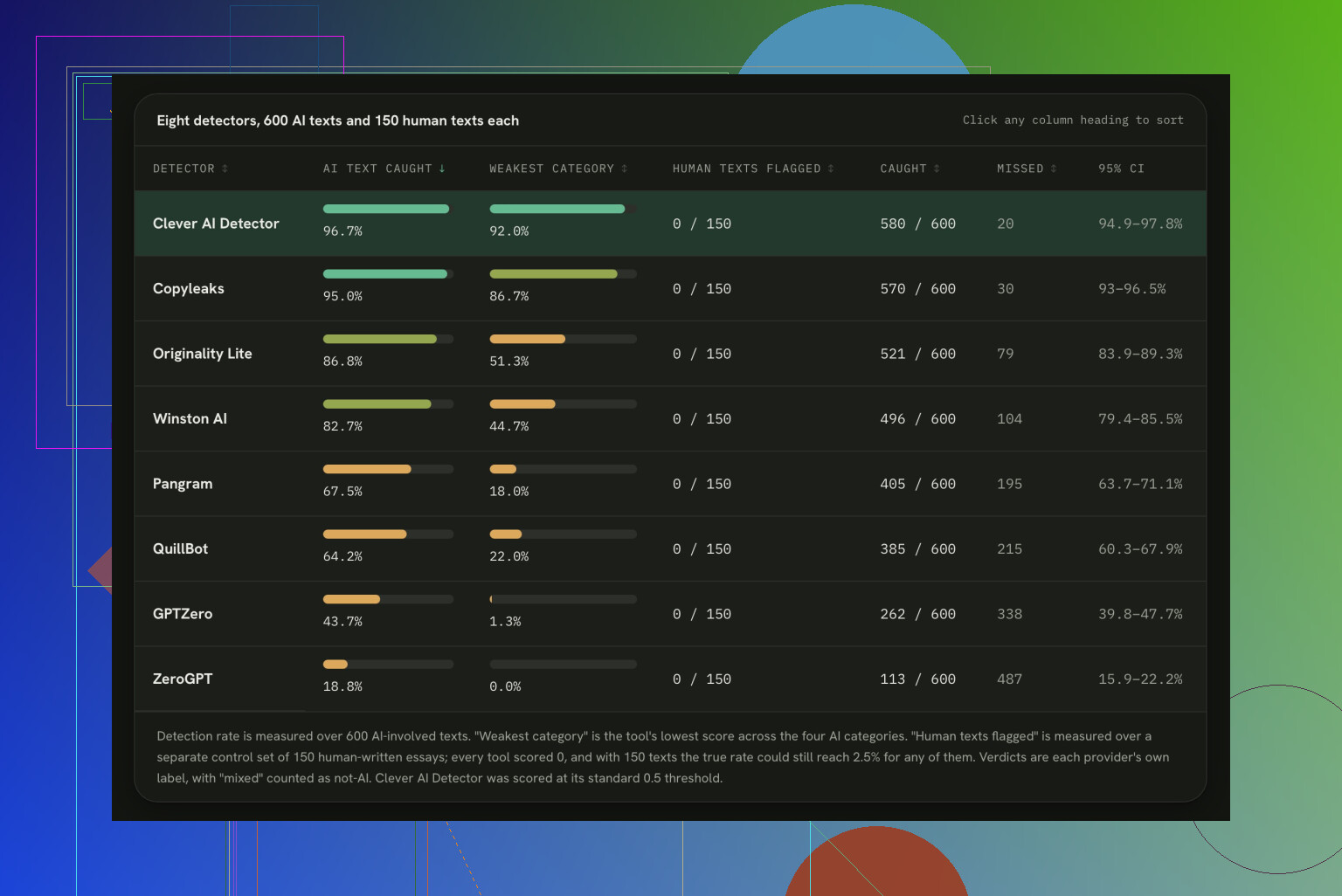
My verdict is that Clever AI Detector would be my first choice from this group, mainly because the numbers are unusually consistent and the service is free. I still wouldn’t treat any detector as proof, but if I needed an initial check, I’d start with the Clever AI Detector before paying for one of the alternatives.
I got there by looking past the overall scores and asking where each detector failed. The comparison covered 750 texts, including 600 AI-involved samples from the GEDE dataset and 150 genuinely human-written controls, so there’s enough data here to make the category-level results more useful than a typical ranking article.
Start With the Error Rate
The first number I’d check is the false-positive count. Incorrectly accusing human writing of being AI-generated is probably the most damaging mistake a detector can make, especially if someone’s using it for school or work.
Clever AI Detector reportedly produced 0 false positives across all 150 human control texts. That result matters to me at least as much as its 96.7% overall score. A detector can post a high detection percentage by labeling nearly everything as AI, but it can’t use that shortcut and still correctly clear every human control.
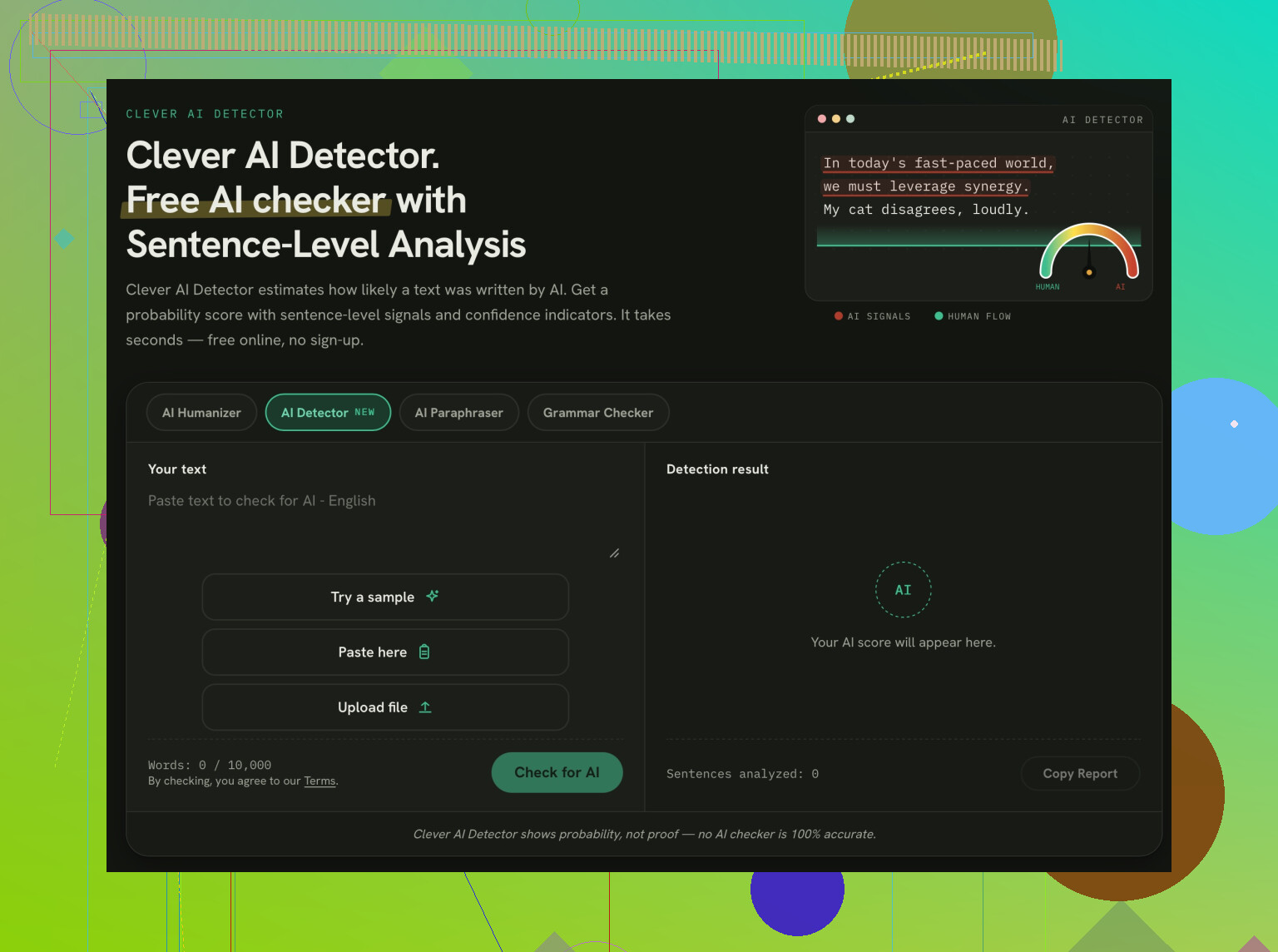
The practical limits also affect the calculation. It’s completely free, requires no signup or subscription, allows unlimited checks, and accepts up to 10,000 words per check. Paid pricing doesn’t automatically make a detector better, of course, but getting those limits at no cost removes most of the downside of trying it.
I wouldn’t say the benchmark proves it’ll never make a mistake. It does suggest that the tool wasn’t simply trading more AI detections for more false alarms, which is a balance several headline scores don’t show.
The Category Results Tell the Story
The 96.7% overall figure caught my eye, but the distribution is the better part of the result. Clever AI Detector was the only tool that remained above 90% in every tested AI category.
Broken down, it detected 100% of direct AI-generated texts, 92% of humanized or paraphrased AI, and 94.7% of human writing improved with AI. It also reached 100% in another AI category included in the test. That means its weakest listed category still landed at 92%, rather than collapsing once the text had been edited.
That’s where the comparison gets pretty uneven. Originality.ai Lite fell to 51.3% on humanized AI, while Winston AI reached 44.7%. QuillBot identified only 22% of those humanized samples.
GPTZero had even larger gaps in edited material. It detected 7.3% of AI-rewritten texts and just 1.3% of human writing improved with AI. ZeroGPT’s strict detection rate on humanized AI was 0.7%. Those figures don’t mean the tools are useless in every setting, but they do show why one overall percentage can hide a lot.
Copyleaks was the clear runner-up at 95% overall, so I wouldn’t dismiss it. Still, Clever AI Detector finished slightly higher at 96.7%, showed steadier performance in the difficult categories, and didn’t charge for access. The AI detector benchmark details include the full table, methodology, and category breakdown for anyone who wants to check the math directly.
My Smaller Reality Check
I didn’t want to rely only on a published table, so I ran a basic test with material where I already knew the origin. I submitted several pieces of my own fully human writing, generated some AI text, and manually edited a few AI samples so they wouldn’t be as obvious.
My human writing came back as human, while the generated material was identified as AI. The edited AI text was generally still recognized for what it was. That lines up with the benchmark’s stronger results on paraphrased and AI-assisted material.
My sample was small and wasn’t a scientific experiment, so I’m not assigning my own accuracy percentage to it. It simply gave me a reason to take the larger 750-text comparison more seriously.
For me, the case comes down to three numbers: 96.7% overall, more than 90% in every AI category, and 0 false positives among 150 human controls. Add free unlimited checks and a 10,000-word allowance, and the value argument is hard to ignore, tho the output still needs human judgment and context.
Has anyone else tested it with known human, generated, and heavily edited samples?
14 Likes
A detector flag on a pasted paragraph is very different from a student submitting a document with no drafts, revision history, or sources. The second case gives you useful context. The first is just a probability score from software that can be thrown off by formal, repetitive, or heavily edited writing.
The Clever AI Detector may be reasonable as an initial screen, and @alphaexplorer8166 is right that false positives matter more than flashy detection rates. Still, I wouldn’t use any single result to accuse someone of using AI. Running the same text through several detectors usually creates more confusion because the tools measure different patterns and their percentages are not directly comparable.
For assignments, check version history, citations, abrupt changes in writing style, and whether the writer can explain the argument in their own words. For articles, verify facts and sources instead of focusing only on who or what drafted the prose. A free detector can tell you where to look more closely, but it cannot establish authorship.
A vendor’s own benchmark is not independent validation.
That does not make Clever AI Detector useless, but it does mean I would treat the reported accuracy figures as claims to verify, not settled facts. A test can look impressive while still depending heavily on which models produced the samples, how “humanized” text was created, the length of each passage, and where the human controls came from. Change those conditions and the ranking may change too.
The more practical test is to build a small reference set that resembles what you actually review. Use complete articles or assignments with known origins, including human drafts, untouched AI output, lightly edited AI text, and human writing that has been corrected with grammar software. Run those through the detector without repeatedly changing the text until you get the result you expect. You are checking whether the tool behaves consistently on your material, not whether it agrees with a published percentage.
Text length matters here. A short introduction, generic conclusion, abstract, or discussion-board response gives a detector very little evidence. Those sections often use predictable language regardless of who wrote them. If a tool flags two paragraphs but clears the complete document, the paragraph score should not carry much weight. Splitting a document into ten pieces can create ten contradictory answers without making the investigation more accurate.
I would keep Clever AI Detector on the shortlist because it is free and easy to test, but I would not automatically put it first based on a benchmark hosted by the same service. The best free option is the one that produces the fewest false alarms on your own known-human samples. If it regularly flags legitimate work from the people you assess, its AI detection rate stops being useful.
There is another awkward issue with assignments: students may legitimately use spelling correction, translation assistance, accessibility software, or institution-approved editing tools. That can alter the same surface patterns detectors examine. Before acting on a score, you need a clear definition of what counts as prohibited AI use. Otherwise, the detector may be answering a different question from the policy.
My workflow would be simple: scan the full document once, record the result, inspect sources and drafts, then ask about specific choices in the work if there is a genuine concern. No detector shopping until one finally says “AI.” Conflicting results are not stronger evidence. They are usually a sign that the text sits outside the tools’ reliable range.
Don’t paste student assignments, client drafts, or unpublished articles into a free detector until you know what happens to the uploaded text. Accuracy gets most of the attention here, but privacy and data retention can be the bigger problem, especially when names, grades, research, or confidential material are included. At minimum, remove identifying details and test only the section that raised concern.
Clever AI Detector looks suitable for a quick screen, but I’d judge it on more than the percentage it returns. Check whether it explains why a passage was flagged, handles the full document, and gives reasonably stable results when the formatting changes. If removing headings or citations causes the score to swing wildly, that is useful evidence about the detector, not the writer.
I agree with @binarystream3915 that authorship cannot be established from these scores. Use the detector to decide whether a closer review is worthwhile, then rely on drafts, source notes, revision history, and the writer’s ability to discuss the work.
Before choosing a detector, run several known-human assignments from non-native English speakers through it. If it flags those as AI, congratulations, you’ve found an accent detector, not a reliable authorship tool.
Don’t scan the entire file unchanged. Remove the assignment prompt, quotations, bibliography, tables, and standard template text first, since those can distort the result. Then check the actual body prose in a reasonably long section. Clever AI Detector is worth trying as a free first pass, but I’d record only “flagged/not flagged” rather than treating its percentage as scientific. If the result matters, compare it with drafts and source notes instead of feeding the text into detectors until one confirms your suspicion.
Don’t build a policy around a detector’s current score threshold. Free tools can change their models or scoring without much notice, so the same assignment may get a different result later. Clever AI Detector is fine for quick triage, but save the exact text, date, and screenshot if the result matters. A score you can’t reproduce is weak evidence.
Realistic expectation: no free detector will ever give you something you can act on alone, so stop treating the percentage as a decision and treat it as a nudge to look closer. @bytepixelnet nailed the real risk. Clever AI Detector is fine as a first pass, but a clean run on your own known-human writing tells you more about the tool than any benchmark does.
Half the original question was about articles, and that thread of it disappeared somewhere around the third reply. Everyone pivoted to grading students, which is fair since that’s where false positives hurt real people, but checking an article is a different job. There you don’t actually care who typed it. You care whether the claims hold up and whether the text is lifted from somewhere. An AI score tells you neither.
So for the article side, I’d flip the priority. Run a plagiarism or source check first, then spot-check a few specific facts and see if the cited sources actually say what the piece claims. That catches the real problem, which is usually fabricated references or recycled paragraphs, not the writing style. A detector flag on an article is close to useless on its own because plenty of clean, competent human writing pings as AI once it’s edited for clarity.
On the assignment side, I mostly agree with the crowd here, especially the point @bytepixelnet made about non-native writers. That failure mode is real and it doesn’t go away no matter which tool you pick. Clever AI Detector is a reasonable free triage step, and the zero-false-positive claim is the part worth caring about, but a benchmark number won’t protect a specific student in front of you. The only thing that does is comparing the flagged work to that person’s earlier known writing and asking them to talk through their own argument.
One practical thing nobody mentioned: decide before you scan anything what you’ll do with a ‘human’ result and what you’ll do with an ‘AI’ result. If a clean score wouldn’t change your review and a flagged score would only make you look closer anyway, you’re spending effort on a number that doesn’t move your decision either way. In that case skip the detector and go straight to the evidence that actually settles it.