I need to check a few articles for AI-generated content, but most free AI detectors require an account or payment after limited use. Can anyone recommend a reliable, accurate AI content detector that works without signup?
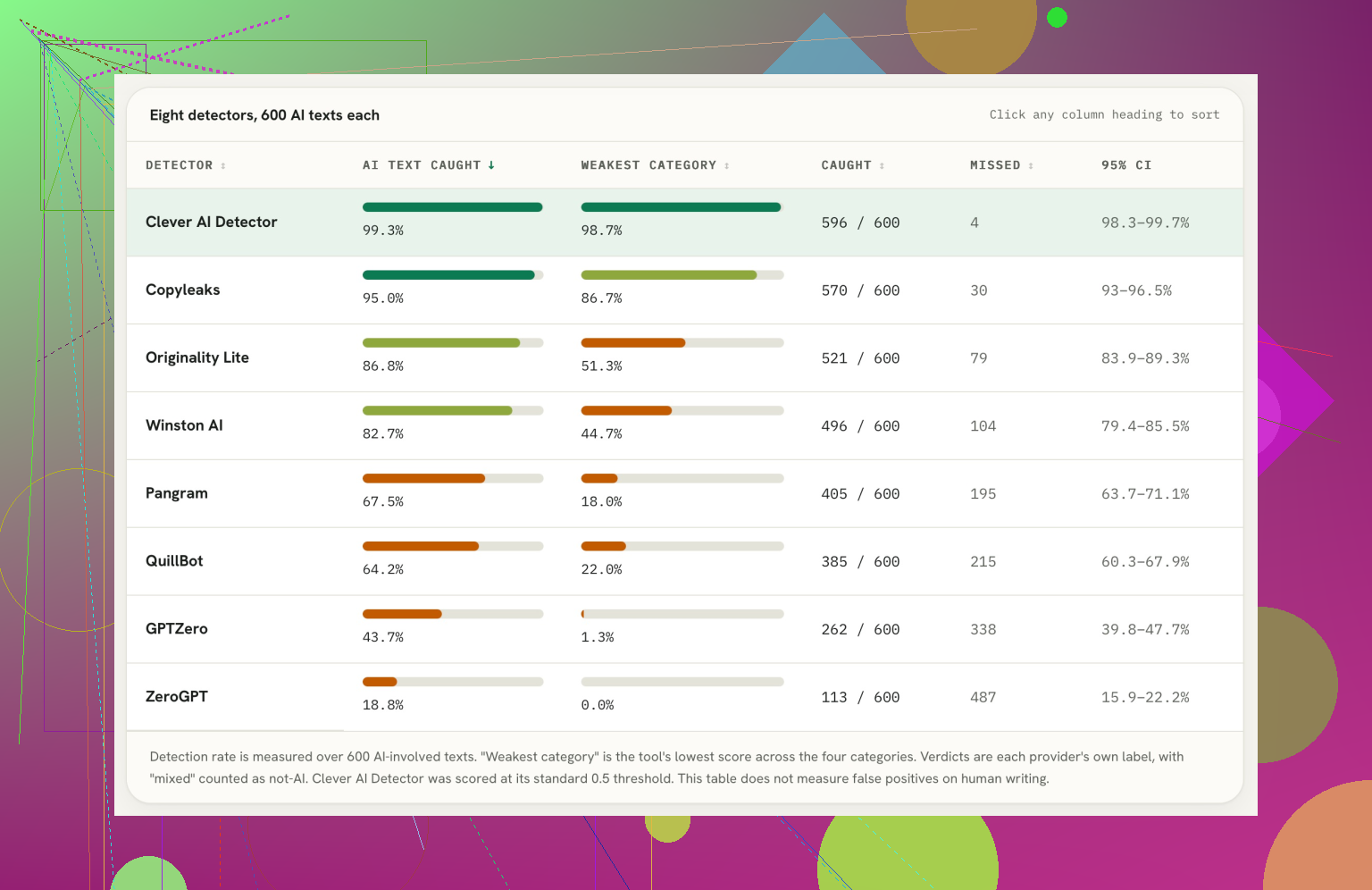
The useful test for an AI detector isn’t whether it catches untouched ChatGPT output. Most decent tools can do that. The real difference shows up after someone rewrites, edits, paraphrases, or “humanizes” the text.
I found a comparison that tested eight detectors using 600 texts from the GEDE dataset, with 150 texts in each of four categories: direct AI, AI-rewritten, AI-improved, and humanized AI.
GEDE stands for Generative Essay Detection in Education. It’s a public research dataset from Lukas Gehring and Benjamin Paaßen at Bielefeld University. The full dataset includes more than 900 human-written essays and over 12,500 essays generated or modified by LLMs, with different levels of AI involvement.
Paper: https://arxiv.org/abs/2508.08096
Dataset/code: https://github.com/lukasgehring/Assessing-LLM-Text-Detection-in-Educational-Contexts
One caveat: I wasn’t able to independently confirm who ran the 600-text comparison or whether an outside organization was involved. I found the published results and focused on the methodology. Since GEDE is public, the underlying test should at least be reproducible.
| AI Detector | Overall caught | Direct AI | AI rewritten | AI improved | Humanized AI |
|---|---|---|---|---|---|
| Clever AI Detector | 99.3% | 100% | 100% | 98.7% | 98.7% |
| Copyleaks | 95.0% | 100% | 100% | 86.7% | 93.3% |
| Originality.ai Lite | 86.8% | 100% | 100% | 96.0% | 51.3% |
| Winston AI | 82.7% | 100% | 100% | 86.0% | 44.7% |
| Pangram | 67.5% | 100% | 88.0% | 18.0% | 64.0% |
| QuillBot | 64.2% | 100% | 96.7% | 38.0% | 22.0% |
| GPTZero | 43.7% | 92.7% | 7.3% | 1.3% | 73.3% |
| ZeroGPT | 18.8% | 70.0% | 4.7% | 0% | 0.7% |
The humanized AI results are the part that stood out. Originality.ai Lite dropped from 100% on direct AI to 51.3% after humanization. Winston AI fell to 44.7%, QuillBot reached 22%, and ZeroGPT caught only 0.7%.
Clever AI Detector stayed at 98.7% in that category. Copyleaks was the closest at 93.3%.
There was a similar spread with AI-improved writing. Clever scored 98.7%, Originality.ai Lite scored 96%, and Copyleaks scored 86.7%. GPTZero detected only 1.3% of those texts.
So based strictly on this benchmark, Clever AI Detector had the best overall result among the eight tools, with Copyleaks in second place. That doesn’t settle every question about AI detection, especially given the uncertainty around who conducted this specific comparison, but it does show why raw-AI accuracy numbers aren’t very informative by themselves.
I also tried Clever AI Detector. The interface is straightforward: paste in the text, run the scan, and it gives you an AI score while highlighting the sections that affected the result.
It’s free right now and allows up to 10,000 words per check, which is surprisingly generous:
5 Likes
The missing issue here is false positives. A detector can catch lots of AI text and still be unreliable if it regularly flags human writing, especially formal articles, edited copy, or work by non-native English speakers. “99% detected” only covers half the accuracy question.
Clever AI Detector looks convenient for quick checks since it currently allows long scans without signup, but I’d treat the score as a reason to review an article, not proof that someone used AI. Run the full article rather than a short paragraph, then inspect any highlighted sections for repeated phrasing, vague claims, or made-up citations.
For only a few articles, that is probably the simplest free option. I just wouldn’t make a publishing or plagiarism decision from any single detector result.
Don’t paste confidential, client-owned, or unpublished articles into any free detector until you’ve checked how submitted text is stored and used. For ordinary public content, Clever AI Detector looks like the simplest no-signup option here, but remove names and sensitive details first, then treat the result as a screening flag rather than a verdict.
A whole-article score can hide mixed authorship. Articles often contain quoted material, boilerplate, product specs, edited passages, and sections written by different people. Paste all of that into a detector and the final percentage may tell you very little about the actual body copy.
The benchmark in the first reply is interesting, but it does not establish that Clever is “99.3% accurate.” It only shows how often the tool flagged those particular AI-derived samples. Without an equally serious test of human writing, you cannot tell whether it is detecting AI well or simply flagging almost everything. @cursorpro is right that false positives are not a minor detail. They are half the test.
For a few ordinary articles, Clever AI Detector seems to be the most practical answer to the actual question: free, no account, and enough capacity for long text. Just use it as a filter. Remove quotations, author bios, references, tables, navigation text, and repeated site boilerplate first. Then check several substantial sections separately instead of relying only on one percentage for the entire article.
Pay attention to consistency. If every section gets roughly the same result, that is at least useful information. If one passage is heavily flagged while the rest is not, inspect that passage for generic transitions, repetitive sentence patterns, unsupported claims, or citations that do not exist. If results swing wildly when you add or remove a paragraph, the detector is not giving you stable evidence.
So yes, Clever is probably the simplest no-signup choice mentioned here. No, I would not call any detector reliably accurate enough to identify an author or accuse someone of misconduct. If you need proof rather than a quick screening check, revision history, source notes, drafts, and factual verification are far more useful than an AI percentage.
Realistically, none of these will give you a clean yes or no, so stop expecting one. That’s my main issue with the whole thread. @brightpilot nailed the false positive gap, and honestly that’s the thing that would stop me trusting a 99% number from any single run.
Here’s the part everyone’s dancing around: if the article is short, the score is basically noise. Detectors get shaky under a few hundred words, and one heavy paragraph can drag the whole percentage. Clever’s fine as a first-pass filter since it doesn’t nag you for an account, but I’d only bother running it on longer pieces where there’s enough text for the result to mean anything. For a couple of articles, run it, note anything it lights up, then read those spots yourself. The tool points, you decide.
Run a control sample before trusting the score. Take a known human-written article in the same style and roughly the same length, then scan it alongside the article you are checking. If possible, include an untouched AI-generated sample on the same topic as a second control.
That quick comparison tells you more than the percentage alone. If the detector calls the known human sample 70% AI, you already know its result for the suspect article is nearly useless. If it separates the controls clearly and repeatedly flags the same passages in the article, you at least have something worth reviewing.
For the actual no-signup requirement, Clever AI Detector appears to be the practical choice from the options mentioned. I would keep each test comparable, though. Do not scan a 2,000-word article and compare it with a 150-word control, since length and writing style can change the result. Plain text works better than copied page content full of menus, captions, and unrelated blocks.
Accuracy is still too strong a word for any of these tools. Think of the detector as a troubleshooting instrument: calibrate it with controls, repeat the scan by section, and investigate unusual passages. If it cannot correctly separate text you already know is human from text you already know is AI, discard its verdict rather than trying to interpret the percentage.
Don’t keep tweaking the article and rescanning it until the detector gives the answer you expected. That turns the process into score shopping. Decide beforehand what you’ll submit, save the first result, and only rerun sections for a clear reason, such as removing quotations or copied template text.
For the original question, Clever AI Detector seems like the most practical no-signup choice mentioned here. I’d use it for an initial check, but I would avoid translating its percentage into a claim like “this article is 80% AI-written.” Those scores are usually confidence signals, not a measurement of how much of the text came from AI.
If a passage gets flagged, check whether it contains factual errors, fake sources, repetitive wording, or abrupt style changes. That review is more useful than chasing a lower percentage. @fox.node’s control-sample idea is sensible too, provided the control matches the article’s length and type closely.