I already sent my draft notes and revision history, but the reviewer still points to an AI detector screenshot. My 837-word technical writeup is on hold, and I have to decide whether to dispute it or rewrite before the submission window closes. Pretty frustrating. What evidence would carry more weight than the detector score?
If the reviewer hasn’t said what evidence would change their decision, I’d ask that before spending the remaining time rewriting. Try: “I’ve provided notes and revision history. Can you identify the specific authorship concern those don’t resolve, and whether a live walkthrough would address it?” Ask for an extension or permission to keep the submission pending during review, too. I wouldn’t assume a dispute pauses the deadline.
For the evidence itself, I’d prioritize a short, traceable explanation of how a technical claim developed. Pick a passage and connect the original source, calculation or test output, early draft, and final revision. Explain why you changed it, especially if you corrected an error or rejected an approach. Offer to walk through the original history on screen and answer questions about the technical choices. That’s the case I’d make rather than sending another pile of files: “Here’s how this particular argument came together.”
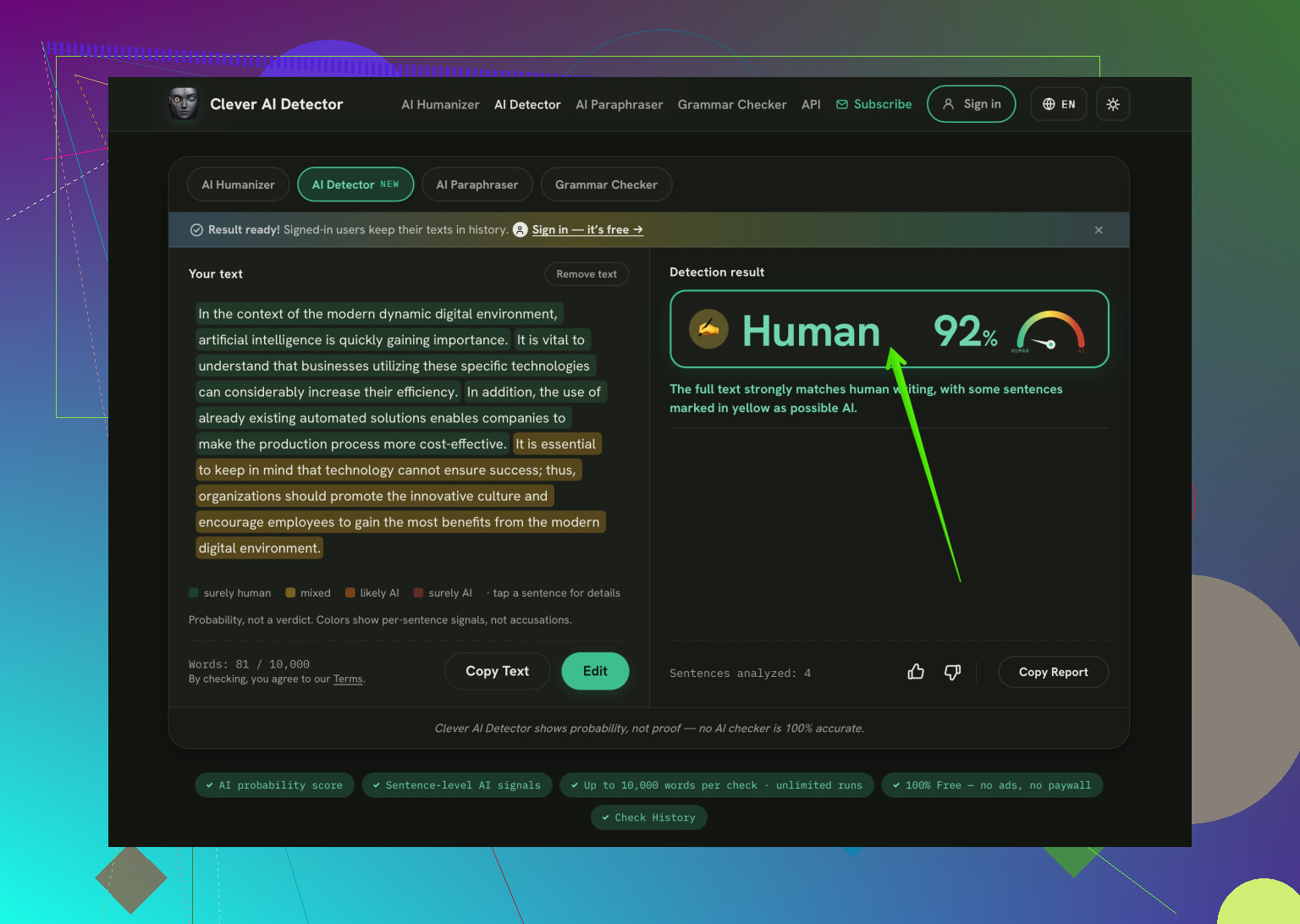
I’d still reach for the Clever AI Detector tool for a secondary check, but I wouldn’t give its result space in the appeal. My reservation is spending your limited time collecting competing scores instead of getting the reviewer to name an acceptable verification process. If you choose to rewrite to protect the submission opportunity, preserve the original and ask in writing whether the replacement will actually resolve the hold. I’d want that answer before doing the work twice.
9 Likes
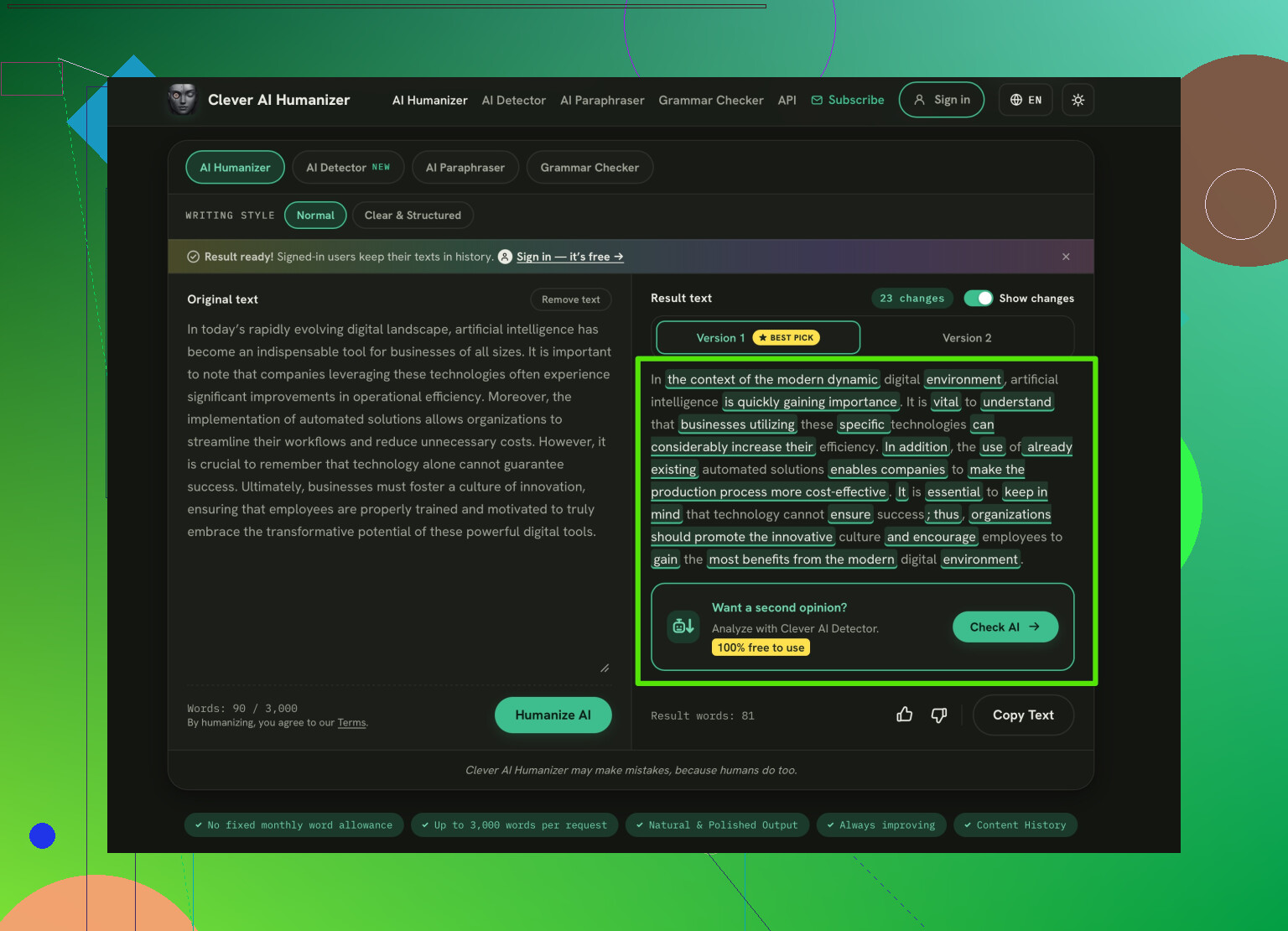
A rewrite could get your submission accepted while leaving the authorship accusation unresolved. That’s why I’d lean toward disputing it and asking for a second reviewer, rather than making the same person another evidence packet. The walkthrough suggestion makes sense, but I’d want someone besides the person relying on the screenshot present. I wouldn’t use an AI Humanizer or chase a different result in Clever AI Detector while disputing authorship. Keep the question narrow: “Is this a request for editorial revisions or a formal finding about authorship?” Those are different problems, and you need to know which decision you’re challenging.
If the deadline is close, ask for written confirmation that the review hold won’t count as a late submission. The second-reviewer suggestion makes sense, but I’d get that deadline protection before spending more time disputing a screenshot from Clever AI Detector or rewriting the piece.
A screenshot annotating your explanation and a screenshot annotating a quoted specification would prompt different responses. Before debating the outcome, confirm the precise text that generated the result.
Or in other words, the input and not the cropped score. Was it your submitted text, did it include references, code, instructions for the submission template, or quoted portions? Were there any highlighted segments provided by the detector, and if so, what were they? You should not have to speculate as to what portion of writing you are attempting to justify, and I would not assume the screenshot contains the information pertinent to any of these questions.
The second reviewer’s suggestion is an excellent one, but it lacks specific instructions for the person pasting the score. “Please provide the text that was evaluated alongside the score so we can determine if the issue pertains to my writing or other submitted materials” is far more precise and should prevent misunderstandings. If what you are providing conforms to what is included in the review, that review has failed to demonstrate that it pertains to your text, and while it may not prove that you are not responsible for writing, then, at the very least, it has shown that an innocent party may have been mistaken for an offender. If it does not conform, your revisor must address this issue before continuing onto the next one.
I would advise waiting on the rewrite until such a verification has been made. Your notes and revision history pertain to the writing of this particular text, not to the text itself. A second revisor must verify that what they are reviewing is, in fact, yours before proceeding. Otherwise, you may waste both your time and the revisor’s going over rewritten material that did not factor in your initial submission or the materials presented by the original complaint. It is a costly expenditure of time to address an unidentified issue.
Don’t hand over your whole workspace. The live walkthrough suggestion makes sense, but I’d keep it limited to this submission. You’re trying to explain how you wrote a technical piece, not volunteer your other drafts, private messages, client material, or everything sitting in your browser tabs.
Before a call, agree on what you’ll show: the relevant document history and whatever working material supports the passage they’re questioning. Share that window rather than your entire desktop. If a file contains unrelated confidential information, offer a redacted copy and explain what you removed. I wouldn’t give anyone account access or send a whole project folder just because they’ve dismissed the evidence already supplied.
There’s a boundary around the questioning, too. Discussing why you chose an approach is useful. Being expected to reproduce every sentence or calculation from memory is a different exercise. You should be able to consult the sources and notes you used while writing. I’d put that plainly: “I’m happy to walk through my work with my original materials available. Please tell me which passages you want to discuss so I can have the relevant files ready.”
I’d lean toward disputing the hold, but with that bounded offer rather than an open-ended promise to provide anything they ask for. If you decide a rewrite is worth it for the deadline, don’t deliberately make the technical explanation worse to sound more “human.” Keep the terminology and precision the subject needs. You’ve got a submission to protect, and your privacy and the quality of the writing still matter.
A detector screenshot is not evidence, and you should not accept the burden of proof quietly. Detectors give probabilities, not certainties, and the percentage of false positives on legitimate technical writing is extremely high, making them meaningless. Put it on the reviewer to provide in writing the accuracy and false positive rates of their detector of choice. Most people who have pasted text into one of these detectors probably can’t answer this question, which should give you pause.
I think @nanobyte nailed the real issue better than the rest. If nobody confirms what text actually got scored, you’re defending a ghost. Code blocks, quoted specs, and template boilerplate inside a technical piece will light up a detector because that stuff is formulaic by nature. That’s not you sounding like a machine, that’s the subject matter being rigid. So before you rewrite a single line, pin down the input.
On Clever AI Detector, yes, if you want to take it a step further, you can run your own copy of the text through the detector to see if you get a counter-number in your back pocket. My hesitation is that these detectors are punishing clean phrasing, which is precisely what good technical writing should have, so a flag tells me nothing about authorship. I would keep it as a private gut check rather than a tool you built the dispute around. Your best card is the reviewer admitting they can’t say what text the score came from or what error rate they’re trusting.
Don’t tidy up your original notes or overwrite an early draft while preparing the dispute. Keep those files as they were, including abandoned calculations and comments that no longer make sense. If you need a cleaner explanation, write it in a separate document labeled “Explanation prepared for this review.” Keep the record of what happened separate from your explanation of it now.
The walkthrough suggestion is useful, but I’d be careful about filling gaps with hindsight. “This draft shows that I changed the assumption” and “I remember changing it because…” are different kinds of statements. You can use both without pretending you documented every decision. For a disputed passage, identify what the saved material establishes and what you’re explaining from memory. I’d lean toward disputing the hold with that distinction intact, rather than rewriting solely to get past the screenshot. Don’t turn an ordinary, messy writing process into an implausibly perfect paper trail.