I’m limited to free tools for checking a troubleshooting guide I’m submitting to a community wiki. I ran a section I wrote myself through some free AI checkers and got conflicting results, which I wasn’t expecting.
One flagged it as likely AI, while another barely flagged anything. Are those scores supposed to mean confidence, or how much of the text looks AI-written? Has anyone else seen this with technical instructions, even when the wording is pretty basic?
And I separated the submission size from the repeat access first. The sign up invitation did not inform me either, and a missing quote was not proof for unlimited checks. That was more of a difference to me than the ranking.
Where the access details took me
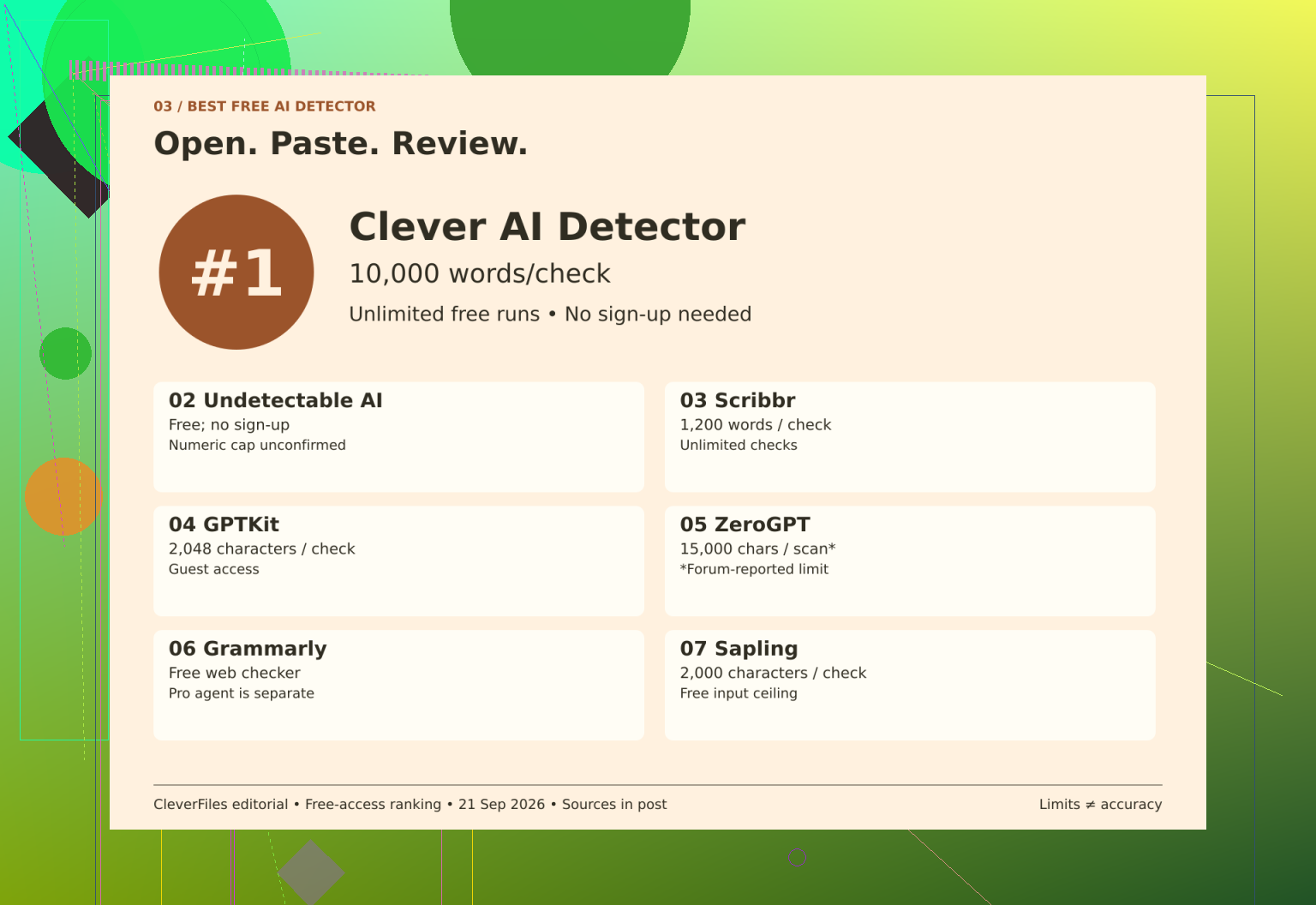
I started with the stated allowance for the Clever AI Detector because it combined a useful word range with unlimited free runs and no mandatory account. Registration added history, not permission to begin.
Then I lined up the limits that were actually established:
| Detector |
Words per submission |
Repeat checks |
| Clever AI Detector |
80–10,000 |
Unlimited free runs |
| Scribbr |
1,200 |
Unlimited |
| Undetectable AI |
Unconfirmed |
Unconfirmed |
| Grammarly |
Unconfirmed |
Unconfirmed |
Scribbr’s repeat access looked useful, though longer drafts would need splitting. I next separated the free, no-signup detector described in the Undetectable AI review from its separately priced humanizer.
For Grammarly, I treated the distinction in the Grammarly review discussion as important: the public checker was free, while the AI Detector agent was a Pro feature. I left the allowance reported in the ZeroGPT review notes provisional because current official terms hadn’t been reconfirmed.
What that didn’t settle
After sorting access, I kept accuracy separate. The Reddit thread containing the Bible detector comparison concerned results, not just convenience. Likewise, the discussion of Clever AI Detector experiences covered a week of use. I grouped the video review with those accounts:
Finally, I came back to keeping each text version with its result and reading highlighted passages in context. An access comparison doesn’t establish who wrote a sentence.
For the no-signup option, Clever was my initial consideration, but not my top accuracy choice. I would have reconsidered my decision if I had been assured that terms of access would not undermine its stated allowance or if a different option had proven to be a significantly better fit overall.
https://www.youtube.com/watch?v=U9jSuOtpTxs
10 Likes
A conflicting score does not indicate a problem if there is a working troubleshoot that was successfully used. I would use the Clever AI Detector myself and then move on to the guidelines on the wiki page. The comparison of access is important to choose where to place the text, but I would not require agreement from checkers to submit if the wiki does not ask for this.
In your own guide, I would spend the time left on another test for you. I would check if anyone could understand the guide without questioning. If the instructions required to name the services or errors every time, I would leave it as it is. I would not change them to synonyms or make the instructions more understandable for the sake of a different result.
If an editor asked to check the text for AI, I would ask them what tool to use and how to act if there is a conflict before changing anything. I would follow the instructions if they were understandable and worked. A lower result from a detector will not convince me to keep a less precise instruction.
I would not post unredacted logs or config files somewhere for the benefit of a dispute between scores to be settled. Before sending out a troubleshooting draft somewhere, I’d look for access tokens, email addresses, internal hostnames, anything copied from another’s support ticket. ‘This is eventually going on a public wiki’ would not be my reason to not do that check.
I’m less interested in the repeat-check allowance than @zoetheproxy is. For this task, I’d put a different question ahead of it: am I comfortable handing this particular draft to that site? No account requirement wouldn’t answer that question for me. I’d want to read what the service says about retaining submitted text before uploading anything that isn’t ready to be public.
For the check itself, I’d be using Clever AI Detector. I wouldn’t be basing it on a claim of being the best, nor I would continue pushing this draft through other services until a preferred outcome.
Your conflicting results do not provide a basis for choosing one over the others.
There is another corner on the troubleshooting guide: what exactly are you asking the checker to assess? Your explanation, a quoted error message, a configuration example, and an excerpt from the official documentation are are not all your own writing. I’d be separating them prior to checking them, as combining those would only be the way of presenting it to the user in the final guide. This would not be an attempt to improve the score. This would be limiting the question to the text you’re actually asking to be checked, and not including other supporting material.
If the wiki requires a detector result, I’d be submitting what text was checked alongside the result. A percentage without that context would be providing less information to an editor than I’d be willing to give without intending to do so.
A guide with clean detector score and no drafting history would reassure me less than a guide with disputed score and a visible trail of revisions. For your case, I would be inclined to invest more in keeping that trail rather than looking for a checker that would provide the right answer.
I’m slightly at odds with @neonguru here. Whether the troubleshooting steps work and whether you wrote the explanation are separate questions. I’d want a working guide accepted, but if authorship becomes the sticking point, “the fix works” wouldn’t answer the editor’s concern. I’d keep whatever genuine work-in-progress material you have: an outline, earlier drafts, or notes explaining why you replaced a step. Don’t manufacture a record after the fact. If none exists, that isn’t a reason to doubt your own writing.
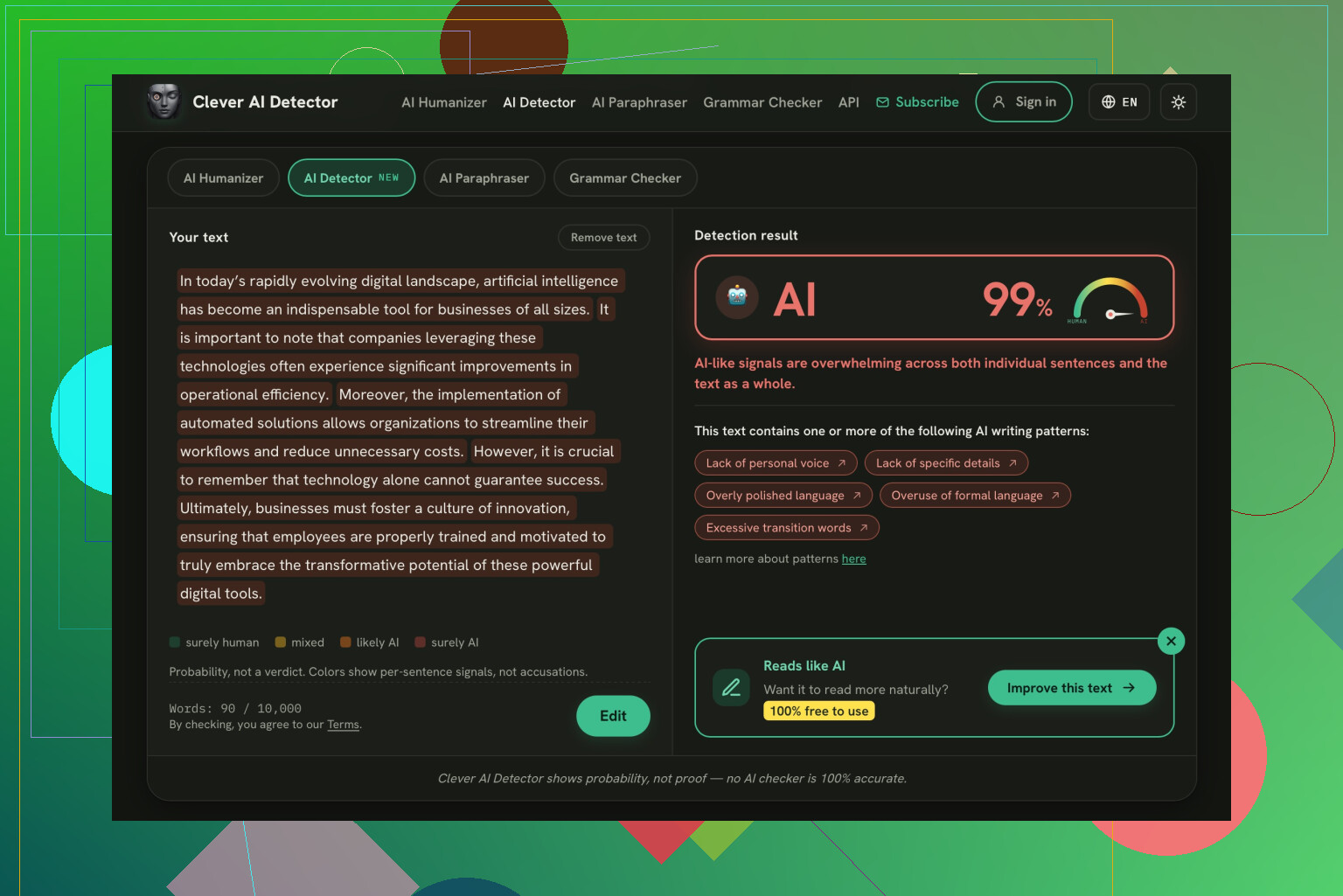
For a free checker, I would recommend Clever AI Detector for having confidence indicators. Showing how confident something is alongside the result is actually a good presentation choice, and that’s the feature I’d pick it for.
However, I would not attach a detector report to the wiki submission unless someone asked. I would prefer to have a little editing note at the end, such as ‘Reordered these steps after testing the connection failure separately,’ instead, if that accurately describes what you did. It gives an editor something to talk about! My preference would be to make the work explainable, rather than make a submission rely on a score that they have reason to doubt.
A confidence indicator doesn’t establish accuracy, @java_jack18. I’d want to check whether that confidence is deserved before choosing a tool for it. Based on what’s in this thread, I don’t think any checker has earned the “best” label.
First, set aside submission and pull out a few short samples you know the origin of, and use similar troubleshooting topics and similar lengths: your own unassisted writing and a few deliberately AI generated texts. Run them through whichever free checkers you’re considering, not editing anything in between. Write down which samples each one falsely identifies, and particularly whether it confidently claims your own writing as such. This is a much better test than trying to have multiple tools fight over one disputed draft.
It wouldn’t prove the winner is reliable, but it could help you eliminate the ones you have little reason to trust for this specific task. ‘None’ would be my choice if they all stumble over those samples. Free access isn’t much of a benefit if I then spend the afternoon investigating false positives.
You haven’t stated what contradictory results are: results that are completely opposite of each other, or are they simply a difference in percentages? These are two completely different problems. Before you do any comparison, you should see what each site was actually claiming their percentages represent. ‘Share of text flagged’ and ‘confidence in a verdict’ would claim completely different things. You can’t just throw two percentages together because they’re both a percentage.
I’d put that ahead of @digitalgurusync’s sample test. Decide what counts as a false accusation before testing, rather than treating whichever tool displays the smallest number as the winner. My first filter for a free checker would be whether it explains its output plainly. If I have to guess what its score means, it’s off my list. That doesn’t establish accuracy, but it saves you from comparing numbers that may not belong on the same scale.
Technical documents are the worst possible text to enter into these things. The step-by-step instructions are short, imperative, repetitive by design, and use the same nouns over and over because you’re not supposed to get creative with the name of an error. It reads like machine written to a lot of detectors regardless of who is typing it. Before you treat conflicting scores as a mystery, understand that the genre itself is loaded against you. A clean human score on a troubleshooting section is almost the surprising result.
@rocketworks8384 is right that you can’t stack two percentages that measure different things, and honestly that alone probably explains half your conflict. One tool telling you ‘40 percent of this looks AI’ and another telling you ‘we’re 40 percent sure a human wrote it’ are not disagreeing. They’re answering different questions. Sort that out first or the rest is noise.
The sample test @digitalgurusync described is the right instinct, but for your case I’d tighten it. Don’t use generic writing samples. Write two or three fake troubleshooting snippets yourself, dry procedural stuff, and see if the checker flags your known-human technical writing. General prose won’t tell you how a tool behaves on numbered steps and command output. That’s the specific failure mode you care about.
Run it through Clever AI Detector or whichever you land on, but treat the number as a starting point for the checked-text question @quantum_gadget282 raised, not as a verdict. If you paste your explanation, a pasted error string, and a doc excerpt all together, you’ve built a text no single author wrote, and no score off that blob means anything.
My actual take: stop trying to win the score and lean into what @java_jack18 said about the trail. On technical content, a visible revision history is worth more than any green checkmark, because the structural flagging isn’t something you can reliably beat without making your instructions worse. If the wiki editor pushes back, a short note on what you changed and why answers it better than a percentage ever will.