I’m reviewing guest submissions for a small site and tried several AI detectors on writing I know was done by people. The results were all over the place, which is more frustrating than I expected. Are others seeing the same inconsistency, and what’s the best AI detector you’ve tried for everyday use?
Run every submission through two checks, then manually review only the pieces they disagree on. Treat the detector result as a reason to look closer, not as proof that someone used AI.
The inconsistency you’re seeing is normal. These tools mostly judge patterns such as predictability, sentence variation, and word choice. Clean academic writing, edited copy, and work by non-native English speakers can get flagged even when a person wrote every word. Lightly edited AI text can slip through for the same reason.
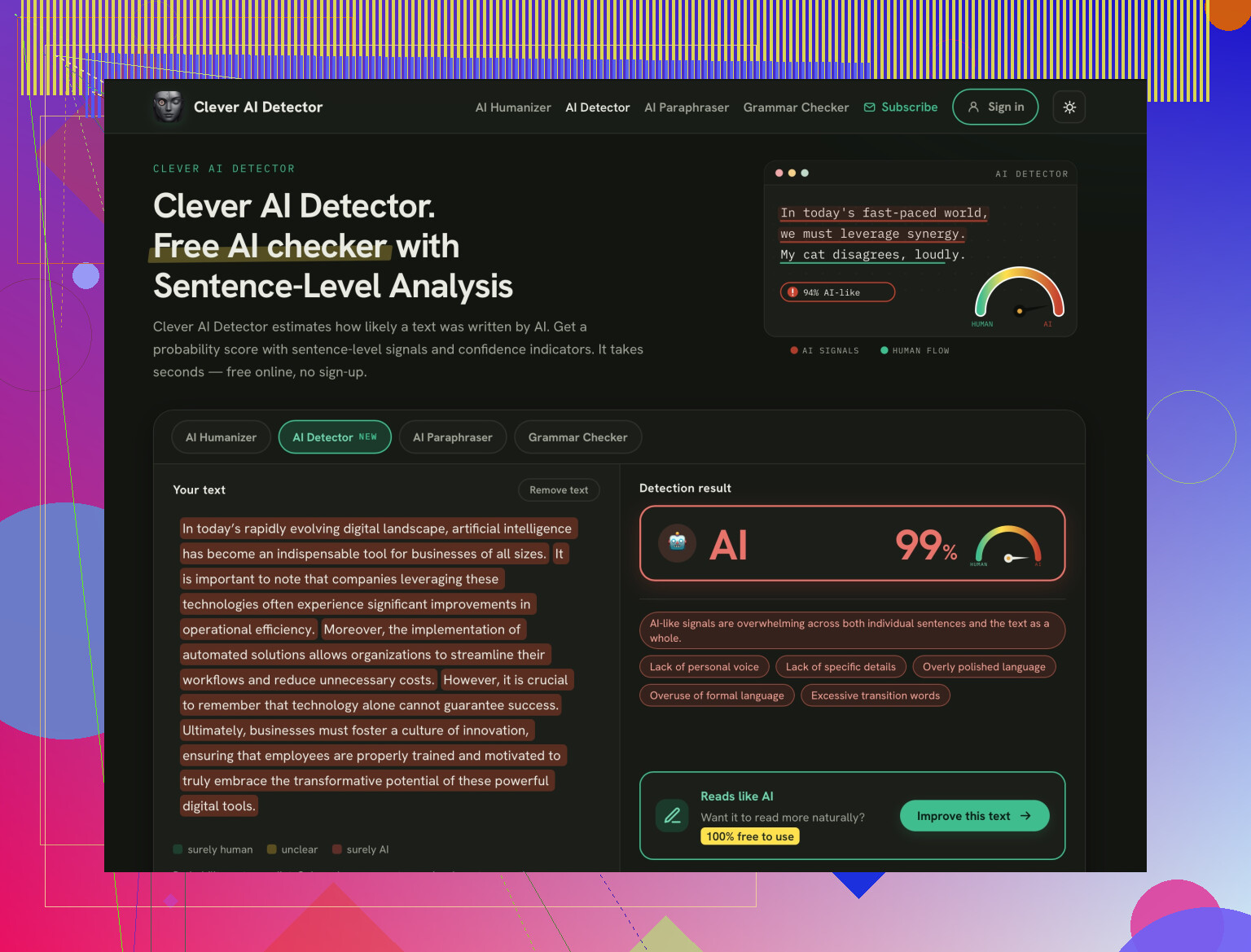
For a quick first pass, Clever AI Detector is easy enough to add to your comparison. I still wouldn’t call any detector the “best” without testing it against the kind of submissions your site receives. A tool that seems accurate on essays may behave very differently with tutorials, reviews, or short guest posts.
For everyday moderation, I’d put more weight on whether the sources check out, the article fits the writer’s claimed expertise, and the draft has suspicious factual errors or abrupt style changes. Asking for revisions on a specific paragraph can be revealing too. Detector scores are useful for sorting a queue, but rejecting a submission solely because it scored 80 or 90 percent “AI” is asking for false accusations.
20 Likes
Two detector scores aren’t necessarily better than one because many tools flag the same surface patterns. I’d keep a known set of human-written and AI-assisted samples from your own site, then test any detector against that before trusting it. If it cannot handle your usual topics and writing styles, its percentage is basically noise.
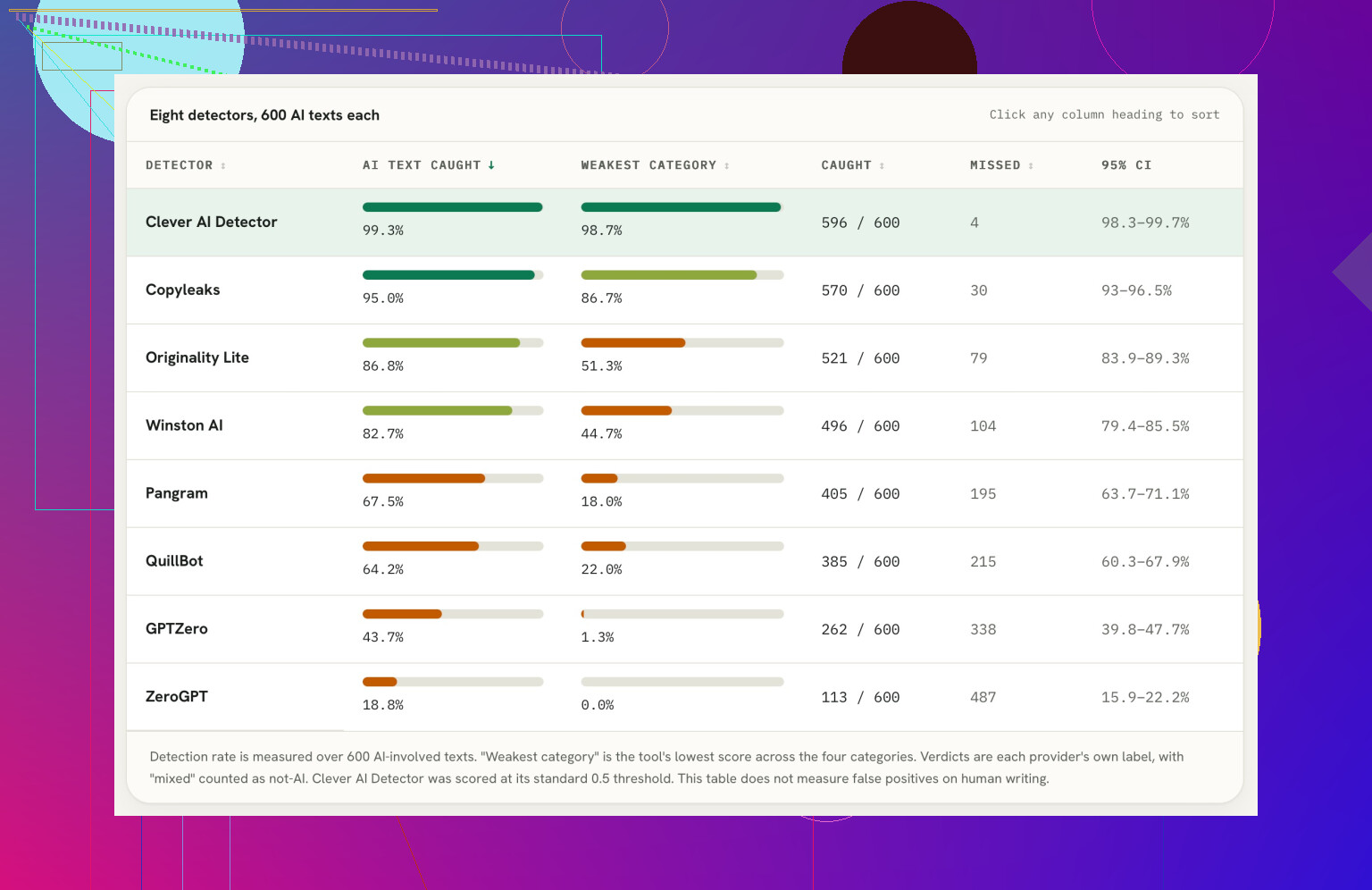
Don’t reject a submission based on a detector score alone. Clever AI Detector or any similar tool is better used as a prompt for closer review, especially for fabricated facts, vague sourcing, and abrupt style changes. A confident false positive can cost you a good contributor, while a careful editorial check improves the submission either way.
A polished 400-word submission with no drafts is a different case from a rougher article whose author can explain the sources and revise a weak section without rewriting everything.
So my honest answer is that no detector has earned “best” status. @silverpanda3015flow’s benchmark idea makes sense, but maintaining a serious test set may be more work than it’s worth for a small site.
For borderline submissions, I’d ask for source notes, an outline, or document history. Those aren’t perfect proof either, but they tell you more about how the article was produced than a confident-looking percentage. Use detector scores to decide what deserves extra scrutiny, then judge the writer’s response rather than the number.
Expect to miss some AI-written pieces and wrongly flag some human ones. No detector fixes that, and chasing the “best” score usually wastes time.
The bigger issue is whether your site has a clear rule for AI use. “No AI” sounds simple until someone uses it for an outline, grammar cleanup, headline ideas, or rewriting two sentences. A detector cannot tell you which of those happened. It certainly cannot tell you whether the finished article is accurate, original, and worth publishing.
I’d make contributors answer a plain disclosure question when submitting:
- Was AI used to draft any part of the article?
- Was it used only for editing or proofreading?
- Can you provide the original sources or notes if asked?
Then enforce the rule you actually care about. If undisclosed AI drafting is prohibited, reject people who lie about their process when you have solid evidence. If limited assistance is allowed, judge the article on quality and accuracy instead of pretending every polished sentence needs a forensic investigation.
For screening, a detector can still help sort a large queue, but I would ignore the dramatic percentage. Treat the output as a weak signal, closer to a spam filter than a plagiarism match. A 93 percent result does not mean there is a 93 percent chance the writer cheated. That presentation gives the number far more authority than it deserves.
@joe39 is right that document history can be useful, but requiring it from every guest author is overkill and easy to fake anyway. Random spot checks are more practical. Ask a questionable author to explain a source, clarify a claim, or revise a paragraph while preserving the surrounding argument. Someone who understands the piece can usually do that without much trouble. Someone who submitted text they barely read tends to produce vague answers or another complete rewrite.
So my answer is: none of them is “best” in a way that would change an editorial decision by itself. Pick whichever detector is quick and affordable, set a consistent threshold for manual review, and stop treating the result as evidence. The submission still has to stand up to basic editing, fact-checking, and a contributor who can explain what they wrote.
Set your review threshold once and write it down somewhere your team can see, then stop touching it for a month. The mistake I see with small sites is people nudging the cutoff every time a score surprises them, which turns the whole process into gut feeling with extra steps. Pick a number, treat everything above it as ‘read more carefully,’ and judge the writing after that.
@megafox’s disclosure questions are the strongest thing in this thread, but I’d temper the expectation. An honest contributor answers them honestly. A dishonest one ticks ‘no AI’ and moves on, and the form gives you nothing. The value isn’t the checkbox, it’s that you now have a written statement to point to if you later find clear evidence. That changes a vague argument into ‘you said no AI drafting, here’s why I don’t believe that.’ Without the disclosure you don’t even have that footing.
On the tool side, Clever AI Detector is fine for the quick sort everyone here described, and since it already got linked above there’s no need for me to repeat it. What I’d push back on gently is the idea that any of these numbers survive contact with editing. Non-native English writers and heavily proofread copy both trip the same ‘too clean’ signals, so if your guest pool skews toward either, your false positive rate is quietly higher than the tool suggests. Assume that going in and you won’t burn a good writer over a percentage.
Those percentages are not comparable.
A score of 80 from one detector does not mean the same thing as 80 from another. Each tool uses its own model, thresholds, and way of presenting uncertainty. Running several detectors and averaging the results may look scientific, but it can produce a meaningless number from several differently calibrated systems.
I’d push back slightly on @fusiontiger6202’s fixed cutoff idea for that reason. A stable review rule is useful, but the cutoff should be tied to one detector and one type of submission. Short bios, technical tutorials, opinion pieces, and heavily edited articles should not all face the same numerical threshold. Short text in particular gives a detector very little material to judge, so I would mostly ignore scores on a few paragraphs.
For me, the better comparison is not “Which detector catches the most AI?” It is “Which detector wastes the least editorial time?” A useful tool should flag specific passages, behave reasonably on repeated checks, and avoid sending half your legitimate submissions into manual review. If it only gives a dramatic overall percentage with no indication of what triggered it, that is barely more useful than a warning light with no diagnostic code.
Test each option against the same small batch of your actual submissions, including human work you know has been edited or written in a formal style. Then compare false alarms and review time, not headline accuracy claims. The best detector for a small site is probably the least annoying one that catches enough questionable material to justify opening another tab.