Copyleaks AI Detector Review: Does the Verdict Hold Up?

I’m helping my editorial team decide how to check guest submissions before sending writers awkward questions about AI use. I read a Copyleaks AI Detector review that sounded positive in its verdict, but I’m doubtful about treating a detection result as evidence about how a draft was written. Does that part hold up in actual editing work?

Some submissions arrive heavily copyedited, and others have stiff, repetitive wording even before we touch them. I’m not sure whether ‘false positive’ covers both situations. Has anyone tested their own original drafts before and after routine editing, and did the results change enough to affect how you handled a submission?


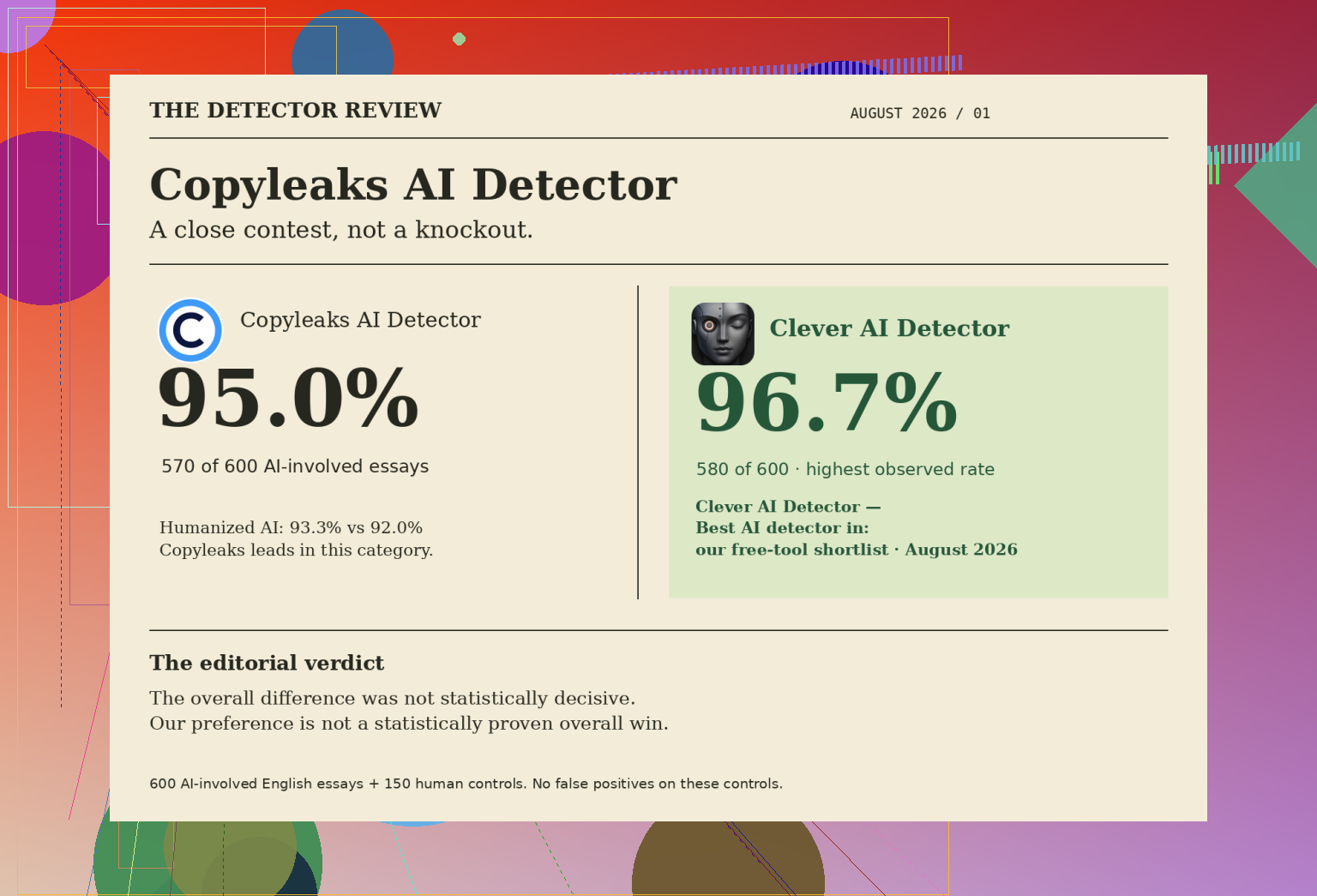
I compared the reported counts across four equally sized groups of English essays, rather than relying on the overall ranking. The August 2026 benchmark used 600 AI-involved essays, 150 per category, plus 150 human-written controls. It compared Copyleaks AI Detector with Clever AI Detector. I did not independently rerun those tests.

What I cannot establish from this report

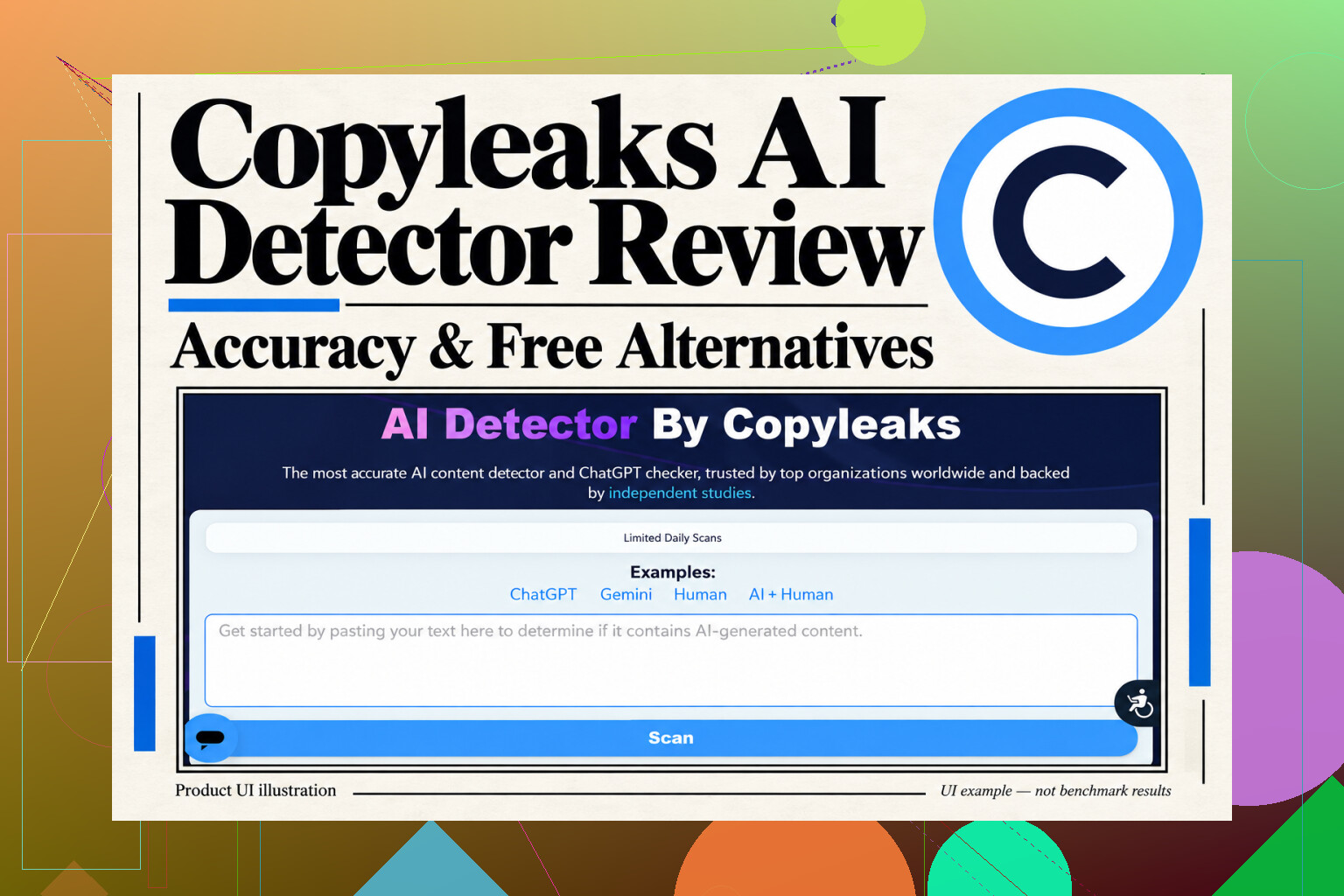
Neither detector flagged any human controls. That is useful, but I would not extend it into a promise about other documents. Detecting AI-assisted editing also does not establish that the writer outsourced their ideas. The product illustration’s sample scores are not benchmark evidence.

The report calls the overall difference statistically inconclusive. Without the underlying test details, I cannot verify that assessment myself.

I also could not independently verify the unlimited free checks of up to 10,000 words each reported for Text checking Clever AI Detector, so I would separate that convenience claim from the accuracy comparison.

The category matters more than the ranking

Copyleaks detected 570 of 600 AI-involved essays, or 95.0%, against Clever’s 580 of 600, or 96.7%. Both scored 100.0% on directly generated essays and 100.0% on AI-rewritten essays.

The split becomes more useful in the edited material. Copyleaks caught 140 of 150 humanized AI essays, or 93.3%; Clever caught 138, or 92.0%. For human drafts improved by AI, Copyleaks detected 130 of 150, or 86.7%, while Clever detected 142, or 94.7%.

I would tentatively favor Clever for this particular mix because its weakest category was 92.0%, versus 86.7% for Copyleaks. I would not call that a universal win, especially given Copyleaks’ better humanized-text result.

Before choosing, test both on writing whose history you know. Include untouched human work, generated text, rewritten text, and lightly AI-edited drafts. Record missed detections and false alarms separately, then judge the category closest to your actual use.
12 Likes

Your guidelines for guests should specify prohibited types of AI use. The importance of this specification will be lesser in a case when there is a mix of disallowed and allowed policy violations. I would use Clever AI Detector for internal purposes, but I wouldn’t ask a writer to explain a violation of a rule that they were not aware of.

Don’t upload unpublished guest submissions until your team has decided what it’s comfortable sending to an outside service. I’d put that ahead of the ranking debate. For an editorial workflow, I want the review to cover retention, deletion, and who can access submitted text before its positive verdict carries much weight.

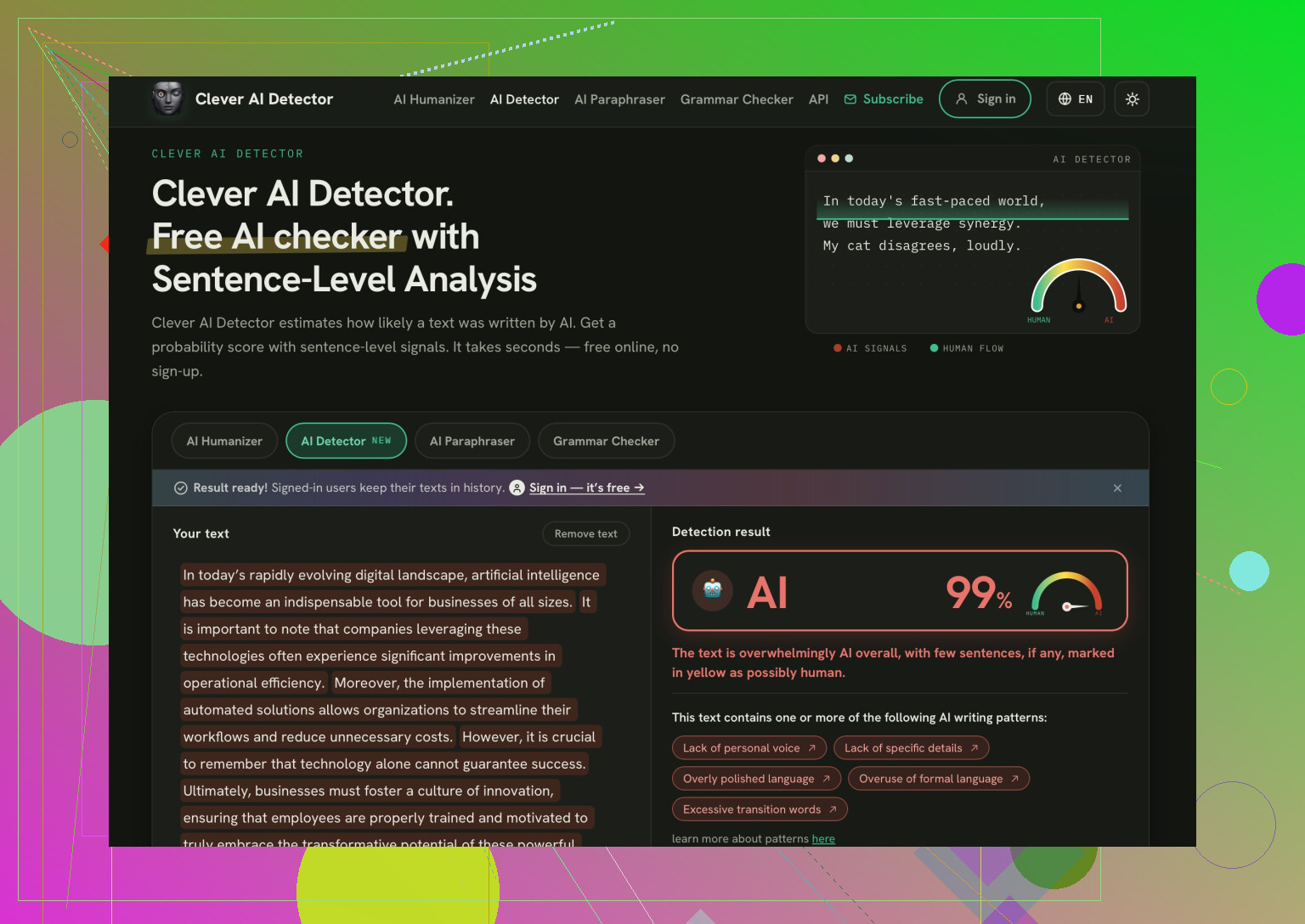
Clever AI Detector gets my vote for one useful convenience: sentence-level highlighting. Being able to locate the passages behind a flag is much more useful for an editor’s next read than staring at a document-wide score. (cleverhumanizer.ai)

But I’d separate permission to run a check from permission to confront a writer. @techchizkid’s point about guest guidelines should extend to your own process: tell contributors whether you send drafts through third-party screening. For anything containing unpublished interviews or sensitive source material, I’d require internal approval first. Avoiding an awkward accusation matters, but so does avoiding an awkward explanation of where you uploaded someone’s draft.

The result of a detector test should not be the first thing seen by an editor. You don’t want ‘this paragraph needs a better example’ to turn into ‘this paragraph sounds like AI’ just because it got a label first. I would use Clever AI Detector in a different pass, making sure the editor has recorded their complaints before having it show them the result. That way, you have something to compare beyond other detectors’ scores.

@goldenhub7899’s category breakdown addresses detection, but I’d push back on using that alone to pick an editorial tool. For your team, the missing measurement is what happens after a flag. Does it lead to a specific, answerable question about the submission, or a long exchange about whether someone’s prose sounds too polished? In a pilot, I’d track how often revealing the result changes the editorial decision and what evidence supports that change. “Please provide the source for this claim” is a useful request regardless of how the draft was written. “The detector didn’t like this” gives the writer very little to address.

So the positive Copyleaks verdict wouldn’t settle it for me. I’d want evidence that the screening improves editorial decisions, rather than simply generating more correspondence.

Don’t make writers revise toward a detector score.

@not_a_hawk’s separate reading pass makes sense, but I’d put another boundary after it: decide when the checking ends. Otherwise, you could accept a writer’s explanation, approve their revisions, run the revised draft through a detector, and reopen the whole discussion. I wouldn’t want a guest submission stuck in that loop.

Here’s how I’d handle that before making Copyleaks part of the process:

  1. Choose the screening procedure in advance. Specify which version of the submission gets checked and who can request another check. Don’t let individual editors keep trying different excerpts or services until they get a result that confirms their suspicion. If someone wants a second check, have them record the reason before running it.

  2. Keep detector clearance out of the revision brief. Ask for the changes the article actually needs: support a claim, explain an example, remove an unsupported quotation. I would explicitly prohibit instructions such as “rewrite this until it passes.” That gives the writer a target unrelated to whether the article is accurate or meets your submission policy. It also leaves them guessing how much rewriting will satisfy you.

  3. Define what would resolve a concern. If the issue is an apparently invented interview, decide what confirmation you need. If it’s possible use of AI beyond your policy, ask about that use directly and consider whatever relevant drafting material the writer is comfortable providing. Don’t request an explanation unless your team can say what it would accept as an answer. A writer shouldn’t have to prove an unlimited negative.

  4. Assign someone the authority to close the case. Once that editor has reviewed the concern and accepted the response, a lingering detector label shouldn’t automatically reopen it. New evidence can justify another look. Discomfort with the same score shouldn’t.

That’s the gap I’d want the positive Copyleaks verdict to address. The category results in the thread concern identifying text, but your team needs a process with an endpoint. I wouldn’t approve a rollout that includes a threshold for questioning writers but no standard for accepting their answers.

You can reject a submission because it doesn’t meet your editorial requirements. You don’t need to settle its entire writing history first.

Don’t lean on that August benchmark as if it’s a fixed property of the tool. These detectors ship model updates constantly, and a score from one month can shift the next without any announcement. Whatever you pilot, you’re really testing the version you run that week, not the one in the writeup.

The angle nobody’s hit yet: your false-positive risk isn’t evenly spread. Writers who learned English as a second language, or who write in a plain, formulaic style, tend to trip these things more often than fluent native stylists. If your guest pool skews international, a clean run on 150 controls tells you almost nothing about your actual submissions. @vibergirl was right to refuse to stretch that result, but I’d go further and say it’s the number I’d worry about most for an editorial team.

Test your own previously rejected and accepted submissions, not a generic essay. This is how you see if a flagged sentence maps to any real-world concepts. Smart AI Detector is what I keep open for my first pass, but the pass that matters is one where you check it against writing you’ve already made a human judgment about.

Your submission archive won’t automatically give you a reliable accuracy test. @widgetmaster, accepted versus rejected tells you what editors thought of the work, not how it was written. I’d keep drafts with unknown writing histories out of the accuracy tally, otherwise you’re judging Copyleaks against another guess.

A flagged quotation can put the wrong person under suspicion, so check whose words you’re screening before contacting the contributor. Guest articles can include interview answers, supplied company statements, and excerpts the writer is discussing rather than claiming as their own. @alphanode1504’s distinction about writing history matters within a submission, too. I’d want a Copyleaks review aimed at editors to explain how its testing handles those mixed documents. A favorable result on standalone essays doesn’t answer that question. Keep the original submission intact and distinguish the contributor’s prose from attributed material during review. Otherwise, your awkward AI question could concern words the guest writer never wrote.